Lyle Kessler’s 1983 three-hander has embedded itself in the American repertory, attracting a Tony nomination and star casting. Here it was graced with an award-winning turn onstage from Albert Finney, who later starred in a film version. But is it more than an actors’ play?
The little Jermyn Street stage brings its simmering tensions straight to your seat, as brothers Treat (Chris Walley) and Philip (Fred Woodley Evans) clash at their Philadelphia row-house. Treat, a self-styled tough guy, is a petty thief who preys on hapless pedestrians, bringing home his booty – watches, cash, jewellery – to fund the men’s meagre lifestyle. For Philip, watching daytime television and delving into the occasional book has to be enough. Treat has told him he is allergic to the air outside, which he naively believes, so he subsists on a diet of Starkist tuna and Hellman’s mayo on toast and Errol Flynn movies on TV. Nowadays, we would be quick to diagnose his super-retentive memory and entrenched obsessions as “on the spectrum”.
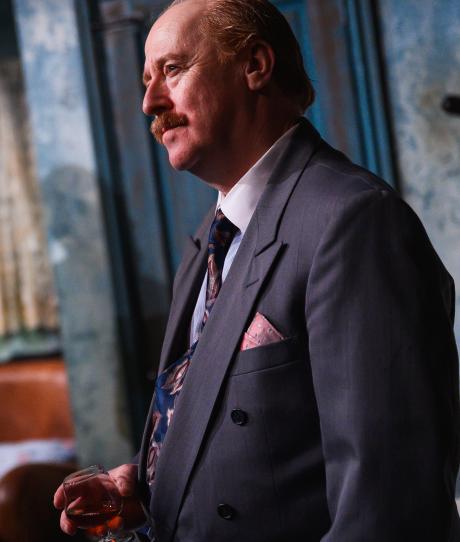
The men spark off each other continually, uniting only in concocting a mad narrative about their home being prey to a phantom intruder, another of Treat’s ways of controlling his brother. Their mother is dead, her presence symbolised by a closet of her coats upstairs, which Philip treasures. Their father ran away when they were small. So the arrival of Harold (Forbes Masson, pictured below) in their lives as both a father and a mother figure is an event. He’s an unlikely guiding spirit, a balding middle-aged drunk in a suit from Chicago whom Treat has come across in a bar and decided to kidnap, for gain. Harold quickly shakes off Treat’s attempts to tie him up and gag him and establishes a firm toehold in the household, a swift transition from hostage to mentor, funded by his Amex card. He's a conjuror of imaginary worlds, and a type Eugene O’Neill would have recognised.
As Treat starts sporting sharp Pierre Cardin suits, and a gun, the tension grows. Just what is the “business” he has been drawn into by Harold? He acts cocky and all-knowing about the older man’s possibly "connected" background – a funny chunk of dialogue has him trying to correct Philip as to what “on the lam” means, which the naif has misconstrued as “on a lamb” – but it’s clear he is as beguiled by a fictive notion of being a gangster as Philip is by Errol Flynn’s swashbuckling. He demands “a real assignment”, but you fear it’s a fatal delusion.
For Philip, Harold is his Virgil, leading him out of his little circle of hell with the simplest of means: a city map. And also a squeeze of the shoulders by way of what Harold terms “encouragement”. Together they go out for a walk. It’s at this point that I wanted more from the actors than director Al Miller has asked for. Masson is mostly an ideal Harold, by turns avuncular and slightly sinister, though perhaps not sinister enough; but Woodley Evans’s Philip misses some of the vital pathos of the role, his cleverness often more salient than his lack of guile. He’s amusingly wide-eyed and bewildered when it’s called for, but the flaws in his sad psyche don’t register emphatically enough.
Walley, a killer of a bungling cat-killer in 2018's The Lieutenant of Inishmore, fares better, bringing that desired pathos to the posturing Treat. (He has made a valiant attempt at a Philly accent, too, which turns “Philip” into “Fulp".) And Masson, with his ambivalent bonhomie, is a mainstay, though a touch more grit in his demeanour would have enhanced the idea that he is a possible danger to the brothers, as well as an apparent ally. His more lyrical side is lovely, though, especially sections like the one where he explains the cosmos to Philip, and how the species that have gone into his bouillabaisse are miraculously mutating inside his body.
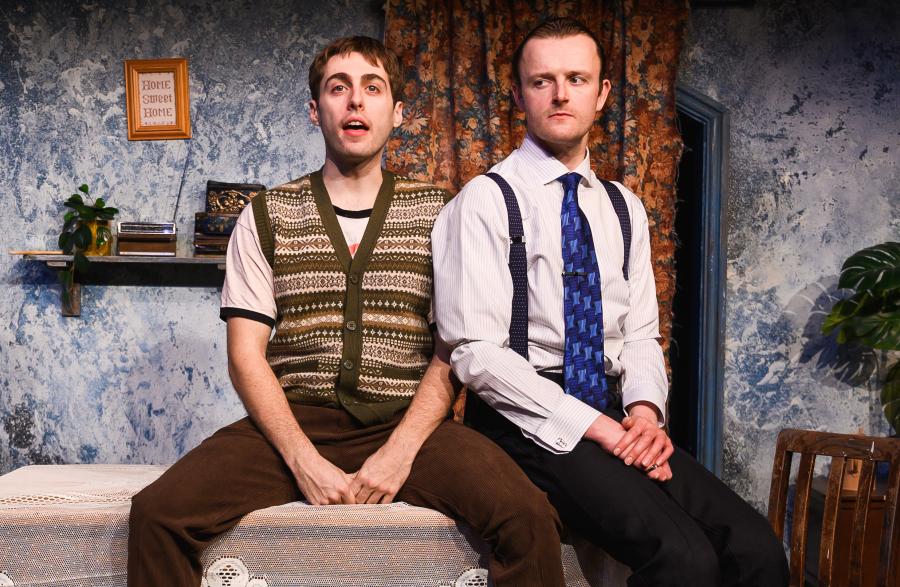
The staging is exemplary. The teeny stage area, surprisingly, is not a handicap (I last saw this play in a capacious Broadway theatre, with a giant staircase up to the bedrooms and a large sofa for Philip to lounge on), and the few props have been chosen astutely. Congratulations on finding an old-fashioned Hellman’s jar! Designer Sarah Beaton has given the set suitably “distressed” walls, too, that seem to suggest the poverty and mental disturbance of the people living there. They prime you to expect something Beckett might have written.
But what lingers in the mind here is the play’s more soft-centred side, the affection between the characters rather than the animosity, as if its setting in the City of Love (Kessler’s home town) has been taken literally. It feels like a missed opportunity with this good a cast, Sam Shepard-lite.
What the production does well are moments like the one where Harold slowly opens the front door for Philip’s foray into the outside world, an odd blank expression on his face, as if he has become an unearthly being on some kind of other-worldly mission, staring into space. It’s a helpfully puzzling note, which the production could use more of, obliging us to ask just what Harold wants. Is he really an orphan? What does that term mean? The last few seconds are powerful, too. But is it more than a vehicle for three fine actors to flex their muscles in? I suspect not. The piece seems to end just as it has built up a head of steam, its conflicts partially resolved, not left painfully exposed.