Lawlessness and lack of accountability seem, tragically, on the verge of becoming a new American norm, so what better time to re-consider High Noon, the classic 1952 Western that forefronts issues of moral rectitude. Will Kane, the marshal who stays on in his tight-knit New Mexico community to square off against an outlaw whom he sentenced to hanging five years before, possesses a moral propriety akin to the likes of Atticus Finch. And look how often To Kill A Mockingbird lands on stage.
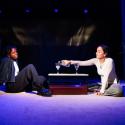
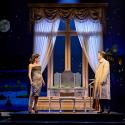
On the face of it, you can see the sense in adapting Fred Zinnemann's four-time Oscar-winner to the theatre, complete with an argument about the efficacy of gun violence that gets handed to Amy (Denise Gough), the new bride with whom Billy Crudup's Will is due to depart town at the play's start - only to have the renewed spectre of the vengeful Frank Miller (James Doherty) stop Will in his tracks.
But the fact of the matter is that more reinvention is needed than gets offered here, however well-intentioned a project that returns the director Thea Sharrock to our midst after a lengthy absence from the London stage.
The principal culprit is a tendentious script from Eric Roth, himself the Oscar-winning film veteran who scripted Forrest Gump (amongst other titles), marking his playwriting debut, age 73. While Roth might seem in pole position to elide the distance between film and stage, the production gets bogged down in speechifying and platitudes which hardly tally with a character fabled for his reined-in stoicism.
Will's unyielding moral compass suggests anew why, all these years later, the film is still heralded as a McCarthy-era allegory about conviction politics and a country given over to guilt by association. That same country these days is ever more fractured and fractious, vengeance politics emanating from the top and a seemingly complete absence of guilt about its societal ramifications (consider recent events in Minneapolis, as just one of too many illustrations of this point).
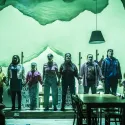
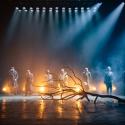
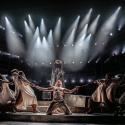
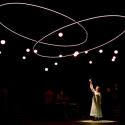
And so the show consists, as it must, of the inevitable build-up to its climactic encounter - a timepiece hanging above Tim Hatley's slatted wooden set, prismatically lit by the busy Neil Austin (Paddington), to remind us at every moment that the clock is ticking. How, then, do the denizens of Hadleyville pass their time en route to the final reckoning? The alternately playful and plaintive Amy is given to vaporous renderings of Bruce Springsteen's "I'm On Fire", the protean Gough displaying a gift for song that wavers only at the high notes. (Frankie Laine's "High Noon: Do Not Forsake Me", so memorable from the film, is - understandably enough - nowhere heard here.)
What we get throughout is one or another packaged aperçu, as if the show were mostly interested in ladling out fortune cookie pronouncements rather than building a sense of community or character. "Without rules there's chaos," Amy remarks at one point (true enough), and such pronouncements come thick and fast. "Nothing in life is free," observes Helen Ramirez (Rosa Salazar), a local Latina who holds fast to notions of a Godless universe. "You can't escape yourself," Will asserts, elsewhere maintaining that a rose can nonetheless bloom after "it's turned black".
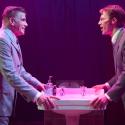
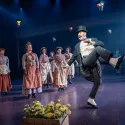
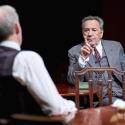
Such dramaturgy can be a bit wearying over time, so it helps that the cast often supply the energy lacking from the text. Crudup couldn't be less like Gary Cooper physically, and he cuts a more tearful, fretful presence than one might expect of this part. That said, he's a seasoned enough stage performer to more than hold the spotlight, and he manages an impressive fight late on with the cast's other Billy - the excellent young English actor, Billy Howle - who inherits Lloyd Bridges' part as the deputy marshal, Harvey, who has been passed over for the top job and has his own scores to settle.
One feels the production wanting to shift its value as parable from McCarthy then to Trump now, and toward a land in which the community looks increasingly powerless set against the venal dictates of those in charge. (A line about not trusting the people you vote for gets the laugh you might expect.) But for all the elegant shifts in light and shade and haze on view before us, the play only intermittently snaps into focus: less High Noon than a middling evening.