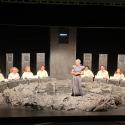
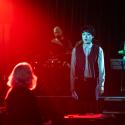
Ten Ways to Die Happy, Underbelly, Bristo Square ★★★★
A live gameshow about life and death? Yes indeed, and host Perla Ambrosini proves the ideal guide, leading a panel of audience members through forks in their lives’ paths, throwing obstacles in their ways, and even offering unexpected rewards and punishments for altruism, selfishness or many other decisions and swerves in direction.
Ten Ways to Die Happy is a neat concept, first explored by the Fondazione Teatri di Reggio Emilia and dramatists Emanuele Aldrovandi and Jacopo Giacomoni, and getting its first international outing at the Fringe. Enlist a gaggle of unsuspecting but compliant audience members, take their lives back to year zero, assign them personal traits and tendencies, then get them to decide on how their lives evolve – from childhood through to adolescence, adulthood through to old age (assuming they make it that far, of course).
There are plenty of laughs to be had at the arbitrary but plausible challenges contestants encounter, and also at their interactions with mates back in the audience. And though Ambrosini keeps the show on a generally even and level-headed keel, there’s the danger that its latent humour might trivialise some of its tougher moral conundrums and its darker turns. It’s a tough balance to strike, and Ten Ways to Die Happy doesn’t always achieve it. Nonetheless, there’s much to enjoy here, and to set you thinking: about foundational privilege or deprivation, about the long-term repercussions of apparently innocuous decisions, and about the very randomness of a life’s trajectory. Don’t dwell for too long on its rather simplistic game-play: instead, take it as an hour of gentle illumination on life’s vicissitudes, or an hour of play with the very constituents of life itself.
Little Animals, Traverse @ The Lyceum Studio ★★★★
We’re gathered, the smartly dressed man in front of us explains, to remember Richard, who was his good friend. His very good friend – in fact, his skin, as they once confided to each other. Richard was last seen on the bank of a fast-flowing river: it’s not clear precisely what happened, but it felt like an appropriate final location for a man who held such a deep and enduring love of nature.
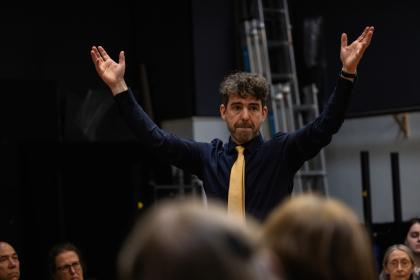
This debut play by Paul Ready (pictured above, image by Chew Boy) – already a familiar face from TV shows Motherland and Ann Droid – seems specifically intended to draw on the actor’s uncannily convincing diffidence and self-effacement. His sentences circle around and around, hesitating to come to their points, fearful of communicating what needs to be conveyed. At the start that’s out of respect for Richard’s rebellious past, as the schoolboy who mocked a classmate for his arrogance in writing an essay on "How I Would Change the World", or who resolutely resisted social pressures, and led his friend obediently following behind. Later, however, that hesitation perhaps draws more heavily on confusion, even shame, as their live paths diverge dramatically: while Richard remains resolutely committed to the natural world and climate activism, our narrator settles down with a job in finance, a young family, and of course an everyday commitment to recycling and buying the right things too.
Created with climate-focused theatre company Fern Culture – whose Caroline Steinbeis directs the show – Little Animals contrasts the two adolescents’ ideals and the two grown-ups’ realities to ask what’s enough action in the face of climate breakdown, and whether paying lip service – however unavoidable that is in the face of a hectic modern-day existence – is really better than doing nothing at all. It’s an uncompromising message, as Richard’s fate ultimately underlines, and there’s also the question of whether Little Animals tells us anything we don’t already know, or even provides a convincing argument to urge us into action, however necessary we all know that to be.
Ready judges his delivery beautifully, however, working himself up into ever greater frustration as he attempts to tiptoe around the booby traps concealed within his sensitive story, and prowling the open, naturally lit space of the Lyceum Theatre’s studio, co-opted by the Traverse Theatre for the production – and a wonderfully informal and appropriate space for the show. It’s a compelling work, powerfully argued and deftly delivered, but its ultimate message remains strangely opaque.
Right Before I Go, Pleasance Dome ★★★★
From a life-and-death gameshow and a memorial for a lost friend, Right Before I Go takes a far more direct perspective on mortality. Its focus is suicide, more specifically the notes left by those who have taken their own lives.
Yes, okay, it’s hardly a cheery subject, and it’s to the credit of Los Angeles-based writer Stan Zimmerman (whose previous credits include The Golden Girls and The Gilmore Girls) that his show isn’t entirely bleak and teary from start to finish (although, to be fair, there’s a fair amount of bleakness and teariness in it). Zimmerman bases the show around his attempt to understand the suicide of his friend Kevin, and the notes that Kevin left behind, leading him to an in-depth – even, as he suggests, obsessive – exploration of suicide notes through history, their varying contents and purposes.
There are some fascinating – and, it goes without saying, terribly sad – examples from the 19th and early 20th centuries, highlighting despair and frustration at issues that might seem relatively trivial to us today, as well as equally tragic more recent examples that give harrowing insights into homophobia, sexploitation, transphobia and more.
Director Abigail Morris has devised a cool, calm staging that sees her sextet of actors standing behind podiums, reading from printed scripts. It’s perhaps a necessary method for providing a sense of objective distance and respect for the letters themselves, but it inevitably makes the whole show feel like something of a lecture, despite its compelling and passionately presented subject matter. Performances are expertly judged, however: they’re level-headed and clear, never overstating yet remaining entirely faithful to the strong emotions conveyed in the letters themselves.
Right Before I Go forms, Zimmerman explains, part of his on-going efforts to understand his friend’s death, and also to destigmatise the issue of suicide itself, and bring its causes and effects into broader consciousness. His quiet but sometimes overwhelmingly powerful show does just that, and a brief post-show discussion – thankfully – offers sources of support. It’s not an easy hour, but it’s a deeply illuminating work, and one that encourages us to reflect on an increasingly urgent issue without the shame that may traditionally accompany it.