In a small Appalachian village, where people say “Y’all” and prospectors are still searching for silver in the mountains, Barbara Allen wants more than the humdrum life of a Trad wife (as I suppose you would call it these days). Already a bit of a rebel, she has a suitor, the dim, fighty Marvin, but there’s something just there, she knows, if only she could see it.
She’s right, of course, else we wouldn’t have a show, and that something is Witch Boy John, part of a coven of sex-mad spirits whose hedonistic lifestyle has become dulled by its accompanying alienation. He wants to feel joy and pain, and especially love, and risks his very immortality to cross the divide into the messy human world so he can be with his soulmate, Barbara Allen.
Even when I was a Young Adult myself, the appeal of this YA stuff was something I could not fully understand. Since then, Twilight has hit big as a franchise and Stranger Things has transitioned to the stage successfully. With a 12 week run in the West End, the producers are gambling on that market being as keen as ever for its hit of undead romantic hokum.
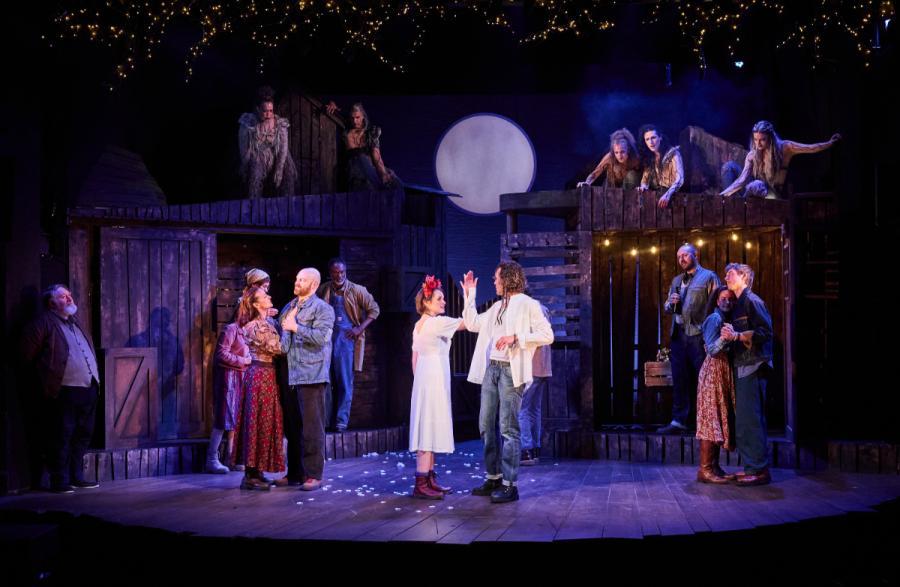
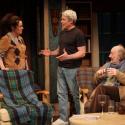
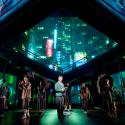
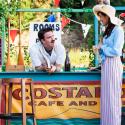
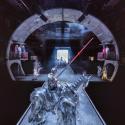
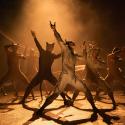
Based on a much-adapted play from the 1940s, itself based on Scottish folktales, the book (by Jonathan Prince) has strong roots, but proves almost painfully predictable, particularly in a first half that drags as cookie-cutter characters do exactly what we expect them to do. I spent some of that time wondering about the costumingwith lots of denim and Gap style shirts and our heroine in lycra and sporting a Jean Seberg bob hairdo, it seemed most unlikely for a 19th century village. The witches appear to have watched the Mad Max movies and gone for the wispy gossamers, all the better to shimmer and snarl in.
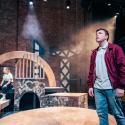
The leads are doing a great deal of heavy lifting in this show, which runs over two and a half hours, albeit air conditioned on a hot night. Director, Georgie Rankcom, makes excellent use of all three dimensions of Libby Todd’s weighty set, but could do with excising some songs, a familiar problem for new musicals.
So much of the emotional heft of the show falls on to the shoulders of our cross-worlds lovers because no other character steps outside what they need to do and say to push the plot forward. It doesn’t help that the actors have to speak and sing lines that surely can only exist on paper, rather than in speech. There’s a small reveal late on, and one wonders if a song will explain the emotional cost to the melancholy Conjur Man (Gary Turner) and his now suddenly interesting backstory. But no.
As our star-crossed lovers, Lauren Jones and Glenn Adamson give heart and soul to performances that are rather better than the parts as written deserve.
Jones captures Barbara Allen’s desire to break out of a life mapped out from the moment she was born and you see why she would fall for the weird stranger with the magical powers and rock’n’roll looks. (As an aside, there was just a tiny bit of me on edge about the power imbalance here. She has almost nothing in dirt poor Hicksville USA and is clearly vulnerable to anyone promising her anything beyond the humdrum, while he can conjure lightning at will. Okay, he’s a gauche teen lost in a world in which he doesn’t even know how to shake hands and she makes all the moves, but still…)
The townsfolk’s songs (and they are all well sung and well played by Matthew Herbert’s band) lean into country and bluegrass, the post-prologue opening number “Ordinary Life” a good example. But the eerie aspect of that genre, done to terrifying effect in Ry Cooder’s legendary Southern Comfort soundtrack and recently explored in the Academy Award winning film Sinners, is frustratingly left unexplored. This is a world in which the humans are transparent what they say and do and it’s the Witches who are hidden from sight, but also interchangeably generic.
Glenn Adamson’s Witch Boy John is at his best going full Rock God (it’s no surprise to see Bat Out Of Hell on Adamson's CV) with his community of immortals favouring electric guitars and power balladsyep, they’re just like The Rolling Stones… It’s a nice contrast in musical styles, but the communities’ signatures soon outstay their welcome as another number saps energy out of the narrative drive.
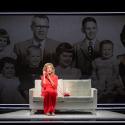
Amongst the songs (written by Lindy Robbins, Dave Bassett and Steve Robson) there are plenty that are pleasing, but no real standouts, the best the love duet “Wildflower”. Underused are Josie Benson’s belt as the hardline Conjur Woman, who ensures an operatic feel to the show in more senses than one, and Kiah Lindsay’s sweet vocals, inexplicably confined to a prologue and epilogue.
So, go for the agonies of forbidden love and the singing and chemistry of the two leads delivering a pleasant score, but don’t expect narrative depth and don’t think too hard about mysteriously powerful men bewitching young women, be they strongminded or not.
For all the flaws, new musicals of this ambition are rare and seldom get everything right first time out of the box. With a few cuts here and some character development there, it probably does not need magical intervention to succeed in the future.