

The Holland Festival is one of the greats. It has a British director, the articulate Ruth Mackenzie, formerly of the Chichester Festival and the cultural Olympiad, now into her second year. It’s the same age as Edinburgh and Avignon – 70 in 2017 – but not as well known, though it should be. “We must,” Mackenzie says, “seriously punch above our weight. And we do.” The festival was founded after the Second World War on, comparable to the Scottish and French ones, principles of reconciliation and presenting the best productions of the human spirt.
Every June many opulent, and some rather more obscure, venues in Amsterdam host plays, concerts, dance shows and, these days, any number of exhibitions, installations and interactive events from around the world. The festival reminds us that, though compared to almost every other European capital quite small – with a population of under a million – Holland’s first city is fabulously international in outlook. It always has been.
That said, things get no more Dutch than composer Louis Andriessen and the Carré Theater. This performance space, built in the 1880s as a circus venue, sits imposingly on the right bank of the Amstel river, and is best-known for broad (and often light) entertainments. Louis Andriessen, just turned 77, is the Netherlands’ leading composer, a radical who used to sabotage concerts at the Concertgebouw. For decades he has eschewed writing for conventional orchestras, preferring his now regular ensemble, Asko|Schönberg, conducted by Reinbert de Leeuw.
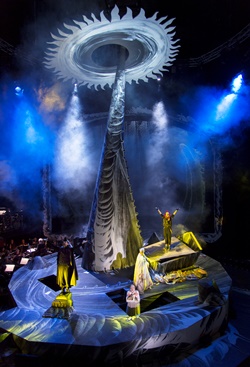 Theatre of the World is Andriessen’s new (and fifth) opera, a co-production between Dutch National Opera, the Holland Festival and the Los Angeles Philharmonic, which premiered the piece at the Walt Disney Concert Hall in March. Directed by former Holland Festival chief Pierre Audi, it’s a deliberately inchoate music drama, based on the efforts of a 17th-century German scholar-polymath, Athanasius Kircher, to escape earthly irrationality through maths: to gain ultimate knowledge.
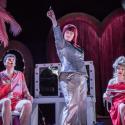
The cast is a rich mix of charismatic if baffling figures, including Pope Innocent XI (Marcel Beekman: his clear, driving tenor is one of the delights of the show), Mexican mystic-nun Sor Juana Inés de la Cruz (Cristina Zavalloni) and three witchy creatures who look as if they’ve strayed from a particularly vampish version of Cats. Love interest is provided by “He and She” (an excellent Martijn Cornet and a less convincing Nora Fischer), though what they really bring to the party is hard to say.
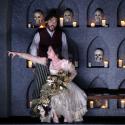
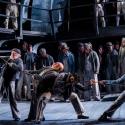
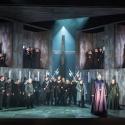
The main action is taken up by the striving Kircher (English baritone Leigh Melrose) and “a boy” (American soprano Lindsay Kesselman), moving, like Faust and Mephistopheles, across a stage of rocks and tombstones, from the middle of which curls high into the Carré a pillar representing the Tower of Babel (pictured above). The opera’s anti-narrative, to say nothing of the fright-night costuming, is extremely disconcerting but the score somehow mitigates final confusion. Andriessen’s famous mix of propulsive brass, sonorous strings and punchy saxophones rarely falters through this hour and three-quarters. The music, packed with jazz inflections, swings and is, if not exactly challenging, entirely pleasing. The singing is top-notch.
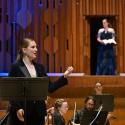
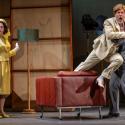
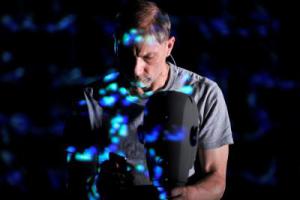 Some already well-known productions are gracing Amsterdam over the festival’s three weeks, including choreographer Akram Khan's Until the Lions and one of Pina Bausch’s greatest stagings, Nelken (“Carnations”), from 1982. Complicite’s ingenious The Encounter, solo-starring the indefatigable Simon McBurney (pictured above left), has been wowing audiences all over Europe: Edinburgh, Lausanne, Berlin, London. This epic (if overlong) auditory jungle-journey, which mesmerised the Dutch in a funky raked space at the top of the gorgeous Stadsschouwburg, readily bears second attendance – so it was for me on 12 June – as there is more nuanced content behind the entrancing technology a first “hear” might not have room for. (Next year expect more hi-tech aural wizardry from McBurney …)
Unknown outside the Low Countries are, for sure, actors and real-life partners Wine Dierickx (Belgian) and Ward Weemhoff (Dutch), though I am reliably informed they are celebs in the Dutch/Flemish-speaking world. Their Privacy, played in the canal-side Compagnietheater, saw them first “doing”, together, John and Yoko in bed in Amsterdam in 1969, followed by Dierickx addressing us as porn-star La Cicciolina (once married to artist Jeff Koons).
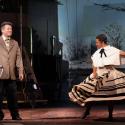
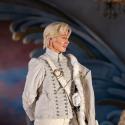
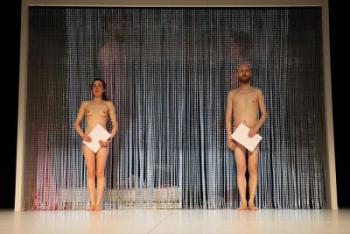 A large part of their subsequent spoken exploration in public of what for most of us remains mercifully private (bodily functions, sexual practices) is – in this admittedly artificial idiom, stage front and in-yer-face – risk-laden, but it stays just the right side of comic. Stark naked, the pair (pictured right) discuss fertility (lack of it), sperm (whose?), conception (hard), excretion (in Italy) and anal sex (in a car). Hmm. Libertinism as theatre goes, and went, down well in super-libertarian Holland, but I also wondered whether this show could possibly be mounted in London without “adult content” strewn every step of the way from flier to seat.
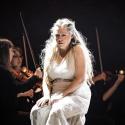
More mysterious and satisfying, at Frascati, was Brazilian Christiane Jatahy’s The Walking Forest. Loosely based on Macbeth (Birnam Wood walking to “high Dunsinane Hill…”), the happening – that’s what it is – consists of four screens at the start projecting documentary footage of poverty and flight from conflict (pictured below). Soon, the screens close up, in line, and images of animal remains appear: a woman’s huge singing voice pulsates. Before the venue's doors open, certain punters have been given written instructions to say or do certain things at specific moments: now, a woman washes her hands in a fishtank; a man proffers to others blooded euro notes; several men speak Shakespeare’s lines into a mike.
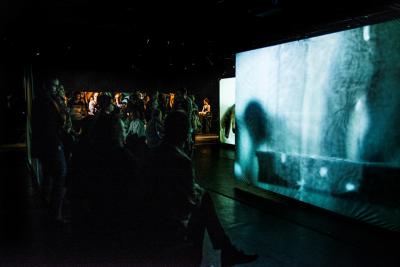
The one live, scripted dimension of this hour-long weirdness is an actress sliding across a long water-splashed table – Lady M going mad? – then delivering a monologue about despots abusing power and the violent rounding-up of youngsters. My summary sells The Walking Forest short. It is a thrillingly sensory experience, inviting responses to film, music, Brazil, Africa, Shakespeare – and third-world politics. It’s also the Holland Festival in a nutshell: quirky, clever, global.

Add comment