King Lear was the play that launched Shakespeare at the Tobacco Factory 12 years ago. The company, under the inspired artistic direction of Andrew Hilton, opened its 2012 season with a brand new production that displays all the qualities that have made this remarkable company unique in Britain.
The strength of all the shows has always drawn on the special atmosphere and architecture of the building. The theatre space at the Tobacco Factory is not just in the round. It is so small and relatively low-ceilinged that actors and audience are drawn into an alchemical vessel which Andrew Hilton has, over the years, refined into a tool which delivers a rare experience: proximity engenders an almost uncanny transmission of energy between the players and those they perform to. There is no need to pander to the gallery here, as emotions pass directly, with an immediacy that conventional proscenium arch divisions cannot deliver.
It is surprising to see the characters’ Elizabethan costumes suddenly shift into a post-modern mix of more contemporary styles
The qualities of the space are ideally suited to the stripped-down style of Hilton’s productions, an approach that works from and through the text. There has never been much need for the Bristol-based director to re-invent the plays or soup them up for the 21st century. Once again, in this new production of Lear, all the actors speak the words with the clarity that comes from a deep understanding of the play’s essence. Much of the play, driven as it is by anger and despair, is delivered at high fever pitch, but only in the storm, with the clatter of thunder and the howling wind are a few words obscured.
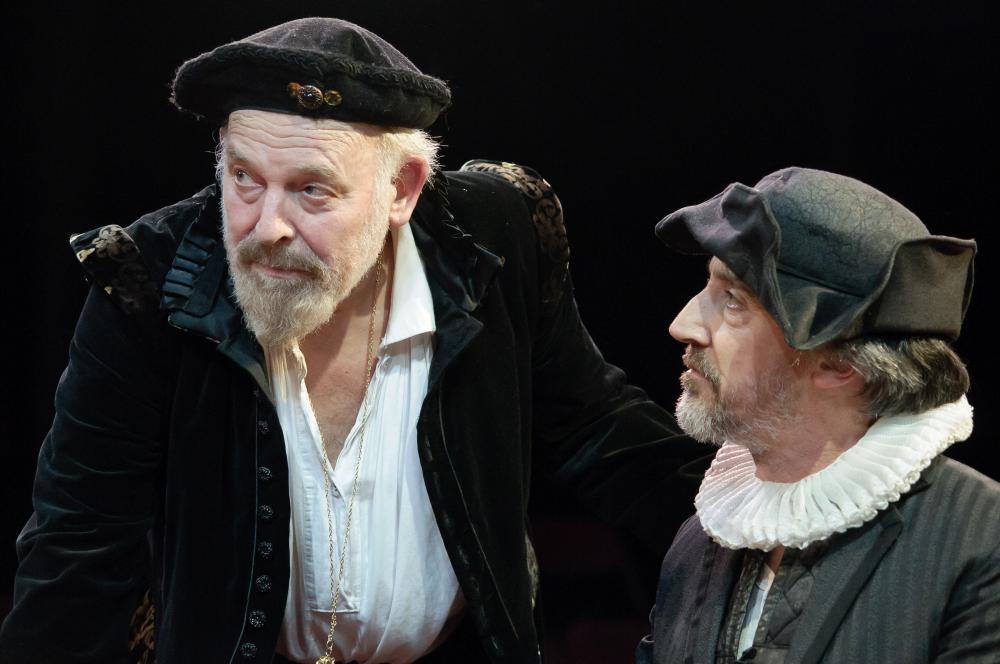 John Shrapnel (pictured left) brings to the doomed King the wisdom of an older actor who has, I suspect, first-hand experience of the shadows of ambition and the hell that comes from taking wrong turns. He plays the twists and turns of an ego’s voyage into annihilation with sensitivity and a nuanced expressive range that makes the man’s descent into hell totally believable.
The rest of the cast do more than support, Hilton produces ensemble work in which every character shines. Simon Armstrong, as Kent, conveys the character’s deep humanity in a palpable way, free of cliché. Julia Hills expresses Goneril’s mixture of psychopathic scheming and chronic insecurity with chilling deftness, though she is a little too middle-aged for the part of a woman whose father curses her with barrenness. Regan is an altogether cooler customer, who spits out venom with no hint of an afterthought, and Dorothea Myer-Bennett produces a tempered yet no less disturbing contrast to her sister's more obviously unhinged behaviour. As her husband, the Duke of Cornwall, Byron Mindahl navigates the character’s descent into evil with a scary hint of camp and his expression of horror mixed with blood-lust after plunging his fingers into Gloucester's eyes is awe-inspiring rather than needlessly over-the-top.
King Lear is as rich as any of Shakespeare’s tragedies. The play is not alone in dealing with the contrast between the so-called civilised court and the wild state of nature outside the city walls. Hilton’s production catches this dichotomy well and exposes its paradoxical nature, along with the relative value of what we call madness. There is a strong earthiness about the performance, a recognition of the incestuous relationship between power, violence and sexuality, expressed in the physicality of the acting, all of which packed a greater punch through being performed in such a contained space. The actors are almost too close for comfort but this is a play that doesn’t stick to the comfort zone. It suggests instead that the zone is illusory, with only a thin veneer of civility masking the fierce and frightening realities below.
Andrew Hilton has always stated very strongly that he won't be tempted by gratuitous updating. It is surprising therefore to see the costumes, which had until then been strictly Elizabethan, shift uneasily, in the play's dénouement, into a post-modern mix of more contemporary styles, with the odd historical reference. When Kent finally returns at the end of the play, he alone wears full Renaissance court costume, as some time-traveller out of Doctor Who. If there's a reason, it isn't clear. By shifting the audience's focus at the moment of climax, when emotion should be paramount, the full impact of this otherwise outstanding production's tragic resolution is temporarily undermined rather than illuminated.
Watch Shakespeare at the Tobacco Factory rehearsals and interviews with actors and director:
- King Lear at the Tobacco Factory in Bristol until 24 March