

The Dracula story has seen almost infinite permutations, though none of them ever manages to improve on Bram Stoker's still-haunting original. This new Anglo-American production keeps Stoker's late 19th-century setting, but has transformed the befanged Count into a kind of supernatural corporate raider stalking the sneering, avaricious fatcats of the City of London.
tv reviews
Jasper Rees

Energy is this season’s dirty word. The big six fix prices from their ivory towers beyond the national borders, and wouldn’t dream of turning up in person to take a fearful wigging from a Commons Select Committee. In the old days, it was all a bit different. Energy came overwhelming from coal, mined domestically by a huge workforce. So central to British life was coal that, when the industry was nationalised in 1947, the National Coal Board took what now seems a remarkable decision to set up a film unit and show the results in up to 800 cinemas.
Jasper Rees

These celebrations of our yesterdays can easily end up all camembert and wind. But while film people and television people will generally cock such things up, we do still have the odd cultural institution which can be relied upon to throw the right sort of party. For the National Theatre's golden jubilee, therefore, the stops were jolly well pulled out and the invitations damn well accepted from the actors who, striplings at the Old Vic in the Sixties, are now our own Oliviers and Ashcrofts and Scofields. And it was almost all impeccable.
Of course the greatest frissons were reserved for those moments when the veterans came back and did their piece once more with feeling – Judi Dench firing up as Cleopatra, Helen Mirren washing her thighs and despatching her husband in Mourning Becomes Electra, Maggie Smith spirited back into The Beaux’ Stratagem. Above all, Joan Plowright, long widowed and no longer sighted, returned to the stage of the Old Vic to repeat with heavy poignancy the words of St Joan she first spoke 50 years ago: “To shut me from the light of the sky… to make me breathe foul damp darkness”.
You’d get an intriguing idea of the history of musical theatre from the shows on show
And yet even if the actors were available, this wasn’t simply an exercise in carbon-copying the past. Penelope Wilton and Michael Gambon might easily have revisited Betrayal, but instead he paired up with Derek Jacobi to reincarnate Gielgud and Richardson in No Man’s Land (pictured below), and she with Nicholas Le Prévost for a slice of Ayckbourn’s Bedroom Farce. If the actors weren’t available, rather than do something else the parts were just recast from the company. Thus Arcadia was (rather uncertainly) peopled by new faces led by Rory Kinnear. Ralph Fiennes ferociously deputised for Anthony Hopkins as Lambert Le Roux. Rosalie Craig not Martine McCutcheon sang of the rain in Spain.
You’d get an intriguing idea of the history of musical theatre from the shows on show here: not just Lerner and Loewe and the inexhaustible Guys and Dolls (Nicely Nicely Johnson was shorn by time constraints of his traditional umpteen encores), but also the fleck and spume of Jerry Springer the Opera and the Ipswich sex worker serial killer musical London Road. And Dame Judi, trotting out “Send in the Clowns” one last time, still can’t hold a tune (no please don’t write in).
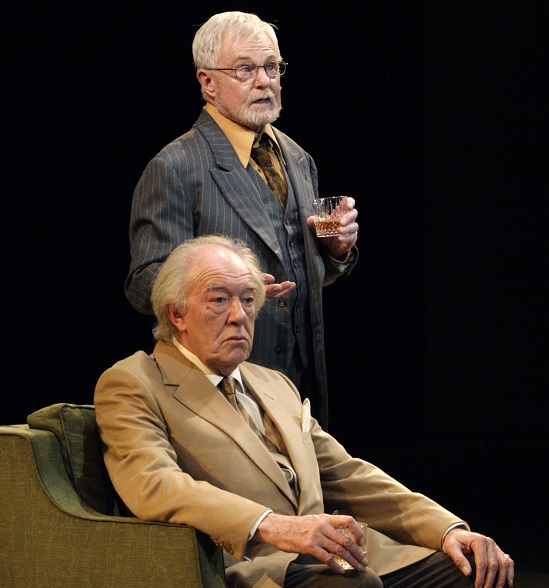 This was a compilation album with well-choreographed tonal shifts. Different buttons were pushed as James Corden beat himself up as Francis Henshall, Simon Russell Beale revisited his fiercely intelligent Prince of Denmark, and Joey the foal ballooned into a mighty stallion. And as the story of the National’s 50 years unfolded, a subtle hand was at work making connections between apparently random clips. We segued from one African queen to another as Cleopatra made way for a young gay man in Angels in America dying of Aids and missing his cat Sheba. Alan Bennett’s history boys, caught napping by the headmaster when playing at prostitution in a French class, pretended instead to enact a scene from a military hospital at Ypres. Straight after that the trenches were presaged for real in War Horse.
And for all the in-jokes about critics and actors, rarely did it feel like a self-indulgent orgy of nostalgia. We don’t know what Rufus Norris’s reign will bring, but this highlights package suggested that it’s high time for a revival of Peter Nichols’ The National Health as the NHS endures its latest growing pains, and possibly also for Pravda as the fourth estate endures moral and financial meltdown. It’s also time for Jacobi, a very early member of the National company at the Old Vic, finally to make his full Southbank debut, possibly in some Pinter.
Quibbles and caveats? As a television event it may have all looked quizzical to non-theatregoers. Filmed theatre has come on a treat since the arrival of swooping high-definition cameras, but stage and screen will never be entirely reconciled so long as actors quite properly see it as their first duty to hit the back wall of the upper circle. Two plays about politicians from David Hare felt like too many. Only one female playwright (Alecky Blythe) was simply not enough. And aside from Clive Rowe rocking the boat, it was quite a white night for lead performers until Adrian Lester came on at the death. His Othello neatly completed the circle, the Moor having been Laurence Olivier’s first role for the National, while making the point that the National and indeed the nation has moved on in half a century.
That’s why the line of the night belonged to Kobna Holdbrook-Smith as Guildenstern in Tom Stoppard’s debut play. “One is having one all the time,” he explained to Benedict Cumberbatch’s Rosencrantz, before clarifying: “A future.” See you at the theatre.
Tom Birchenough

Compulsives may be wondering whether it was coincidence that Bedlam, Channel 4’s new four-part documentary following the work of the Bethlem Royal Hospital, reached our screens in the same week that the same channel’s Obsessive Compulsive Cleaners returned for a second series. The channel’s own internal debate as to whether it’s out to entertain or enlighten us has clearly not gone away. Then there was ITV’s hour on OCD Ward on Monday as well, dealing with many of the same issues as Bedlam, no less seriously, this time at Springfield University Hospital.
Adam Sweeting

Most of us like a good legal drama, which is why there have been so many of them. By the same logic, finding a fresh spin or a new way of writing and shooting them inevitably grows ever-tougher.
Lisa-Marie Ferla

Proof that the BBC’s love of gritty realism is not solely the province of Luther and similar modern-day urban crime dramas comes just minutes into the second series of Ripper Street, before the credits even roll. In the East End of London a police officer is thrown from a window, only missing a little boy playing recorder for the amusement of the street below when his leg is gruesomely impaled on a railing.
Jasper Rees

In the early 1980s the television producer Richard Denton was given considerable access and freedom of movement to make Public School. His documentary about Radley College remains the only really frank account of what goes on inside such an institution. It was a fine piece of patient fly-on-the-wall filmmaking of the kind that simply doesn’t exist anymore, so a documentary which sought to find out what happened to Public School’s subjects was also an elegy to a bygone age of television.
Adam Sweeting

Grand claims and superlatives were not lacking in this examination of The Who's fabled rock opera. "This is a quintessentially important creation," said Des McAnuff, the man who staged Tommy on Broadway and in London's West End. "This might just be the first pop masterpiece," wrote pop critic (and Pete Townshend's pinball-playing buddy) Nik Cohn in his review in 1969.
Claudia Pritchard

How irksome in some ways for the National Theatre that both the glamour and the accessibility of cinema have bookended its first 50 years, when the company and, latterly, its Southbank home, are essentially driven by and dedicated to live performance. But it was Laurence Olivier’s film career, making him a household name, which helped secure for him the job as first director of the National Theatre in 1963. And it is cinema relays that have taken NT productions to places and people who might never step into Denys Lasdun’s building, despite the company’s national ambitions.
Jasper Rees

The funny business of being British, and the even funnier business of being foreign, are at the heart of the latest vehicle for the talents of David Mitchell and Robert Webb. They’ve conquered the sketch format and the grimy sitcom but in Ambassadors they branch out into trickier terrain of comedy drama. The show's task is to snigger at the absurdities of international diplomacy while also showing signs of some sort of beating heart.