

Ratchapoom Boonbunchachoke’s film was a surprise hit at Cannes last year, winning the Critics’ Week Grand Prize. It’s a ghost story that wears its genre trappings lightly, because it isn’t a regular ghost story at all. None of the usual shock tactics are deployed; instead, an offbeat whimsical humour guides the narrative, to an unlikely destination.
Boonbunchachoke sets us up in the opening sequence with a key theme: how to handle the past. We see a beautiful sculpted frieze in pale stone taking shape, based on a tableau of people from different walks of life – a soldier, a teacher, a loving couple with children – before being put in place around a small tower. Then a large hoarding featuring a glamorous woman in sunglasses proclaims the arrival of the future, a luxurious one, and the frieze crumbles into dust.
But the dust doesn’t disappear. Government announcements deem it a “necessary evil”. It plagues the local residents and especially the workers in a down-at-heel local factory. One local (Wisarut Homhuan), who lives in a converted lock-up with a print of the frieze on his wall, is especially rabid about removing all traces of the dust from his home, for which task he buys a new vacuum cleaner. Even the government, an official announcement proclaims, is looking into ways of curbing the spread of the dust and its polluting effects. It chokes those exposed to it, some of whom sicken and die.
Enter the newly purchased vacuum cleaner, destroyer of dust. And sleep. When its young self-styled “academic ladyboy” owner is disturbed in the night by loud, aggressive male coughing, he suspects the appliance is the source of the noise that’s keeping him awake, so he calls a repairman. And one arrives with inhuman speed, a young man with dyed blond hair called Krong (Wanlop Rungkumjad), who calmly tells the man his vacuum cleaner harbours a ghost and that he is truly ”fucked”. (The word is chosen carefully.) Ghosts, Krong reminds the man, return to the location of their deaths, and the local factory where the vacuum cleaner was made was a source of many fatalities. They also form bonds with living humans, as ghost spouses.
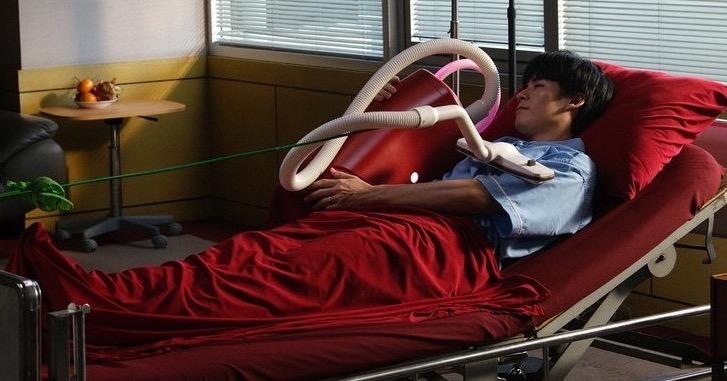
Gradually, it becomes clear that dust here is not what it seems, it’s the tip of a metaphorical iceberg. As is the concept of a ghost. Krong tells the Academic Ladyboy of a striking case of a haunting involving the son of the factory owner, March (Wisarut Himmarat), whose wife Nat (Davika Hoorne) died after a miscarriage, afflicted by the dust. March too is showing signs of the same malady, in the form of a cough that’s starting to bother him. His wife, meanwhile, as do other ghosts in this script, returns to his life by animating an inanimate object, in her case a shiny red portable vacuum cleaner with white tubing and a selection of brush heads and nozzles with which she can “touch” and “see”. The sight of her quietly and purposefully moving over the floor is weirdly charming, much as the cartoon WALL-E is.
But this scenario, which sees Nat and March giving new meaning to the term fluffing and catching up on their lost sex life in inventive ways (pictured above), becomes more sinister when March’s grim older relatives convene (pictured below) and call in local Buddhist monks. All decide he must be sent to a psychiatrist. A minister, Dr Paul (Gandhi Wasuvitchayagit), whose house is also haunted and who seems to be his ally, becomes increasingly unreliable; and eventually March is sent off for electro-convulsive therapy, to erase his memories of Nat. He fights back by reading everything he can find about a major source of other hauntings: the ghosts of the victims of the 2010 anti-government protests in Bangkok, which led to numerous deaths.
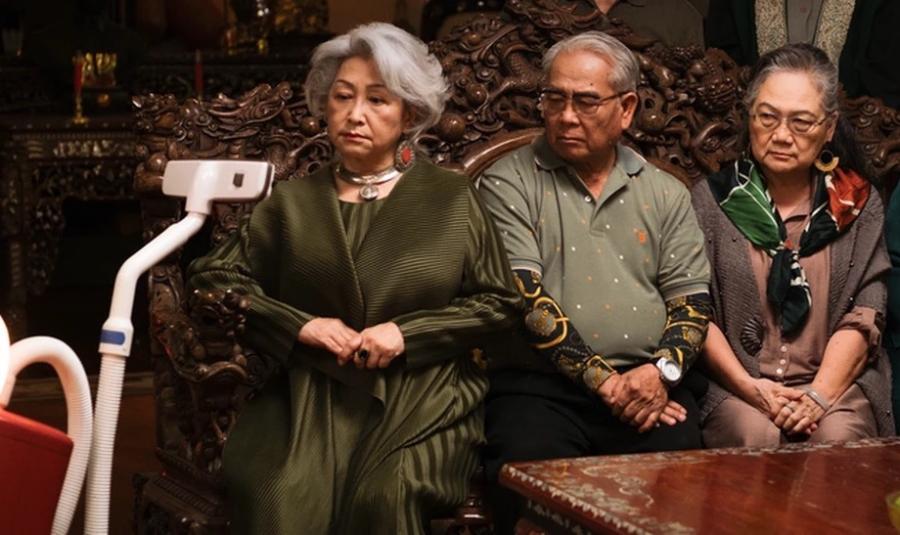
It’s here you realise Boonbunchachoke has skilfully flicked a switch and that what we are seeing is a protest against state suppression and the cruelties of the ruling regime, not just a sweet plea for people to resist forgetting their loved ones. It’s also a protest against the hounding of gay people by a society hostile to social change and liberal values.
This is a cleverly constructed film, its low-budget effects nevertheless striking, as when a translucent Nat walks through the factory, looking for other ghosts. The shots of the natural world are especially beautiful and elegiac, and its music is carefully chosen to underpin the tone of each scene, which ranges from arch to emotionally charged. Tinkling cascades of Debussy-esque piano music alternate with lusher passages, their upbeat robustness usually barbed and satirical in aim. It’s a comedy, its humour deadpan-dry, much like Krong’s stance towards the story he is telling Academic Ladyboy. But the passion behind it, reflected in Academic Ladyboy’s mounting anger as he listens to Krong’s story, definitely isn’t.
Things drift slightly off-course in the final reel, where the metaphors are stretched a tad too thin and the time-travelling plot line becomes hard to follow at times. But this is a terrific debut film, making a very welcome splash.










Add comment