

The best thing about a year without Doctor Who? It’s been a year since we last heard people (adults) complain that the show’s increasingly labyrinthine, convoluted plots were too complex for children.
But the best thing about this year’s Christmas special? It was a self-contained, fast-paced hour which perfectly captured the childlike wonder and good fun that has always been at the heart of a show about a time-travelling space alien.
Everything else was present and correct for this festive feastIn what was perhaps a nod to the show’s ever-increasing popularity on BBC America, The Return of Doctor Mysterio swapped the usual dramatic aerial shots of London for a New York setting: a couple of spectacular, CGI-driven flights over Manhattan and a scene on top of the Empire State Building in place of the London Eye or Big Ben. But everything else was present and correct for this festive feast: Peter Capaldi’s eccentric, cranky Doctor mistaken for Santa Claus, comic book superheroes and, of course, a truly scary alien threat hell bent on colonising the human race. It is Christmas, after all.
This time around, that threat takes the form of sentient creatures that look like human brains – the idea being that they’ll pop into the heads of and ride around in the skulls of various world leaders and important people. It’s a 2016-style plot if ever there was one (quoth the Doctor: “Brains with minds of their own – nobody will believe that, this is America!”) even while it breaks no new ground for the show. Thankfully, the technology has progressed from the aliens in flatulent skin-suits of the Christopher Eccleston era: some things are best kept inside after a few too many Brussels sprouts, after all.
What sets this particular tale apart is the cast of supporting characters. There’s Justin Chatwin as Grant: superhero The Ghost by night, thanks to a chance encounter with the Doctor and ingestion of a mysterious crystal as a youngster; mild-mannered live-in nanny … also by night. It gets complicated, in a subplot that couldn’t pay more lip service to the travails of working single mothers if it didn’t also feature a working single mother. Lucy Fletcher/Lombard (Wolf Hall’s Charity Wakefield) is a whip-smart investigative journalist, Grant’s employer and The Ghost’s love interest. No prizes for guessing how that one ends.
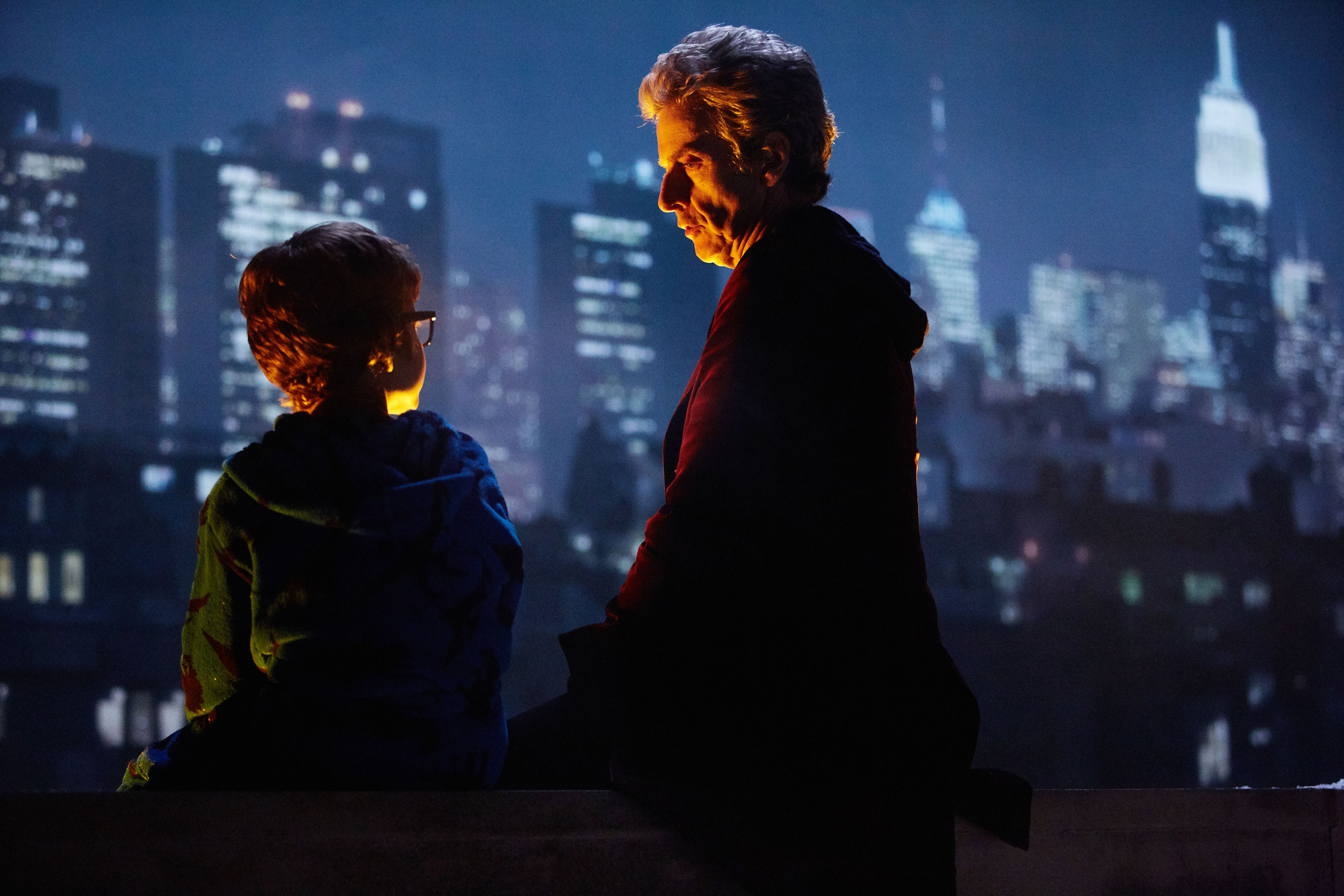 While the superhero plot is a new one for Doctor Who, it’s pretty obvious from where it takes its cues: Grant’s “disguise” is a pair of thick-rimmed glasses, while Wakefield’s journalist character is the spiritual heir of Lois Lane. But it’s no less charming for that, not least because show runner Steven Moffat’s fast-paced script takes a playful joy in the tropes of the source material.
A huge part of that joy is a tribute to Capaldi’s performance as the Doctor: his take on the role has come to feel increasingly definitive over the past three years, and the irascibility that belies a big heart makes particular sense in the universe of the show. His unfamiliarity with the concept of superheroes was particularly delightful, from his belief that he had cracked some sort of secret code after sketching a pair of spectacles onto one of young Grant’s superhero comics, to this glorious exchange with the boy (Logan Hoffman, above right, with Capaldi) on the origins of Spider-Man:
“Why do they call him Spider-Man? Don’t they like him?”
“He was bitten by a radioactive spider and guess what happened?”
“Radiation poisoning, I should think.”
“He got special powers!”
“What, vomiting, hair loss and death? Fat lot of use those are.”
Matt Lucas as Nardole, the Doctor’s straight-talking alien companion last seen in Christmas 2015’s The Husbands of River Song deserves a brief mention: the character has far less to do than the youthful female companions who are usually the Doctor’s stock in trade but, in the hands of Lucas, what could easily have become a one-note Jar Jar Binks-style oddity brings the sort of eccentric Britishness Doctor Who fans are familiar with to its fairly atypical American setting. Lucas will return in the spring, on some of Capaldi’s outings with new companion Bill Potts (Pearl Mackie) – worth watching to see if Moffat manages to squeeze a whole scale out of him.
Overleaf: watch Pearl Mackie as the Doctor's new companion in the series 10 trailer


