

Don't spend too much time looking for Kristin Scott Thomas in writer-director Pascal Bonitzer's Looking For Hortense (aka Cherchez Hortense). In keeping with the fleeting presence afforded the Hortense of the title, the divine Scott Thomas gets her customary star billing only to pretty much vanish from a largely somnolent Gallic exercise that sorely needs this actress's effortless command and wit. Cast as a theatre director called Iva who strays into the arms of her leading man - quelle surprise!
film reviews
emma.simmonds

In the 1997 TV sitcom I'm Alan Partridge, Alan's nemesis, BBC commissioner Tony Hayers (David Schneider), describes his methodology as "evolution not revolution" before smugly axing Alan's chat show. It would pain Alan to hear those words again, but "evolution not revolution" perfectly describes the approach of the small screen icon’s first cinematic outing and the reason for its success. Directed by TV veteran Declan Lowney (Father Ted), Alan Partridge: Alpha Papa sees Alan at the centre of a local radio station siege.
Kieron Tyler

A taciturn, bearded Irishman leaves Berlin to return to his homeland. He’s travelling there to record silence. Arriving in Donegal, he wanders the countryside with a microphone trying to capture an environment where sounds made by humans do not intrude. In the rain and on moors, he stands or crouches with his equipment. Occasionally, someone encounters him. He returns to the house of a raconteur for bread, cheese and ham (pictured below right), before he’s drawn to the remote, Atlantic-buffeted Tory Island where he grew up.
emma.simmonds

Things go bump in the night in James Wan's chilling latest, based on a supposedly true story. The Conjuring is an event horror movie, benefitting from a sizeable marketing budget and the distribution of a major studio (Warner Bros); appropriately enough it simply screams to be seen. And those looking for a touch of class to elevate their frights will find it heartening to hear that there's a leading role for Oscar nominee Vera Farmiga.
Graham Fuller

Michael Cimino’s Heaven’s Gate is the most Melvillean of modern Westerns. It is the American conquest tragedy allegorised in a sprawling semi-fictional account of the 1892 Johnson County range war, in which the big ranchers of the Wyoming Stock Growers’ Association, supported by President Benjamin Harrison, waged a vigilante campaign against the region’s small farmers, settlers, and rustlers. The film’s Ahab is Frank Canton (Sam Waterston), the supercilious, monomaniacal leader of the WSGA’s mercenary Regulators.
Veronica Lee

The basic set-up for The Heat is familiar – two mismatched cops are thrown together on a case and have to find a way of working together despite their differences in social background and methods – only in this case the officers are female. Add to the mix that the two actresses playing the roles are playing to type - loudmouth Boston street cop Shannon Mullins (Melissa McCarthy, almost reprising her Bridesmaids role) and prissy, super-bright but socially inept FBI agent Sarah Ashburn, as essayed by Sandra Bullock in any number of her films.
Nick Hasted

Ulrich Seidl claims there’s a simple reason he goes easier on young teenager Melanie’s stumble through 21st-century sexual desire and disaster than he did with her mum and aunt in Paradise: Love and Paradise: Faith. Going further with her requited crush on an adult would have involved exploiting his young star Melanie Lenz. So a director known for his provocations dutifully pulls up short.
emma.simmonds

Introducing his latest film at a preview screening, the Danish director Nicolas Winding Refn commented, "If Drive was like taking really good cocaine, Only God Forgives is like taking really good acid." It's an appropriate (and characteristically provocative) comparison - and if Only God Forgives is not quite the trip one might hope for, it's certainly hypnotising and alarming.
Nick Hasted

Wolverine is a second-division, third-generation Marvel superhero, and for all the care devoted to his sixth cinema outing, he remains the problem here. First introduced in 1974, Stan Lee and Jack Kirby – comics’ Lennon and McCartney – were no longer on hand to conceive this metal-clawed lunk with the adolescently resonant weaknesses they gave Spider-man and the rest. Instead, Wolverine had over-wrought, tin-eared Chris Claremont to chronicle his key years as the star turn in the X-Men, a firm fan favourite who never touched the general public.
This second attempt at a solo film away from the X-Men franchise is based on a 1980s mini-series by Claremont and Frank Miller, which landed Wolverine in Japan, and Miller’s favoured milieu of samurai, ninjas, codes of honour and gut-opening swordplay. The capable, stylish director James Mangold exploits this setting for all its worth, aiming for a “fever dream” of modern Japan, mixing ancient warriors and industrialists, and bullet-training from Tokyo to the rustic, lazing south.
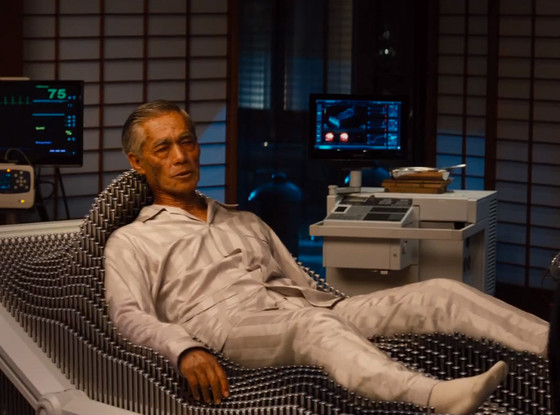 He opens with the Atom bomb blasting Nagasaki, where the immortal, indestructible Wolverine (Hugh Jackman) saves a young Japanese soldier. In the present day, that soldier has become dying industrialist Lord Yashida (Haruhiko Yamanouchi, pictured right). Drawing a drifting Wolverine to his death-bed, he tells him that the immortality which has come to seem like a curse can be extracted and transferred to another. After a mass Yakuza assault on Yashida’s funeral, Wolverine rescues the industrialist’s grand-daughter and heir Mariko (Tao Okamoto, pictured below with Jackman), going on the run together across Japan. Finding his indestructibility has indeed been removed, our hero is bloodied, wounded, vulnerable: about as interesting as he’s ever been.
Mangold is responsible for surprising and entertaining turns in the careers of Sylvester Stallone (Cop Land), Angelina Jolie (Girl, Interrupted), Russell Crowe (3.10 to Yuma), Joaquin Phoenix (Walk the Line) and John Cusack (Identity), and has worked with Hugh Jackman before, on the Meg Ryan romance Kate and Leopold. He brings out his star’s easy, straightforward decency and muscular charisma, and sets him to work in what for much of its more than two hours is a modern film noir, with a haunted knight errant as its hero. Okamoto is also excellent, woefully under-written but communicating great depth, as does Yamanouchi, fearsomely steely and calculating even as his character lies dying. There are some extraordinary images too, such as Wolverine’s harpooning by dozens of ninja arrows, straining but reeled in to a backdrop of mountain snow.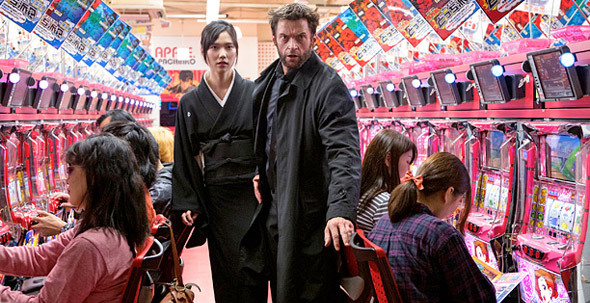 The moment when all this good work unravels is easy to spot: it’s when Wolverine regains his indestructibility. When a hero instantly heals after his opponent hits his heart fair and square with a sword, you start to side with the hapless bad guys. The final reel is schematic and battle-heavy, full of obvious revelations and the over-heated, unconvincing pulpiness of a typical 1970s Marvel comic. Basically, it becomes another Wolverine yarn, and the energy and talent expended to find something worthwhile in that falls exhausted to the floor. It’s enjoyable, even memorable. But comic-book lead can’t be turned into gold.
Overleaf: watch the trailer to The Wolverine
Kieron Tyler

Newly restored versions of old films in cinemas are commonplace. This revival of Alfred Hitchcock’s Dial M for Murder is set apart due to it being in 3D, as it was originally intended to be seen. But unless you were able to catch it in the few American cinemas where it screened after its May 1954 New York premiere, the original has proved elusive, although 3D versions have surfaced intermittently.