

Obsession makes for good drama. Looking back over 30 years of in-yer-face theatre in general and female monologues in particular – anything from Fleabag to Superhoe – I’m struck by the power of the individual voice to take us on journeys into the underworlds of extreme feelings. Dark places; dark thoughts; darkness visible. So Tanya-Loretta Dee’s debut play, Loop, which she performs herself, starts with a very promising premise. Described as a “surreal one-woman fever dream”, it plunges us into the mind of a young woman whose infatuation with a man rapidly becomes obsessive and self-destructive.
In this 65-minute one-woman show, Dee plays Bex, who works in a Peckham party shop twisting balloon animals for a minimum wage. Here she meets middle-class James, whose intense eyes, polite demeanour and job in a charity organisation combine to impress the yes, rather impressionable Bex. Despite the warnings of both her bestie Greta, who has known her since they were at school together and has witnessed her obsessive behaviour before, and her down-to-earth Brummie mum, Bex falls for James. Their affair is played out in various hotel rooms, which get cheaper and cheaper as James grows less and less interested, and Bex gets more and more distressed.
Dee’s monologue is short, but powerful. Bex is presented as woman who loves to fantasise about being swept off her feet by a ravishingly handsome prince, and her imagination mixes gothic imagery with folk tale archetypes. Here are deep forests; here are wolves. And antlers. At the start, once upon a time, a beautiful deer is slain by arrow fired by a nobleman on a white stallion, a metaphorical forecast of what is to come. Her subsequent musings about princes and witches (does this word describe herself or any woman she’s jealous of?) show how our internal fantasies are a response to feelings of loneliness and of being ignored.
But with Bex the problem is not fantasy so much as reality. Not only is she in love with the unsuitable James, but also her behaviour soon spirals into obsessive repetitions of deeply damaging actions. Like Baby Reindeer, this becomes a disturbing tale of stalking and self-deception. What is great about the writing is that Dee is highly perceptive about the psychological shifts from attraction into eroticism, which are familiar to all of us, and then shows how easily this can tip over into a mental state where thoughts are uncontrollable and self-damaging. And nothing anybody can say will help you.
At one point Bex mentions limerence, which is defined by AI as “a state of involuntary, obsessive infatuation with another person, often fuelled by uncertainty about their feelings”, and it’s “characterised by obsessive thinking, idealisation of the other person, and an intense longing for reciprocation, which can lead to a rollercoaster of euphoria and despair”. This describes her emotions, her altered mental state, perfectly. It’s love as addiction, with ideas about neural pathways running into more ancient feelings about animal spirits, and the mythical creatures who lurk in the dark – usually the darkness within.
These ideas are beautifully blended with acutely physical sensations, such as the smell or sound of the loved one, as well as with recognisable warning signs about toxic set ups, from your beloved sending you a dick pic too early in the relationship to your besties telling you to pay attention to his ring finger – he’s not going to leave his wife for you. Or is he? The problem with the euphoria of new love is that you are so overwhelmed by intense feelings that it completely skews your sense of reality. Bye bye self preservation; hello, hello self harm. Psychological self harm. The kind you create all by yourself, for yourself – and defend to the last.
The main problem with this well-written, and strongly performed, monologue is that its short length inevitably means that there is not enough substance or detail to make the experience of watching it completely satisfying. I really wanted to know more. More about Bex and her mum, more about Bex and Greta, more about Greta and her lover Kiera, more even about James (ugh). More about her lucky charm and absent father. And more about how you deal with obsession and addiction. What’s the cure? Is there a cure? Who can cure you? Loop invites us to desire this kind of detail, but doesn’t give us the full picture. Of course, that’s partly the point – it’s a subjective sketch. But still.
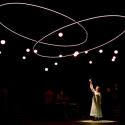
Sophie Ellerby’s production, designed by Mydd Pharo, creates the world of Bex’s psychodrama by making concrete the forest setting of her fantasies, complete with antlers and romantically shiny fairy lights. The sawn-up dirty mattress pieces serve as a metaphor for bad sex and bad beds everywhere. While Cheng Keng’s lighting and video projections provide James’s text messages and alert Bex to her mum’s phone calls, Dee’s performance combines a knowing charm with moments of baffled dismay as her character spirals into increasing discomfort. She has a very appealing stage presence, sometimes assertive, often self-questioning, at other times ironically quizzical, taking us into her confidence, then plunging into the perverse. If the play remains a bit of a taster, I’d love to see what Dee does next.







Add comment