

“I was not a bad man. Nowhere near it. But they said I was anyway.”
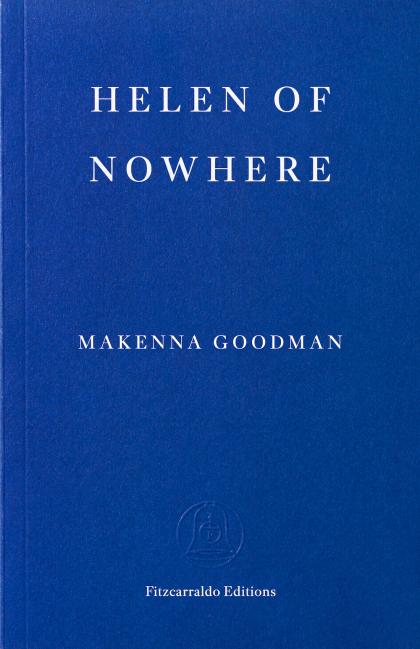
Makenna Goodman’s second novel (her first, The Shame, a brilliant exploration of motherhood, came out in 2020) is, on the surface, an account of a cancellation, though there’s nothing straightforwardly black or white about any of it. In fact Goodman seems to shy away from binary thought, which is refreshing, if sometimes confusing.
It’s also about love, class, nature and the way we relate to it. It is structured like a six-act play, with monologues by four rather abstract protagonists: Man, Realtor, Helen and Wife. Its narrative is challenging, sometimes surreal and obscure, though beautifully written with a poetic, intriguing rhythm. But because the characters are not fully drawn, one never feels very involved.
The Man, a university professor – “I was hardly a man in its modern sense” – questions the originality of a beautiful student’s work. “You know, in the spirit of discourse.” He is jealous of her exquisite idea: the reenactment of the funeral of Achilles from the perspective of the flowers growing near his funeral pyre.
His suspicions of plagiarism do not go down well. The student is made a professor, while he is disgraced (though his offence does seem relatively mild). His department declares war on him, says he’s a colonial artefact and his wife, who was once his student and is now also a professor, appears to agree with the new consensus.
She says she’s always supported his vision, which involves nature and “our literary relationship to the earth”, but is adamant that her own work has been sidelined and that she was now nothing but a hat stand. “The dog officially took my spot on the bed.” He moves into the guest room. Act 1 is over.
In Act 2 things turn very cerebral. The Realtor – and she’s hardly a realtor in its modern sense either – is showing the Man a house belonging to a woman called Helen. He has left the city after being fired by the university – and by his wife -– and is attempting to start a new life in the country. “The city’s green spaces now seemed grotesque. These places were not nature at all… I yearned for the real thing.”
Helen is now in assisted living but the Realtor’s relationship with her is close and intense, even adulatory. Helen also left the city and became transformed, in tune with nature, acquiring the wisdom of the seasons. “She came to know a different kind of language... the words of natural systems.”
As we haven’t met Helen yet, this is at one step removed. Does she even exist? (Helen, Goodman has said in interviews, is partly based on Helen of Troy and on Helen Nearing, wealthy guru of the back-to-the-land movement of the 1960s, who wrote a bestseller about homesteading in Vermont with her husband Scott Nearing. Goodman herself moved from New York to Vermont in 2008.) “To me,” says the Realtor, “Helen is an entity that is pure consciousnesses, beyond form.” However, someone called Helen does appear in Act 4, and she’s oddly similar to the realtor in appearance. Are they one and the same?
There are vivid moments in this section: the Man talks to Helen about his wife and how, before she decided to leave him, she told him that she, an introvert, was an anchor, and he was a kite, and that this had been satisfactory, despite her bad feelings, until “my kite-ness tugged her up at times she didn’t want to be tugged up.” She wanted to be a kite too, and in spite of his protestations that he could become an anchor instead, she knew that a kite could never do this.
In spite of being in tune with the wisdom of the seasons, Helen isn’t wholly positive about life in this rural setting (and here she sounds refreshingly like the conflicted mother in The Shame – she, like the Wife, is married to a college professor and grapples with family life in a Vermont farmhouse; she describes winter misery particularly well).
“When you live here you’ll have community,” she tells the Man, “and you’ll think they’re different from your colleagues, but they’re not, they’re the same.” She goes on to describe being stabbed in the back by some neighbours after she allowed their teenage son and his friends to use the lake on her property on hot days. One of the kids got drunk and almost drowned and the adults ended up planning to sue her for negligence.
But such accessible moments are too few. We’re left wondering if the professor can transform himself into someone who can learn how to love his wife in a deeper sense, to put himself into the shoes of the Other – or has he actually changed into something else entirely?
- Helen of Nowhere by Makenna Goodman (Fitzcarraldo Editions, £12.99)
- More book reviews on theartsdesk









Add comment