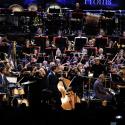
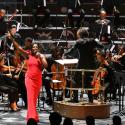
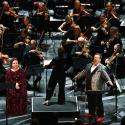
The Northern Chamber Orchestra is unusual in that it plays almost always without a conductor. It’s been doing that for nearly 60 years, and there’s a unique frisson to be had from experiencing orchestral music-making done almost entirely through eye contact, careful listening and telepathy, as real chamber music always is.
At the same time, with larger numbers of players and complicated scores, it’s a bit of a high-wire act. Its concert at King’s School Macclesfield was a demonstration of how well it can work and how testing the concept can be.
A Haydn symphony is sure ground for the NCO: in years gone by, its recordings of many of them were hailed as masterly. On this occasion they began their evening with no. 49, “La Passione”, which is seen as one of Haydn’s Sturm und Drang works – “Storm and Stress” being the proto-Romantic movement in 18th century German literature that spread into other branches of the arts and in this case is apparent in the dominating minor key writing, dramatic pauses, big changes of dynamic and surprising harmonic effects with which it abounds. Though in four movements, even that plan is hardly text-book, as the first is a slow one, followed by an Allegro di molto, before a minuet and final Presto.
With Zoë Beyers, NCO music director (also the BBC Philharmonic’s and Britten Sinfonia’s leader) in position at the front desk, that opening movement had an effective mobility in its tempo, with carefully enunciated pauses and rests and gently initiated, at times almost hesitant, phrases, creating a sense of foreboding, which contrasted with skilfully detached articulation in the faster movement (which would surely have been labelled furioso in the aesthetic of a later era). The Minuet brings major tonality like a few rays of sunshine, and its Trio gave principal horn Naomi Atherton and principal oboe Rachael Clegg their chance to glow in its brief warmth.
The concert was named after the piece that followed, a sample of a present-day composer’s work such as might have been considered scary for a Cheshire audience even within recent years – but its reception was evidence of the NCO’s bond with its concert-goers and their faith in it. Anna Clyne’s Prince of Clouds is a two-violin concerto with string orchestra, intended to be a companion piece to the Bach double concerto according to Zoë Beyers, and with some of the sort of allusions to landmarks of the baroque/classical tradition that Clyne likes to make. She says herself that she was thinking of the transfer of knowledge and inspiration from one generation to another in musical performance when she wrote it, and that it was intended as a dialogue between soloists and ensemble.
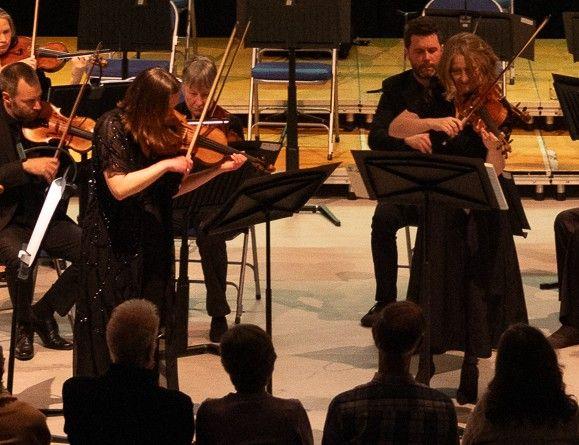
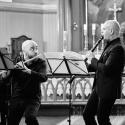
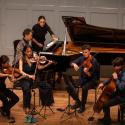
She and the NCO’s associate director Sarah Brandwood-Spencer (pictured above) took the solo roles with lyrical skill and clean-cut, dramatic effects in the close-to-bridge interjections that they, and sometimes the main body string players, make in contrast with the initially idyllic intertwining of the solo violins’ voices. There are tricky lines for the other string players, and both soloists played their part in helping to visually co-ordinate their colleagues’ entries. The music was executed with impressive clarity, including its build-up of intensity through Bartók pizzicati (thwacking plucked strings) and acceleration – though, happily, it finally reaches a point where serenity wins.
“We keep trying bolder, bigger pieces,” Zoë Beyers said, introducing the concert’s second part – Schumann’s Symphony no. 3 (actually his last). This must have been one of the biggest and boldest things they’ve ever tried, as the 16 total strings’ strength has to be joined by four horns and the standard early 19th century orchestral quota of trumpets and trombones, plus timpani. It was an illuminating exercise: Schumann’s scoring is sometimes criticized for its doubling of instrumental lines and perceived muddiness of texture – but you can see why he did it when strings are on the lean side (as by all accounts they were at Düsseldorf when he wrote the symphony), and with these forces in play those issues hardly mattered.
What did slightly inhibit things was the need to hold everyone precisely together in the weightier passages: achieved, but without daring many moments of drama or anticipation in the first movement. The details of the writing came out notably – the violas’ tremolandi (not shared by the other strings) at the close of that movement, for instance, and the melodic touches in the middle of the texture in the last.
The “very measured” pace of the second, still called a Scherzo, brought precise and unified staccato articulation from the strings, albeit with a rather plodding rhythmic foundation, and the woodwind choir proved themselves in fine voice. And the wind-led gentle sway of the third movement was a delight, with well-shaped arcs of swell and fade, and a noble though self-effacing cello solo line. The surprise element in the symphony is its evocation of supposed antiquity in a brass-laden, minor-inflected fourth movement marked as “solemn” – inspired by a great ecclesiastical event at Cologne Cathedral. The counterpoint came over clearly, as did the periodically awesome fadings of its sonic broadsides, but some of its subtler aspects proved more difficult to bring off, in these conditions. The finale was rhythmically buoyant, though, and its accelerating finish excitingly achieved.
So would direction with a stick have been an advantage? Possibly, but Schumann himself was apparently not much use as a conductor, even with his own music, so maybe this was about as authentic an approach to his own audiences’ experience as we may ever get.