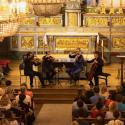
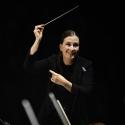
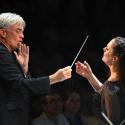
The members of the National Symphony Orchestra of Ukraine, on an intensive tour of the UK and Ireland which sees them right now performing daily after long journeys, are heroes by any standard.
They are also musicians of high calibre and with a distinguished tradition. The programme they offered in Manchester was designed to link Britain and Ukraine symbolically, but it was – as with all its variants on the tour – built around Beethoven.
For a symphony orchestra, their numbers on tour are modest, with 34 string players and 15 others, but it’s a contingent that works very well for Beethoven – because they play with intensity and precision, and the balance of the strings, a bit more weighted to the lower instruments than our conventional allocations usually provide, is very well suited to his writing.
They began with a rarity – a symphony (so called) by Maksym Berezovsky, an 18th century musician trained in Italy and who worked for much of his time in St Petersburg, who can be claimed as Ukrainian on the basis of birth. It’s an Italian overture really, with a segue between its fast-slow-fast sections compelled by a dominant seventh closing each of the first two. It was played in eminently classical style, mellifluous in phrasing, under conductor Volodymyr Sirenko, with briefly starring roles for bassoon (in the first section) and flute (in the second) brought out of the texture, and introduces trumpets and horns to conclude effectively.
The main event of the whole concert – and the one element in the programme common to all iterations – was the “Emperor” piano concerto of Beethoven, played by Maria Pukhlianko, an exemplary exponent of it. Too often we hear soloists who pound their way through it with so much pedal as to obliterate its detail, but with her every note was clear, there was delicacy as well as power, never any doubt as to the voice lines in the counterpoint, and the music spoke for itself rather than being a vehicle for a pianist’s self-aggrandisement. It’s a pleasant surprise to hear the opening tutti chords all precisely together with the piano (and the same when they were recapitulated), as that can easily be a case of hit-and-miss, which says much for the unity of purpose between her and her colleagues.
The strength of the cellos and basses made itself felt in the Allegro, and, with Maksym Grinchenko in the leader’s chair, the string ensemble was capable of real discretion in accompaniment, too, and in the slow movement the blend of solo and accompaniment was beautifully accomplished. The finale was lithe and athletic, rhythmically tidy and bounding along at a well-chosen pace, solo and orchestra single-minded to the last.
Turning to Delius to open the second part of the concert was a welcome gesture by the Ukrainians, and there was a certain fascination in hearing a central European approach to “On Hearing the First Cuckoo in Spring” and “Summer Night on the River”, aka Two Pieces for Small Orchestra. They don’t play Delius the way we do: their approach to phrasing, with every unit instinctively given its own swell and decline, made for a rather over-regular rhythmic pattern, and their generous vibrato is a bit different from the English string dolce. While the clarinet’s cuckoo made his contribution discreetly, the right balance of wind and strings in “Summer Night” hadn’t really been calculated.
But back with Beethoven again, Symphony No. 7, they were on surer ground. Full marks for two of the movements, certainly (the second and fourth), but I guess they come from a tradition where portentousness and even solemnity are admired in interpretation of his work. Though the Poco sostenuto (Poco?) was clear and cleanly played, the transition to the main theme of the opening movement seemed dragged out to eternity, and the Allegro tempo, when it came, was less than dance-like. In the third movement – Presto, it says, and only a little less than that for the Trio – the latter left the movement’s impetus periodically becalmed, though the wind playing was elegant and precise at the jogging speed that Volodymyr Sirenko set as the main one.
The second movement, though, was precisely right in pace and showed the Ukrainian strings in precise and passionate form, and the finale was energetic and triumphant, with the brass at their fiery best.
- Repeated tonight at Cadogan Hall, London (without Delius and with Beethoven Symphony No. 3); 18 March at G Live, Guildford (without Berezovsky and with Beethoven Symphony No. 3); 19 March at The Anvil, Basingstoke (as Manchester); 21 March at Perth Concert Hall (without Delius and with Beethoven Coriolan overture); and 23 March at Dublin National Concert Hall (without Berezovsky and with Beethoven Symphony No. 3)
- More classical reviews on theartsdesk