

There was a macabre irony at the heart of this final concert in the CBSO’s Mahler cycle in Symphony Hall. Everything was back to front. It started with a Resurrection and ended with a death. Like the universe, it began with a bang and ended, Eliot-fashion, with a whimper. And the Resurrection wasn’t even Mahler’s (that happened last month), but Messiaen’s: his Et exspecto resurrectionem mortuorum, a work which reduces redemption to sounding brass and crashing gongs. Mahler’s was the death, in the wild and haunting shape of his Song of the Earth, not his last work but in many ways his truest epitaph.
I daresay circumstances conditioned the choice of ending: Sir Simon Rattle’s availability to conduct, on the 20th anniversary of the hall which he, more than anyone, caused to be built; his own choice of work. But for me this is the right piece to sum up a Mahler cycle. I may be out of step in thinking Mahler usually at his best when setting or at least contemplating words; all the same, these particular Chinese poems come painfully close to the essence of his self-absorption. “My friend,” Wang-Wei sighs in the last song, “fortune was not kind to me on this earth”. “Dark is life, dark is death”, Li-Tai-Po’s maudlin drunkard assures us in the first. And at the very end, the word “ewig” – “forever” – laps the shores of oblivion to precisely the melodic pattern (the first two notes of Beethoven’s three-note “Les adieux” motif) that will dominate the Ninth Symphony, which really was Mahler’s last finished work.
Nobody understands these associations better than Rattle, and here, as ever, he explored them with loving precision. In his review of the Second Symphony under Kazushi Ono last month, David Nice complained in passing about Rattle’s micromanagement in Mahler’s Third (with the Berlin Phil); and it’s true that one can become over-conscious of his attention to detail, his sense of the distinct phrase, as opposed to the grand formal arches which some conductors seem able to achieve while barely twitching a muscle.
ut then Mahler does often compose in that way, assembling his paragraphs out of exquisitely turned figures, like the individual twigs or the ripples on the water in a Japanese print. Sometimes his textures are so sparse that one wonders where the continuity comes from, just as in those prints the picture sometimes forms out of little more than a suggestion. Mahler can be noisy and complicated; but it’s this economy of figuring that I love most in his music. And I suppose that’s why, of all his works, this is the one that moves me most.
Michael Schade was fidgety, self-conscious, hyperactive, constantly letting us know what a swine of a part this is
Rattle did not, in any case, leave the continuity to its own devices. As well as being rich in detail, this was a finely paced performance of a work which can be disconcerting in the way it lurches from the bibulous to the reflective and back again. The CBSO were on terrific form throughout, but nowhere more than in the lovely wind solos that track the mezzo-soprano, from the blue autumn mists of “Der Einsame im Herbst” to the eternal blue distance of “Der Abschied”. And Jane Irwin, standing in at short notice for the indisposed Magdalena Kožená, matched them in the sensitivity of her response to words and situation, though she had some difficulty filling out her sound in the low registers. Could this be a consequence of her recent upward move? She sang soprano in the Ono Second Symphony, and such equivocations (literally) are rarely effective.
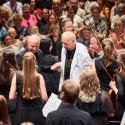
he was, nevertheless, a perfect foil to the tenor, Michael Schade: serene and inward, where he was fidgety, self-conscious, hyperactive, constantly letting us know what a swine of a part this is. Even in his way with the score – hand-held, like a scatter-gun, then slammed shut as he reached the final page, not without comedy and certainly not without vocal brilliance – he tended to strain the nerves. Maybe this is what Mahler meant. But I still feel that the best Mahler tenors (this and the Eighth are his only symphonies that need any) are the ones who leave the score in the green room and simply let rip.
s for the Messiaen, I can only close my ears. Et exspecto was written to be played in Chartres Cathedral (in honour of the World War dead), but Messiaen thought it would sound good at the top of a mountain, and probably that’s where it belongs. Apart from some astonishing woodwind chording in the penultimate movement, I can hear nothing in it but bashing and blasting. No doubt that’s my loss; but I’ll just have to live with it.



Add comment