

What lies ahead for dance as arts spending cuts bite? Can it survive the withdrawal of public funds that support dancers' training, choreographers' creativity, employment costs and health care? Is protest necessary? A panel of the British dance world's leading figures was brought together by theartsdesk for a major debate last Friday in central London, as dance faced its own Question Time.
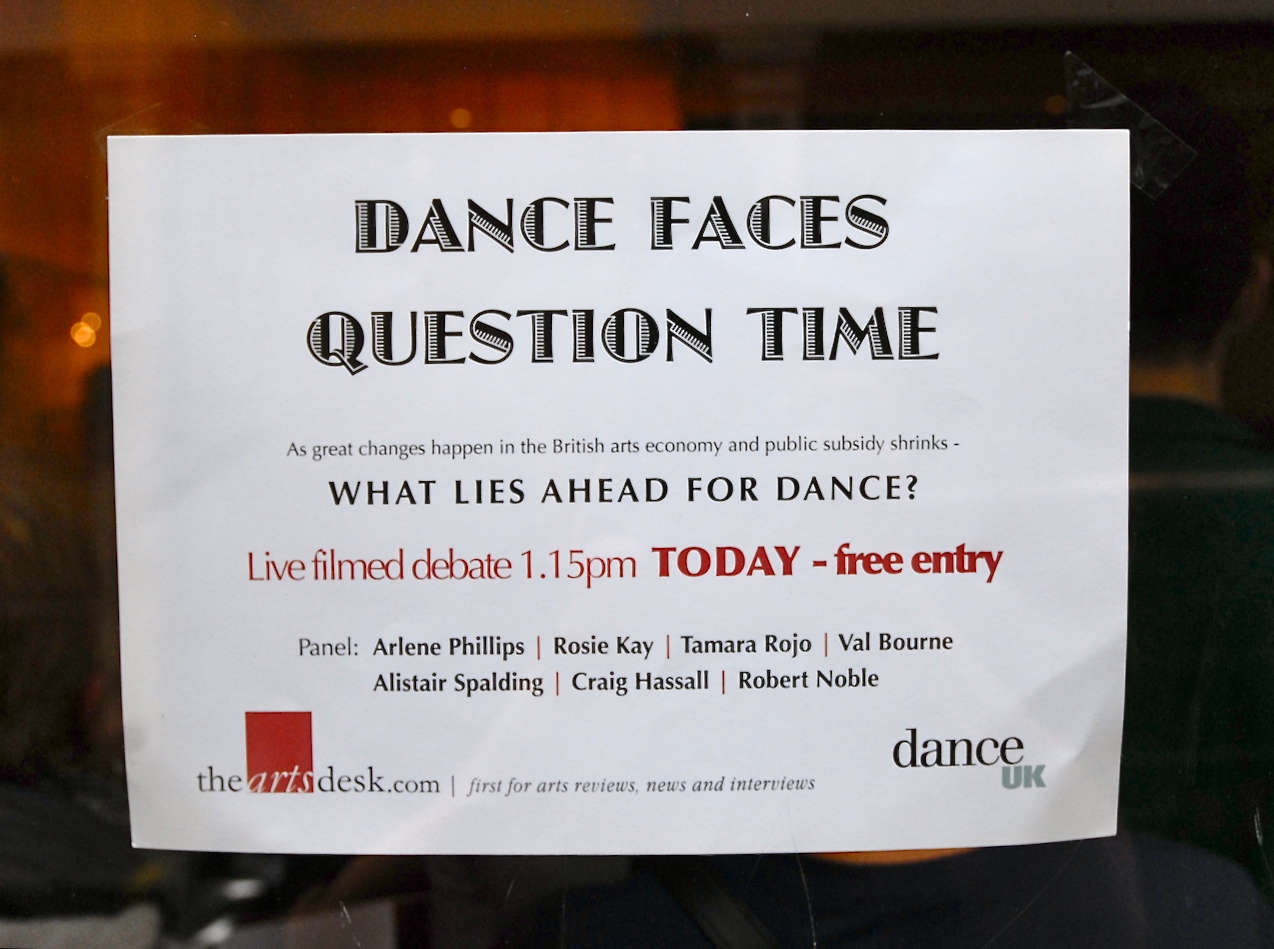 Royal Ballet ballerina Tamara Rojo and English National Ballet's managing director Craig Hassall led the ballet troops, choreographer Rosie Kay and Val Bourne, founder of Dance Umbrella, headed the contemporary dance brigade, Alistair Spalding, chief executive of Sadler's Wells, and Robert Noble, deputy managing director of Cameron Mackintosh Ltd and co-director of New Adventures, represented management and dance-theatre interests, TV celebrity and choreographer Arlene Phillips and Caroline Miller, director of the lobby group Dance UK, spoke up for West End and freelance dancers. The debate was chaired by theartsdesk's Ismene Brown.
During an 80-minute discussion - the second artsdesk debate - there was unanimous consensus that dance's value was massively understated, and that dance had to make a better case to get this across to the public and politicians. Major points were that schools should not cut dance from their curriculum, that dance would have to unite its different strands or it risked being left behind by other, more coherent art forms, and that to win attention might even entail a march on Westminster. It was also revealed that MPs are hunting around for dance teachers to help them survive charity events without humiliation.
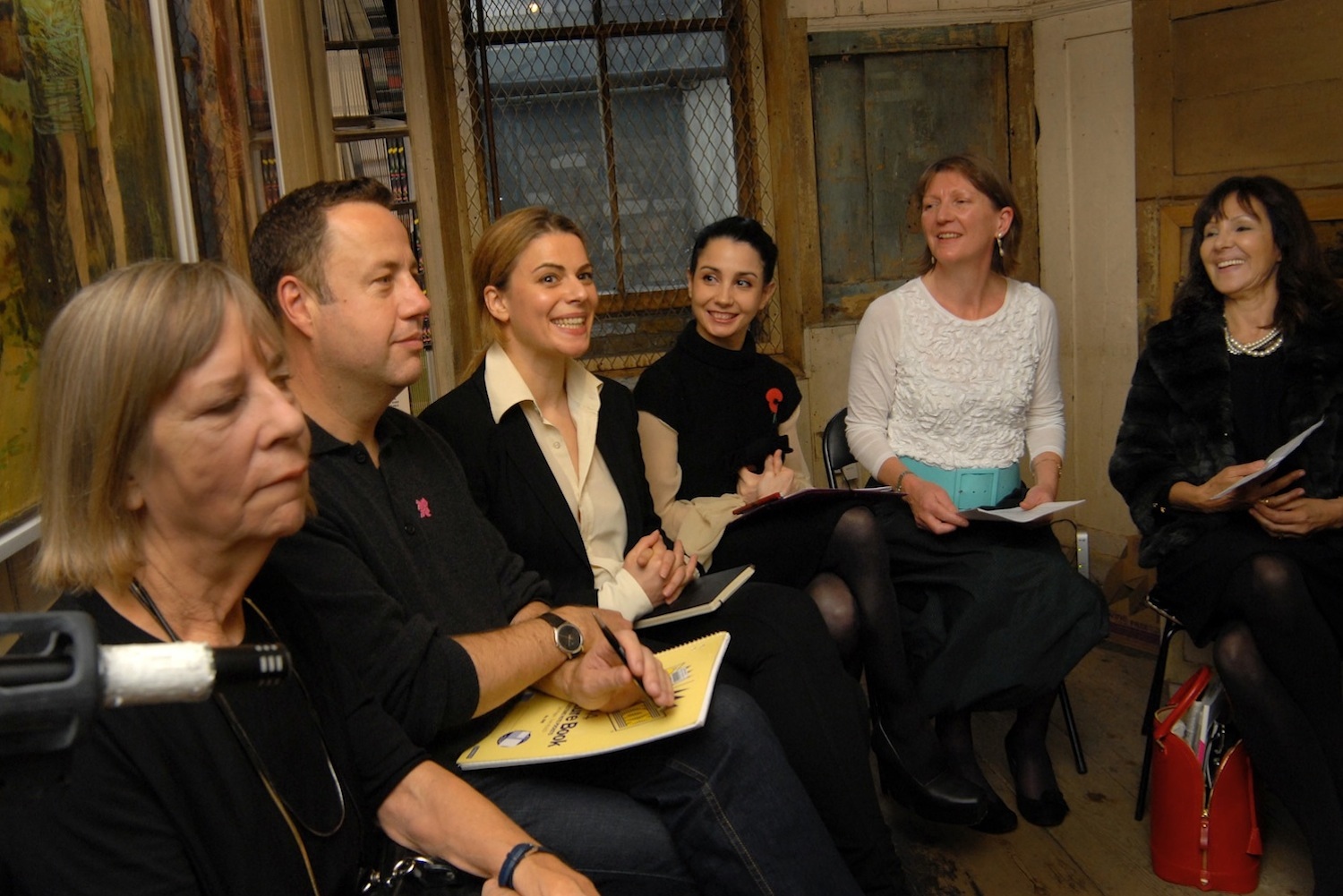
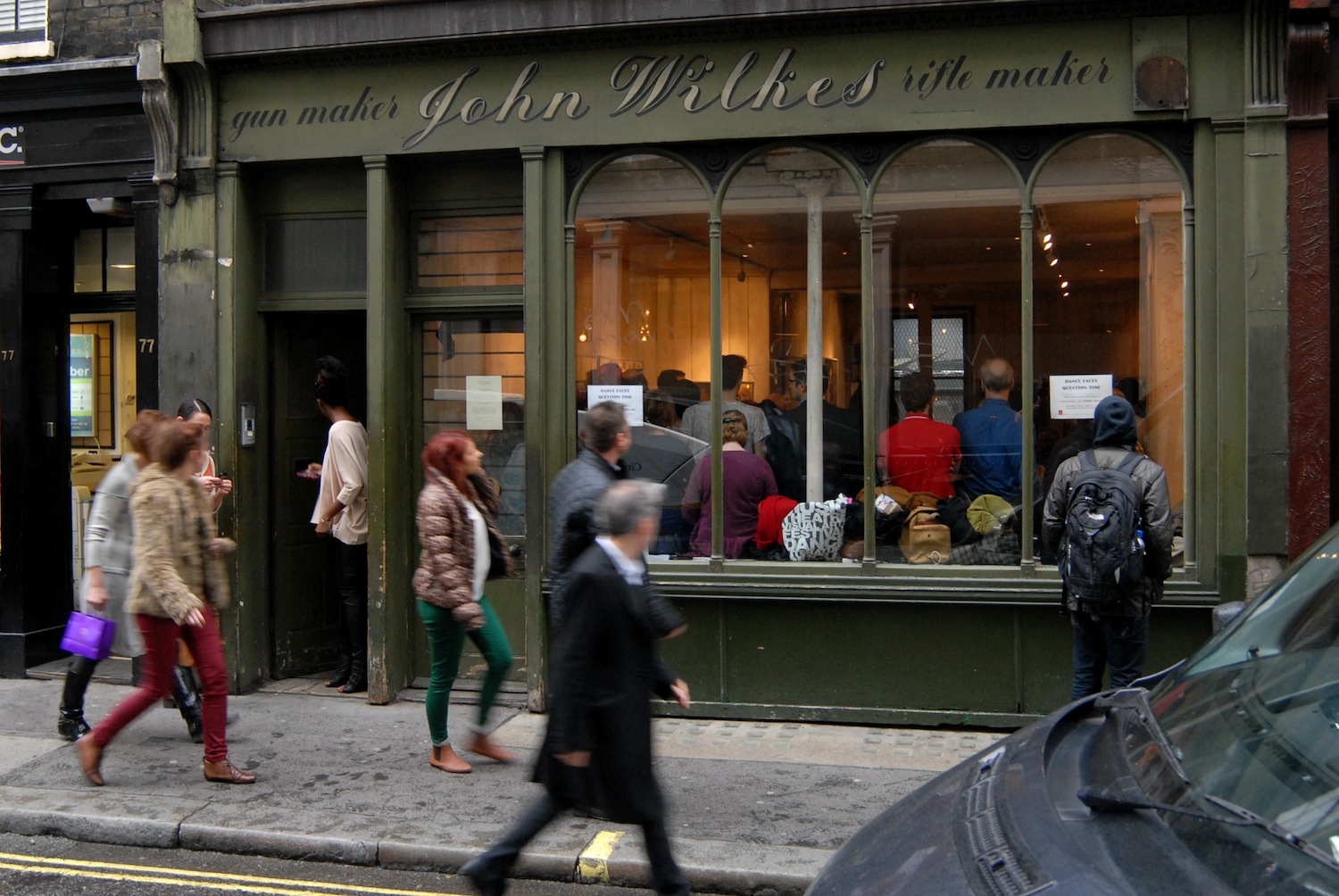
You can watch here the video of the debate, which was held in the Riflemaker Gallery in Soho, or read the edited transcript of it below, with corresponding time checks in the tape marked for each new question. Seated from left to right are Val Bourne, Craig Hassall, Rosie Kay, Tamara Rojo, Ismene Brown (chair), Arlene Phillips, Alistair Spalding, Robert Noble and Caroline Miller.
Watch a video of the debate
Ismene Brown: Thank you all for coming to this live debate, Dance Faces Question Time, in which we hope to air the big worries and issues and perhaps opportunities that lie ahead for dance in the time of cuts in public spending for arts. Questions about what we will be watching, what we’re prepared to pay for, what we would like to see, how we maintain the fabric of the dance required to give us the pleasure that we take. The calibre of the panel says how urgently this discussion is needed. Every interest is represented here from performance to management, from independent choreography to West End commercial and the big ballet companies... Could I have the first question please?
[01.55] Jeanette Siddall (former director of dance at Arts Council England): Every member of the panel has made a real and positive difference for dance. If they could be granted one wish today, what would it be?
Val Bourne: Only one? I woke up one morning a few years ago and heard on the radio that suddenly all galleries and museums were going to be free because the public had the right to the works of art, and I thought, damn, why can’t they have equal access to the performing arts? Now I am retired I can’t afford to go to see things. It’s going too far to say it should be free, but it should be affordable. People have got close, like Alistair did at Sadler’s Wells, and the Jerwood Foundation started Prom events and people got in to stand for £5, and it enabled all sorts of people who’d never been there to go. That was a fantastic initiative.
Craig Hassall: At the risk of sounding like Oprah Winfrey, it would be good if dance was reintegrated into the culture of our society. Dance is seen as an “elsewhere” art form. I don’t understand that, but it seems to be more in dance than any other art form. We all go to weddings and dance, we love dancing, so why is that? I work for a ballet company which is probably the most “elsewhere” art form, and we spend half our lives trying to make it affordable and accessible, all the things you say, Val. I wish it was more so.
Rosie Kay: My wish for the future generation of dancers is that we could abolish tuition fees. Where are risk-takers going to come from if you’re already going to be saddled with debt? Would talented people choose to go into the dance profession or is it only going to be the domain for the privileged? (Pictured below, from left: Val Bourne, Craig Hassall, Rosie Kay, Tamara Rojo, Ismene Brown and Arlene Phillips.)
Tamara Rojo: I wish that the National Institute of Dance Medicine and Science that has just started would become the one stop for anybody in dance to go to for rehabilitation, prevention of injuries, to do really good research and provide all kinds of support systems that dancers don’t have today from the health perspective.
Arlene Phillips: I would like there to be an understanding that dance develops intellect, gives you an understanding of how your body works, but most important, makes you feel good. So I want every morning, every school in the UK to start to spend even as little as 10 minutes every day gathering kids together and dancing. For the future of this country it would be a huge help.
Ismene: Didn't Toyota do this before the start of the working day? All employees had to do an hour of exercising before they began their work.
Arlene: And in China. When I was at school, we used to do skipping in the morning on the field before classes.
Val: Oh, I hated that!
Arlene: Now they can dance to music!
Alistair Spalding: Rosie has beaten me to it. But even before tuition fees, I think there is a real threat to youngsters thinking of going into dance. There were grants to help people get to a CAT (Centre for Advanced Training) scheme and they’re dwindling again. We’ve seen already from some of those schemes how a great diversity of people from all sorts of social and ethnic backgrounds could get into dance. That’s going to stop happening and there will be just one kind of person who can go through, which doesn’t feed the wonderful diversity we have in dance today. So it’s that investment that I wish for.
My great wish is that dance is seen more seriously. In the commercial sector dance is still seen as the lowest rung of the ladder
Robert Noble: Following on what Craig said, my great wish is that dance is seen more seriously. In the commercial sector dance is still seen as the lowest rung of the ladder. It’s depressing that people don’t understand that the mastery of a choreographer starts with a clean piece of paper - it’s not like writing a play down and then directing it. We as the dance community have to look at ourselves and ask why dance is still regarded as slightly lower than other performing arts. As someone who came very much more from a theatre background into commercial theatre, and came into dance slightly later in my career in terms of working with Matthew Bourne, I am staggered at how we’re not seen as one of the major forms. We know it’s one of the fastest-growing art forms but why are we not getting that across?
Ismene: Does anyone in the audience have an idea why it hasn’t got that status?
Audience woman: I think for the lay person who doesn’t encounter dance in any way other than social dance, there’s a real divorce between their mind and their body. There’s a real fear of looking stupid in front of other people that needs addressing, and through doing more of this in school and having access and exposure through getting free tickets to see dance, that fear will gradually come down, and we may go back to something more like Louis XIV’s time when dance was seen as a natural part of culture.
Ismene: Perhaps it’s a British disease. Caroline, what’s your wish?
Caroline Miller: I’m cheating a bit. This is a real fairy godmother wish. It’s that dancers should have better pay. If they had better pay, we wouldn’t have to worry about things like the National Institute because they could pay for the classes and physio and preventative support that they need. I’m a fairy godmother and everybody is earning at least 30,000 a year! [Laughter]
Val: But then you’d have to pay back your tuition fees!
[10:10] Ismene: This feeds into our next question, which was sent in by a choreographer, Simon Ellis, who’s working away from London today. “How can the value of dance be recognised and communicated without always focusing on its fiscal worth and economic cost?” Because actually all your wishes have involved wholehearted acceptance that dance can’t exist without it.
Val: I think as this group of people here today we can see that dance isn’t just contemporary dance, it’s ballet and commercial dance. I went to a meeting at the Young Vic three or four years ago about cuts, mostly about theatre cuts. And it was quite extraordinary to me that the room was full of people from the National Theatre, the Royal Shakespeare Company, everybody, who all stood up for the Gate Theatre and the Lemon Tree and the small theatres. We need to work together, because together we are a very strong body of people and I think it’s been too fractured.
There is no shame in saying dance makes money for society. We make society richer both culturally and economically
Tamara: I don’t think anyone is questioning the value of dance. We have to be pragmatic - everything is being cut, not just dance. It’s not that dance was singled out, but it’s probably the one that will cost the least votes. If they cut health, education and defence, how can they not cut dance? So we shouldn’t hide away from using the fact that we are also economically valuable. It is another of our strengths. There is no shame in saying we make money for society. We make society richer both culturally and economically. Particularly for this government that is so concerned with our happiness!
Audience woman: Dance is a preventative activity too for the health of the country. It prevents problems of mental and physical health.
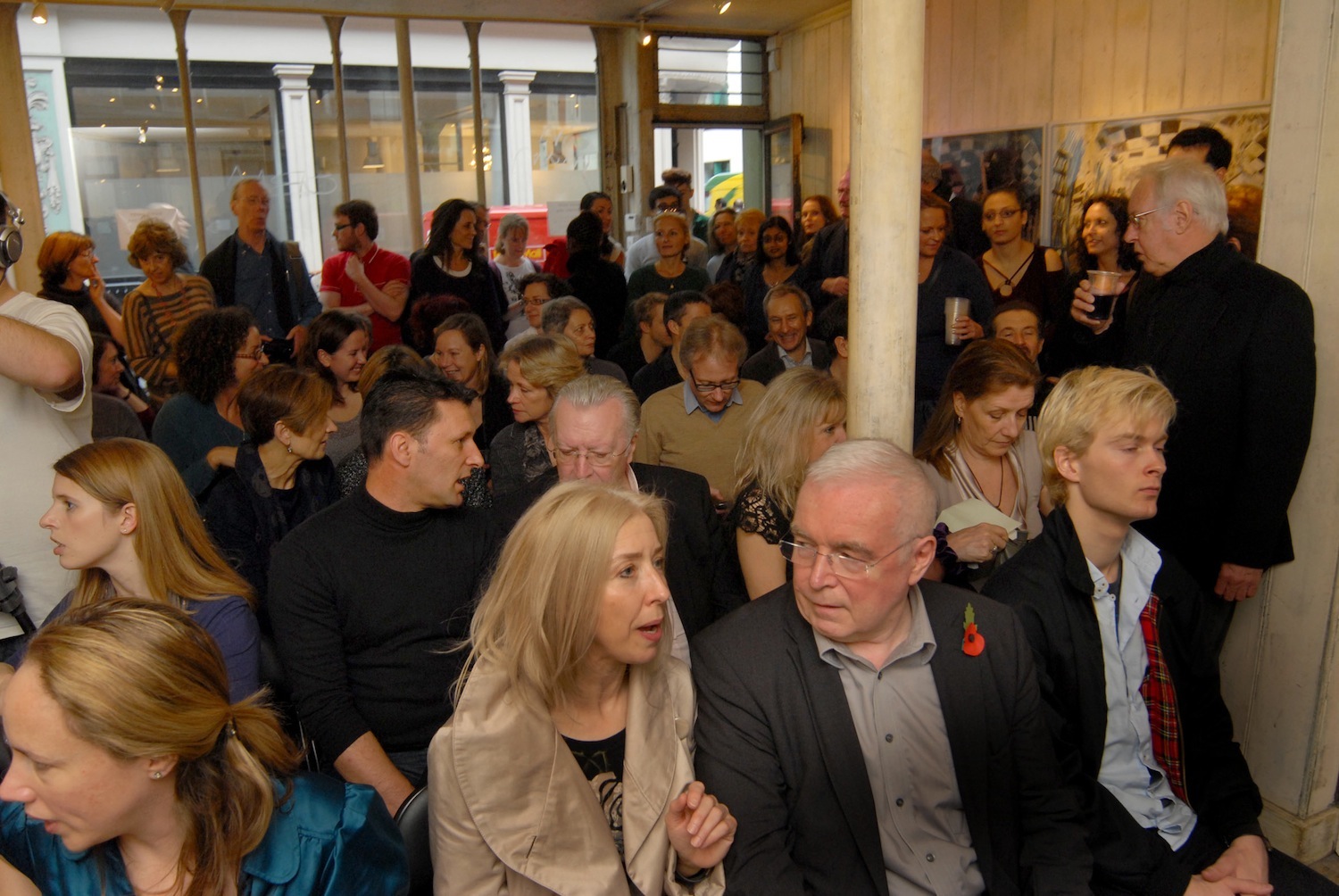 Audience (Martha Oakes, dance PR): I agree with Tamara that it isn’t the time to say dance should be exempt from cuts. I also agree with Val that we are stronger when we are together, and Dance UK has done sterling work in getting us together. I think we should continue on the path we’re on here and make sure we are as ready as we can be when times get better - because they will - so that we are well placed and well organised to receive and do well with the money that is available. (Audience pictured above before the debate began.)
Craig: And I think we are actually more together as a sector than some other sectors. Artistically I don’t think we’re vying for the same audience so it’s not either/or. And Big Dance 2012 is a demonstration of how dance is a very unifying thing for society - I wouldn’t say the same thing is possible for opera or even theatre.
Arlene: Dance globally is one of the biggest activities the world has ever known. I agree with Val. Dance is fractured because there are so many different forms. It feels like everybody has a tiny little piece of the pie, but actually the pie is enormous. Somehow there has to be a way of understanding that not just in the UK, but worldwide dance is as big as, if not bigger than, football... I’ve just come back from America where they have these huge dance conventions. And the sums of money that are being made from dance conventions, I’m telling you, could keep English National afloat. This is just what happens there over the summer! So in terms of money, I don’t think we’re looking well enough at ways to use dance to propel fortunes to where we need it. Because the sums of money being generated by dance elsewhere are phenomenal.
[16:50] Ismene: The next question is about blue-skies thinking.
Sarah Lanzon (dancer): What would happen to dance if it was left to private patronage and public taste, rather than arts funders and media commentators?
Ismene: Robert, you are in the commercial sector...
Robert: It’s a difficult one to answer, because I’m not sure that situation would ever happen here. Even though Matthew Bourne has to be commercially savvy, nonetheless we need public subsidy to create the pieces. Most of them can then be delivered to the public without subsidy once created. It’s a slightly difficult one to answer... Craig might be able to answer better than me what would happen to ballet companies if you had to live on private patronage alone.
Craig: If you go towards the model you’re talking about, which is little or no public funding, private support, reliance on the box office, you’re talking about the model that exists in the United States where they have tremendous patronage from foundations, trusts, individuals, corporations, and successful box-office seasons. But the major difference is the tax breaks. The tax situation is completely different here. If that’s the way the Government is sending us, then they have to follow up with tax breaks that support philanthropy in a really serious way, rather than a nod to it.
Ismene: Alistair, how would Sadler’s Wells work if you had to give up subsidy entirely?
Right now we’re not seeing the effect but in 10 years' time there is going to be less talent around for me to present
Alistair: It would look a totally different programme, no doubt about it. We have to cross-subsidise the things that do need it with the more commercially successful things. And the point is that some things do need subsidy, they always will do, and they should have a subsidy. Because as well as paying for things which are never going to get their money back in terms of the number of people on stage, the orchestras, and so on, it’s also very important to invest in the young companies, the people at the beginning. Matthew Bourne, for instance, was getting grants from the Arts Council when he started out, and got a grant to go to Laban. So these subsidies are investments and they should be at the beginning. Not everybody becomes Matthew Bourne, but when they do, they start to feed back. For him it’s a semi-commercial situation. So it’s all about beginnings. And that’s another worry I have. Right now we’re not seeing the effect but in 10 years' time there is going to be less talent around for me to present. And the whole thing is going to be in jeopardy. So we must ensure we can support the young companies and that they’re feeding us.
Ismene: Rosie, as a choreographer, how would your company work without public subsidy to rely on?
Rosie: I always think I’d dance alone in an empty room and make up dances! It’s so integral to my way of assimilating the world. I think as a young person running a company today you’ve got to be very entrepreneurial. We’ve gone from art-houses with a serious piece of work, to large-scale productions on a railway, little bespoke corporate pieces, working in digital arts - I’m constantly striving to think of new ideas that aren’t about “selling” but about connecting with different people, who might offer money in different ways. Whatever the situation is you want to create in, you’ll find a way to be entrepreneurial about it.
Ismene: Val, Dance Umbrella could never have come into being without public subsidy, both in this country and actually abroad too.
Val: No, it couldn’t at that time. When we started the subsidy was not large, we’re talking about £5,000 here and £5,000 there. It was, I have to say, tremendously exciting. That’s why I do feel rather like Rosie, that it will go on, but subsidy made it happen much faster.
Ismene: Has subsidy made the work better? Higher quality and more creative, more radical, more fun for the audience? Or has it set traps?
People pay all that money for football because they know what they’re getting. If you go to a piece of contemporary dance you don’t know what you’re going to see
Val: It’s made it much more accessible for many more people. Otherwise it would just be in a small room performing to your friends, which is really not the object of the exercise. But then you get somebody like Trisha Brown who decided to take it into the open air and do it on the rooves of New York. She said it was pretty desperate, she wouldn’t have done it if they’d let her into the theatre! It wasn’t a choice! [Laughter] I just have a horrible feeling we’d end up with a whole lot of competitions or dance marathons or something. Since I’ve retired I see more daytime television than I should, and I’ve realised how formulaic things are now, you get Masterchef, and Junior Masterchef, and Celebrity Masterchef, and so on. You think, NO, this is not creative... It’s an advantage of dance over sport that we’re not competitive, but then people do pay all that money for football or rugby because they know what they’re getting: one of the teams will win. If you go see a piece of contemporary dance you don’t know what you’re going to see. That, for me, is the excitement but for a lot of people who are spending a lot of money, they want a sure thing.
Ismene: Does anyone in the room want to put up an argument for dance without subsidy?
Audience man: I’m not from the world of dance, but is there a substratum of people doing it for the sake of it, not subsidised, in some back room somewhere? Are there people just out there on their own?
The truth is, corporations and private funders don’t want to take risks. They want to take their friends to a very safe show that ends well!
Tamara: Yes, there are but the amount of people who access that work is extremely limited. I think it’s a very dangerous path to take - I agree with Alistair. The truth is, corporations and private funders don’t want to take risks. They want to take their friends to a very safe show that ends well! [Laughter] And which is not going to offend anybody, and is a great celebration of their year’s economic success. In America this has translated, in my opinion, into the death of artistic creation, there is no risk-taking in the ballet companies, there is nothing being created of any significance. There is only Sleeping Beauty, Swan Lake, Romeo and Juliet. Now I love these ballets, I do them all the time myself. But unless we invest in the new unknowns, there will be no future Romeo and Juliets, there will be no future Swan Lakes, there will be no future for the art. [Applause]
Audience (Johan Christensen, dancer): I’d like to say that Peter Schaufuss lost all his funding a year ago. He runs his company entirely without subsidy, which is all production-based, which leaves dancers to stay in shape themselves - a question which comes later. So it is possible.
Tamara: But to be honest, what he pays you is indecent…
You try to make sure you don’t exploit your dancers, but how else are you going to get a good idea off the ground?
Rosie: There’s an interesting point here. When I started, I was making work maybe with only the promise of performance. When you start you draw in your friends, you beg for space, you do work in an entirely unsubsidised way. You have to go through various gateways as a contemporary choreographer - something like Choreodrome I think is verging on exploitation, because you have to ask your dancers to work for free. You try to make sure you don’t exploit them, but how else are you going to get a good idea off the ground to show to someone who might believe in you, who might produce you, who might take you to the stage? You’re constantly playing a balancing act till hopefully you get to the stage where you can say, no, I will never take advantage of anyone ever again, I will only do work where I’m paying my dancers properly.
Robert: I think that happens in small theatres too: if a production has no funding, often the actors don’t get paid. It’s happening in other performing art forms too. In terms of my own experience, I think 10 or 20 years ago the dance world was the most protectionist, horrible place one could possibly work in. There was actually very little support among the dance fraternity. I cannot tell you how I think dance was very inward-looking - if you were in any way bringing in big audiences to dance, that was pooh-poohed.
I don’t think it’s all about pay - it’s about the dance fraternity coming together and making a very strong case. Theatre did that five years ago. Visual arts did it five years ago
What has been very positive over the past 10 years is things like what Alistair has done at Sadler’s Wells to create a real dance house, and raising and enhancing its profile. And guys, if we’re going to get the support from trusts and foundations to help improve the very base of dance, I’m afraid I don’t think it’s all about pay - it’s about the dance fraternity coming together and saying, "Now we must make a very strong case." Theatre did that five years ago. Visual arts did it five years ago, when, as the lady in the audience said, we had good times. But unless we as a group of people are very clear about what we’re doing in terms of dance, I tell you now, I feel very strongly that theatre and the other art forms will be walking all over us.
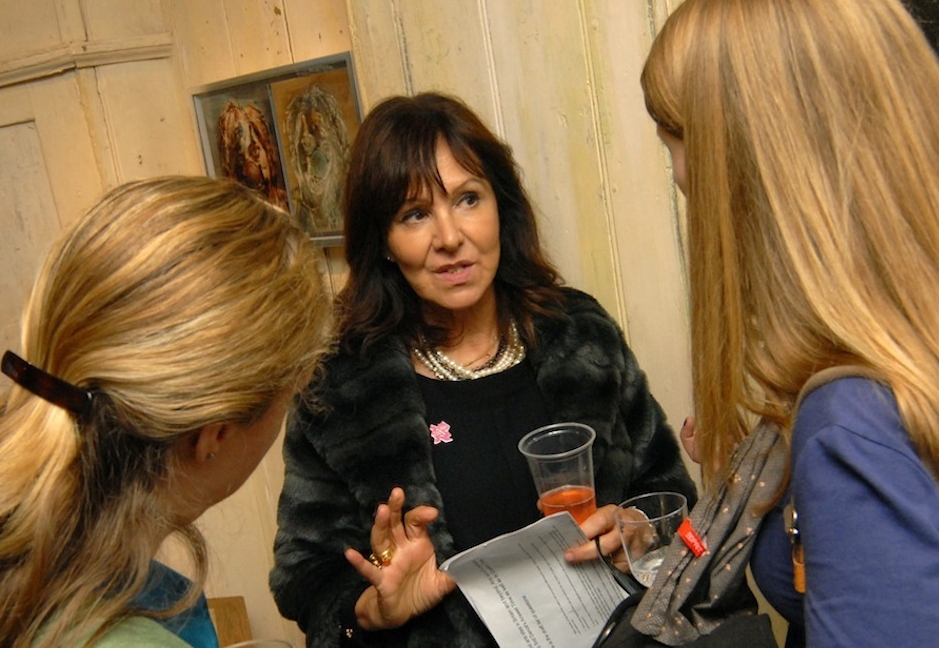 Arlene: But dancers, in terms of pay, are the lowest. I agree with Caroline. You are talking about indecent pay. I know what dancers are expected to do that no musician is expected to do. They’re expected to do charities, to do galas, they’re expected to rehearse for it, go here and there, everything. Of course, every dancer in the West End thinks they’re so fortunate that Equity has given them a wage they can live on. Well, they can live on it if they live in Ilford and take the bus home after the show every night. But they can’t live in the West End or run a car. (Pictured left, Arlene Phillips talking with audience members after the debate.)
Robert: I agree with you on all of that, Arlene. But I’m saying that generally as a group unless we get together to fight on some of these issues together, you’ll never change what’s going on at the experimental level or where young choreographers are beginning. Matthew Bourne is putting together a fund of £15,000 to support a young choreographer award - there ought to be more of that going on. And we are not as a group coming together enough to fight on all these issues - I think the other art forms are doing it better.
Caroline: Can I say something about public taste? We might come off better than we think. Arlene was telling me about an appalling situation this morning of the line-up of key figures to promote London Olympics 2012, where there was only one dance name, but five or six film, theatre and so on. Yet look at public votes in TV primetime shows: what do they choose? Again and again, it’s the dance act they choose. Kate Prince, who’s the director of ZooNation, sent Ismene and me an email saying, "Why isn’t hip hop on the panel?" Maybe she’s right. Maybe we’ll find that in a few years' time, we’ll have a prime minister who has a thing about hip hop. They won’t have Oasis and Blur and rock-concert things at 10 Downing Street receptions, maybe it will be street dance.
Audience man: I’m a contemporary dancer, and I’m not interested in hip hop. Do I have to do hip hop because that’s the thing that’s in now, when my own passion for contemporary isn’t being put forward and supported?
[36:30] Ismene: That’s a very good question, it is very germane to the range of dance we all want. Here is a new question. It’s been emailed in by a blogger whom many of you will know, Emilia Spitz of theballetbag. She takes issue with what we were discussing earlier: “The big UK ballet companies seem increasingly reliant on reviving ‘best-sellers’ or producing ‘family-friendly’ works, despite the fact that they get public subsidy. Conversely, in the US where dance companies are privately funded, there seems to be more appetite for risky new creations right now. Is ballet is dying in the UK?”
Craig: Oh, can I please answer that? [Laughter] First of all, can I apologise for putting on shows that people want to see? I’m really sorry that Strictly Gershwin is selling out. It’s got tap and salsa and ballroom and lots of ballet. It’s a crime. But we put on a Roland Petit season which will play to 25 per cent - it’s fantastic, and you’ll never see works like this on a London stage, but we almost can’t give it away.
But a bit like Alistair, we have a mixed ecology - we have to balance our Strictly Gershwin with our Roland Petits and Manons, and over the year the finances just about work out. This is a very ENB view, but I have no problem with doing ballets that are popular. I don’t understand why that’s a pejorative. A popular work can be done excellently. Peter Farmer, who’s a ballet designer, said to me, “It’s funny, people ask why do you do Swan Lake over and over again?” I said, “Because it’s a very good ballet.” That’s the answer. And if it’s danced well, it’s a wonderful night in the theatre. It goes back to the ecology point of Robert’s - we all do what we do in the dance ecosystem.
New York City Ballet lamented that the Balanchine legacy doesn't really pay. They do Swan Lake and Nutcracker which sell out - it’s almost a dirty little secret
But just to answer the American point, I’ve just been over there asking American Ballet Theatre and New York City Ballet and San Francisco Ballet how they manage in terms of engaging dancers and orchestras with no government funding, which is where we are heading in this country. And it wasn’t a rosy picture at all artistically. New York City Ballet lamented that they are the keepers of the Balanchine legacy, and it doesn’t really pay. Financially it is difficult to sell. They do Swan Lake and Nutcracker which sell out - it’s almost a dirty little secret that they do these ballets because they make money for them. And they don’t have the cushion that we have of government support that allows us to take risks. In our world Roland Petit is risky but the risk-taking is fundamental to the funding ecology and you can’t separate the two. The American model is not an aspiration.
Ismene: It may be a temporary blessing that they happen to have had the choreographers Alexei Ratmansky and Christopher Wheeldon resident there. Tamara, you are a member of the best-funded ballet company in Britain, one of the best-funded in the world. Should it be part of its duties that it advances ballet creation rather than constantly grooming an audience that is almost entirely raised on classics? Great as they are, it is like only reading Dickens or Austen.
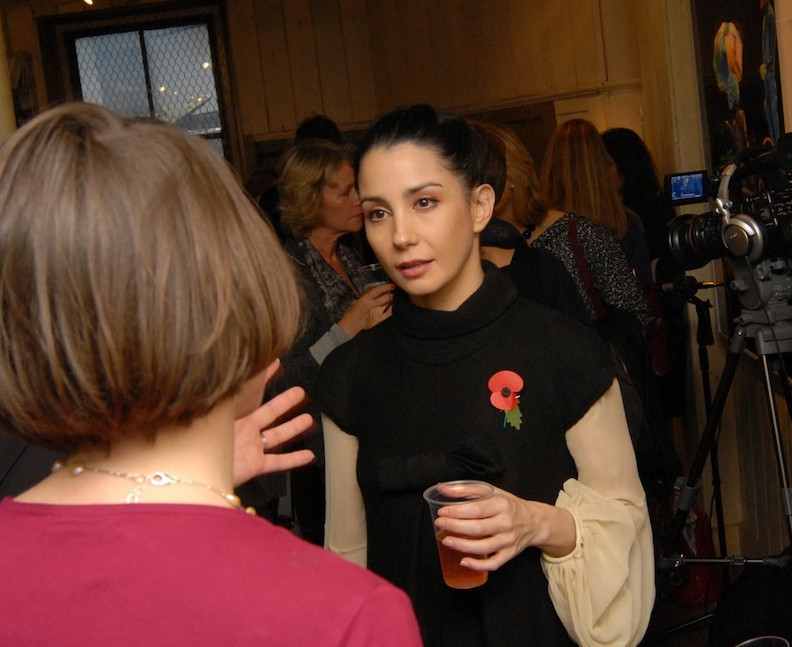 Tamara: I agree with Craig that these are very great works. They survived for very good reasons and the audience goes to see them for very good reasons. However, it is my personal view that if you have that funding cushion you ought to take risks. But really it is entirely in the hands of the artistic direction. The Government can’t tell companies how to spend their money. It is an artistic decision of the director, who has to answer for the programming...
Can I say that the two choreographers you mention, Wheeldon and Ratmansky, are not exactly risky - they are very good choreographers, but they are traditionally based in classical ballet. Whereas at the Royal Ballet we have two in Liam Scarlett and Wayne McGregor, Liam who is really new and is doing his second piece this season, and Wayne who is actually not from the classical tradition. So we are, to be honest, a lot more risk-taking than America, but then we ought to be. (Pictured above, Tamara Rojo talking with audience members after the debate.)
Ismene: Does anybody in the audience think ballet ought to be doing more work that might risk an audience not turning up? [Several hands go up] Craig, take note!
Arlene: How can you ever say an audience won’t turn up? Having watched Wayne since he was first starting, even I could not have believed the joy I get from seeing his work now at the Royal Ballet. And there are extraordinary experimental choreographers who need a wider platform, and with whom people will fall in love.
Ismene: Alistair, when you put on ballet at Sadler’s Wells, do you feel you’re betraying your ethos to represent more contemporary work?
Alistair: In our programming we tend to stay away from the 19th-century repertoire, which others are doing enough of. So we tend to be trying to tell the other side of the story, that there are good 20th-century works too. My personal opinion is that there is a bit of crisis, not to do necessarily with funding - that the ballet world should looking at what goes on within it, in order to make sure that there are more than just Chris Wheeldon and Liam Scarlett, that there are many people making new exciting ballet, because in the end that does translate into good box office. It just seems like there isn’t the excitement coming from within ballet’s own ranks.
[44:45] Ismene: Next question - which is about regionalism.
Corinna Chute (dance teacher in Berkhamsted): Many towns and cities are cutting their culture budgets but the Arts Council and politicians seem to be wanting to pass the arts back to the regions. Looking ahead five years, will it be better if dance becomes less London-dominated?
Val: Well, I think there’s something to be said for a critical mass. I think that’s why New York and Paris and London are arts hubs. It creates a good atmosphere, a competitive sense, a fertility. Having said that, I’m worried about it, it’s a bit like the NHS. The Government passes the buck to the regions and says, it’s nothing to do with us now. That’s happened with many theatres, too, which have been subjected to savage cuts. The Government says, "Oh, we didn’t do that." But they did really.
Rosie: I’m lucky, because in Birmingham we have a real dance community. We have the Hippodrome, the DanceXchange, Birmingham Royal Ballet, quite a few independent companies, it’s a small ecosystem there. I love London and I trained there, it’s a great place to go and see work, but in terms of nurturing and long-term development and being able to experiment with work, I felt it was the right decision to be based outside the capital. The same kind of thing is going on in Leeds, and Newcastle. There are a lot of good choreographers based outside, and in terms of that quiet development it worked for me.
Ismene: But you are heavily dependent on your civic authority supporting you. Look at Manchester and Doncaster and so on, making massive culture spending cuts. How can you be sure that in five years' time DanceXchange will still be there?
Rosie: Yes, you are at the bottom of the food chain. I rely on DanceXchange which relies on the Arts Council who rely on the city council which relies on the Government, all these partnerships. But I look abroad at how things are, and I think remaining independent and quite light of foot is the way to go.
Ismene: Robert, as part of the London hegemony, how do you feel about dance pushing out into the regions away from London?
The disaster when the Arts Council moved control into regional offices was the diminution of the calibre of the conversation you had
Robert: What was the big disaster when the Arts Council moved control into regional offices was the loss of the national picture, it wasn’t about being London-centric. If you went to talk to an arts officer in Dewsbury, West Yorkshire, for instance, the calibre of the conversation you had with the office was diminished. I’m not being rude about Dewsbury, I used to live there, but it’s about the diminution of view that can result from regionalism. There have been some major regional achievements like the Wales Millennium Centre and the Birmingham Hippodrome development, but we must never lose the national picture, and I think dance has suffered because of that. Though a lot of other art forms have too.
Ismene: Alistair, at Sadler’s Wells, when you’re fighting for audiences for something that’s hard to sell, do you feel in competition with cities developing dance? Or are they helping you build your audience?
Alistair: No, I think we all feel calmer about competition, even in London. There was a survey done about five years ago which found that only 15 per cent of the people who go to the Barbican to see dance come to Sadler’s Wells. People tend to go to a venue and stay loyal to it. Touring went off the agenda for quite a while, but there is now some money back in the arts budget for touring. Because if we are to use London as a hub, work should be going outside for people to see it. There needs to be a network of cities that are vibrant and thriving, where the audience exists and they and the artists feel like something is happening there. You don’t want to play to a studio with only 10 people in it.
Val: Companies are currently being actively discouraged from touring at the moment. Rambert, a flagship touring company that the national taxpayer is paying to see, has lost six weeks touring this year.
Ismene: Craig, it’s been suggested, not least by me, that ENB should become a regionally based touring company. Is it possible that in five years' time the regions would have enough audience and interest to sustain this?
Three weeks of Sleeping Beauty in London will pay for the loss on four weeks of doing Beauty outside London
Craig: The regions are very interested in having us tour more but it comes down to economics, not interest. The way we construct our finances is that half a week of Nutcracker at the Coliseum will fund the deficit on a 10-week mid-scale tour of a collaboration with a streetdance company for next spring. That’s a real example. So I’m relying on half a week of Nutcracker to pay for that loss on this regional tour. If I don’t do Nutcracker, I couldn’t do the other. Another example: three weeks of Sleeping Beauty in London will pay for the loss on four weeks of doing Beauty outside London. We will lose £100-150,000 per week doing Beauty outside London, since ballet is really expensive, a lot of people on stage, a lot of people in the pit, the lorries to carry it all about, and so on. Also our support base is here in London for fundraising. We try to raise money outside, but in terms of donors the money is in London.
Ismene: One reason why people perceive dance as being so London-dominated, and particularly ballet, is that the Royal Ballet doesn’t tour at all. Tamara?
Tamara: To be honest, I don’t see it as a bad thing. I think there is Northern Ballet Theatre, Birmingham Royal Ballet, English National Ballet and Scottish Ballet all touring, and they do a very good job of it, and I don’t think they would be very happy…
Craig: We wouldn’t be very happy. [Laughter]
Tamara: I think there is a market for each company. And there is an economic reason why we are always here in London at the Royal Opera House. We make a lot of money for it. There is a reason why we do 140 shows a year in the Opera House of 14 different programmes. We need to do all those shows there.
Arlene: But I remember standing outside the stage door in Manchester for the Royal Ballet when I was a small child. We would see all the Royal Ballet dancers, Nadia Nerina, Lynn Seymour. It was a thrill like nothing else because for some reason the names of the Royal Ballet dancers are out there in a special way. Even though I realise about setting up competition and all that, I think it would be incredible if the Royal Ballet could go to the cities - maybe not Birmingham or Leeds where there’s a direct competition, but there are places.
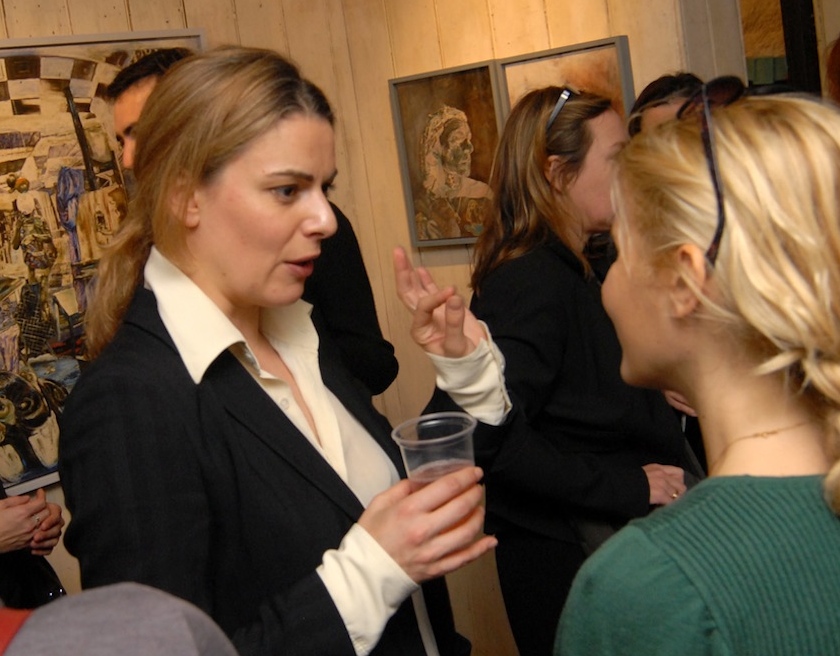 Rosie: I think it’s really important to tour. We’ve just done a two-year tour and how a piece goes down in London is completely different from how it goes down in South Shields - a load of soldiers turned up! It keeps your feet on the ground, it makes you look at your work differently, it makes your dancers look at it differently. (Pictured left, Rosie Kay talking with audience members after the debate.)
Tamara: We do tour, we do international tours. It is very important for the reputation of the country that the Royal Ballet goes abroad.
Val: Sadler’s Wells Ballet did once have a touring company and it became the “second” company. It’s much better that it’s Birmingham Royal Ballet.
[57:00] Ismene: We’ll have a new question which is about a practical problem, if dance lost its subsidy.
Johan Christensen (dancer with Peter Schaufuss ballet): If dance were left to the free market, how would professional dancers afford the vital daily classes and physio they need, even when they’re not working? Is some form of private insurance the only answer?
Caroline: Currently when it’s not a free market, dancers are not affording the daily class, they aren’t affording the daily physio, they aren’t affording the treatment. The problem with private insurance is that premiums are already skyrocketing and they don’t deal with any type of preventative treatment, and certainly not class. And that’s why we’re looking at some kind of national strategic intervention scheme, which is what Dance UK, Birmingham Royal Ballet, Trinity Laban, the University of Wolverhampton and the Royal National Orthopaedic Hospital have been trying to do in trying to get the National Institute of Dance Medicine and Science off the ground. This would be polyclinics all around the country where there are concentrations of dancers, potentially shared with the sports world so we’d have some kind of saving, which dancers could access whether they’re in a company or an independent dancer. But this is an expensive long-term goal. It would cost the equivalent of a gym membership monthly. I don’t think the free market is going to make it any easier.
A lot of dancers in England don’t do the warm-ups and the classes they need, and the cost of their rehabilitation to all the theatre managers is way, way above what it should be
Arlene: I think any scheme that helps dancers do what they do would be incredible, but I have to say I’ve worked a lot in America and the thing that shocks me there is that whether it’s for musical theatre or classical ballet companies, where you always start with class at 10am, at 9am all the dancers will be in doing their own class - preparing for class. I’ve worked a lot with Antonia Franceschi, one of my favourite dancers in the whole world, and she always does an hour-and-a-half class of her own before the main class. I know a lot of dancers in England, particularly in the commercial sector, don’t do the warm-ups and the classes they need, and the cost of their rehabilitation to all the theatre managers is way, way above what it should be, and in fact if they took class, that money could be well used to support dancers who really need it. I remember coming once to see Twyla Tharp’s company here at the Queen Elizabeth Hall, I think, and her dancers were doing a 10-hour day starting with class, and again they did their own class before class. And I was astonished at such a vast gap between the dancers I worked with and American dancers. It’s because they don’t have the money and nobody’s going to pay for them to go and get the rehabilitation if they’re not careful.
Rosie: A lot of contemporary companies like me are working on short-term contracts. Even those with full-time funding don’t pay their dancers full-time contracts, it would be project-based. So you do have to rely on your dancers keeping fit and training themselves outwith the work you do with them. You try and educate them, and they’re coming better educated now out of the conservatoires, they understand this need to really look after their bodies, and if you’re going to make demanding work you’ll give them extra training.
I have amazing dancers who work in milkshake bars because they offer the flexible hours to give them the time off to continue dancing
But this is a contradiction: it’s people like us who are supposed to make the experimental, cutting-edge work but we also have the least support, and the least ability to offer class and training. I have amazing dancers who work in milkshake bars because they offer the flexible hours and they can take time off to do the project work. It’s a tragedy to see these amazing artists who have to do anything in order to keep the freedom to continue to keep dancing.
Ismene: It is the basic building block of the entire dance industry, this daily class to stay good enough to work on a creation and then go on stage with it.
Audience (Corinna Chute): Being an ex-dancer and dance teacher, one priority I had was to set up a place where people could do all forms of dance and have all forms of therapy there. Now we’ve built a theatre with private funding, where we would like to start a charitable ballet company for out-of-work and resting dancers. I wish that in every town in the country there was a place where dancers can take morning class without money changing hands so that people with no work don’t have to struggle to keep classes going.
Tamara: To be honest, I am a very privileged dancer, because all my career I’ve been in companies that have been able to provide daily classes, good studios, good floors, good physio, rehabilitation. But I’m also very aware that there are lots of freelances who don’t have it. And when I choose to do classes outside, for any reason, I am aware how very expensive it is to take class every day in London. I don’t think there is a lack of commitment among British dancers, at least in the ballet world. We all see each other in private places taking extra classes to keep getting better.
In America you see that for the corps de ballet dancing has become almost a hobby because it’s not a job
I don’t know how I would cope as a freelance. I tried once to insure my legs, and it was impossible, it was an outrageous amount. I cannot afford private insurance. I don’t know how a person who is in and out of work can manage to maintain a level of fitness and excellence that they need for when they’re back to work. In America this model of being laid off and laid on is really not sustainable for ballet companies, because you see that for the corps de ballet it’s almost a hobby for them, it has become a hobby because it’s not a job - even a part-time hobby. Their job is probably selling houses, or something else where they make a living and ballet is what they love, but not their job any more.
Ismene: So it’s an attitude towards dance that is changing - that because dance isn’t built into essential life, therefore it’s a luxury, therefore you can do classes at your choice, and this feeds into the political will not to fund dance.
Tamara: Yes, they’re self-funding the art form. That’s why I say to you (to the dancer) that you are not supposed to self-fund other people’s businesses. It’s all very well for private entrepreneurs to want to produce art, but you are not supposed to fund that.
[1:07:05] Ismene: We'll take two more questions.
Clare Farrow (Dance Umbrella): Following Michael Gove’s remarks, is dance a soft option in regard to education?
What annoys me is how dance is often treated in education as a soft version of PE. Such a lame description
Craig: No, of course it’s not! What annoys me about the way dance is often treated in education is that it’s seen as a soft version of PE. Such a lame description. It’s the same thing that annoys me about how they talk of the “economic benefit” of dance - the number of hotel rooms we sell, the number of ice creams and so on. I know it’s valid, but it’s so much more than that.
Val: Caroline, you did some seminars three or four years ago at Sadler’s Wells about people who’d done dance and made successful careers that were not in dance now. Many people were making very successful careers in commercial theatre, teaching, opera, and so on. And I thought, there are a lot of people out there who are now making loads of money and having very successful careers, and I think dance training is a really good preparation for life.
Ismene: Robert, you came into dance management relatively late - what’s your impression of the difference you see in dance people and others in the theatre world? (Pictured below right, Alistair Spalding and Robert Noble talking with audience members after the debate.)
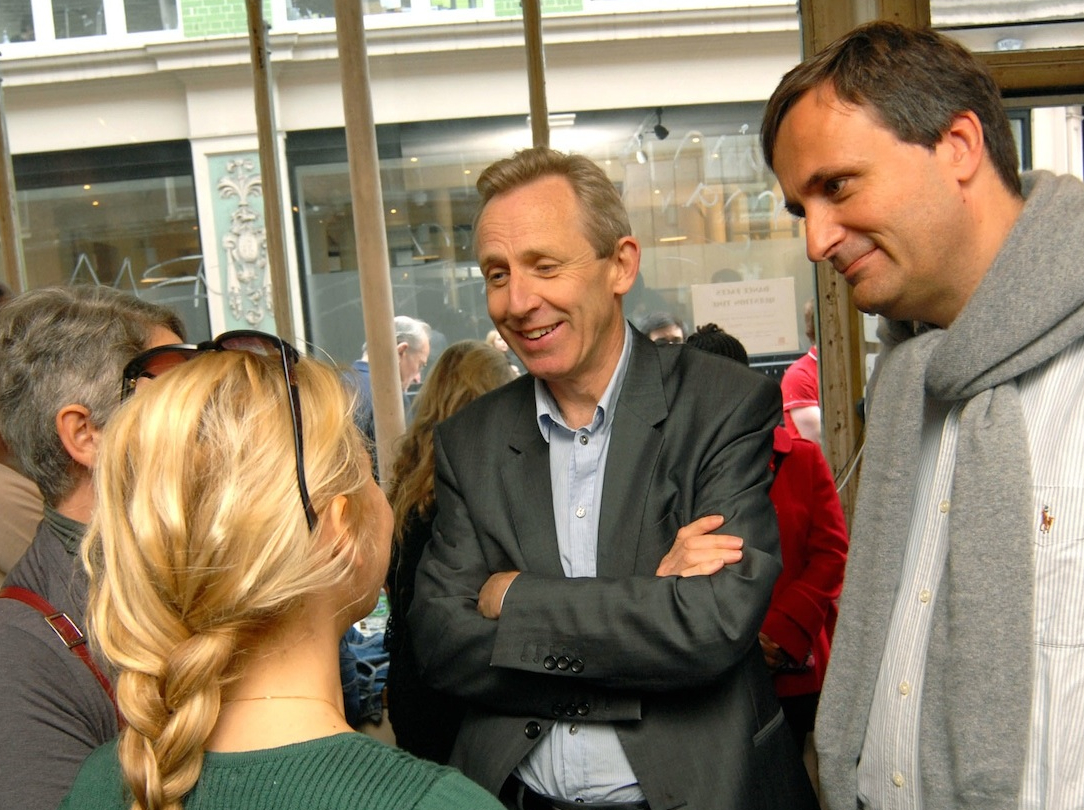 Robert: The longer I do it the more amazed I am by the professionalism, the integrity, the commitment and the talent of all the dancers I’ve ever been part of the management team employing, whether Matthew’s company or in some of Cameron’s major shows. I don’t believe that Ed Vaizey has the same view as Michael Gove, but I think unfortunately we have to work very hard at educating people. There are a lot of associates I have who do not really understand dance, and again it’s about us being very, very clear that dancers are as gifted and as brilliant as a Premier League footballer, though they may not be able to earn anything like as much money, and they have amazing skills and are normally much nicer people than Premier League footballers.
Arlene: I believe that dance develops the intellect. I think it is an intellectual pursuit. I disagree with it being downgraded. I look in schools and I see that what dance is helping is children with dyslexia, who can’t access right and left properly, or who can’t access the brain instantly. Dance will definitely help them to understand their bodies, send the messages how to remember and coordinate. One hundred per cent - dance needs to be considered a highly intellectual pursuit.
Tamara: I heard this story that there was a teacher who was running out of patience with this little girl who couldn’t learn anything, seemed out of control, and she told her mother to take her to the doctor, she was retarded. The doctor examined her ears and eyes, and then said to her mother, “I can’t see anything physically wrong, let’s go out and talk.” He put the radio on for the little girl while they went out, and they looked in and saw her dancing to the radio. The doctor said to the mother, “Madam, your little girl isn’t sick, she’s a dancer!” [Laughter] And this girl was Gillian Lynne! One of the most successful choreographers of the 20th century! So I think academic studies are all very well if you’re going to be academic, but they’re not going to create all the jobs of the future. They don’t encourage creativity and imagination, and arts education does. So I think Michael Gove is very narrow-minded.
Caroline: Let’s be clear about this. The department’s point is not just about professional dance training to become an artist. Their clear point is that you shouldn’t do dance A level if you want to do an academic degree. They are literally saying these poor children who want to be a scientist or do maths are being advised to make bad decisions like taking dance at A level. What this will mean is that schools will look at their league tables and their points, and they won’t invest in the dance department, for any child whether you want to be a dancer or not. I think it’s a very dangerous point we’re at.
As someone who interviews for sciences at Cambridge, I do want to see at least one other A level being something different
Audience (Prof Nicky Clayton): As Rambert Dance’s scientist-in-residence, but also a professor at Cambridge University, I sit on the admissions board for undergraduates applying to Clare College. I strongly disagree with Gove’s position as someone who interviews people coming in to read natural sciences at Cambridge. Actually what I look for is I want two science A levels, but I do want to see at least one other to be something different, because it shows a broader picture. When I was around doing A levels, sadly dance wasn’t around but I did the closest, which was music. And I found that actually music was one of the most challenging A levels. But what it did was help me think artistically, and help keep the movement part of my brain working, even though I was going down the path of science. And now look at me, I’m one of the luckiest women alive, because I can do both now. Life should be about multiple options.
[1.16.20] Ismene: Last question has come from Twitter: Considering the success of Occupy London, is it time for dance to occupy Westminster? Audience, let’s have a show of hands - do you think so?… Quite a few hands up there. Robert, let’s start with you.
Robert: I don’t think so! I go back to my previous point that there are many, many good things to say about dance, how we’ve moved on in the past 10 years, and we as a sector just have to be stronger in what we want and need, and be very, very vocal in that, in relation to the noise made by other art forms. And I think maybe in dance we rather talk to ourselves. So I wouldn’t go as far as marching. I think there are more subtle ways.
Arlene: A flashmob!
If it means physically moving into Westminster, why not? I mean, look at the publicity that event has generated
Alistair: Actually yeah, I think we should. I think what’s happening both in the Occupy movement, and generally at the moment, is that things are shifting, there is a sense of democracy happening... I think it is a moment where people can voice what they think, and the dance movement can say it now. And if we can have a collective voice that would be good. And if it means physically moving into Westminster, why not? I mean, look at the publicity that event has generated and people are actually really talking about the issue. You do have to do those extreme things sometimes. I just want to add: I hate camping!
Craig: You don’t have to sleep there!
Arlene: Dance in its widest, widest form has to make a noise. Right up at the door of Westminster because I cannot believe that they realise how much it means to so many people.
Ismene: Tamara, are you going to march on Westminster?
Tamara: Yeah! I’m not sure it would be a very efficient way to do it, but it certainly would make people talk, and that’s what we need. We need the attention of the wider community. And we need to the politicians to listen, because eventually they make the decisions.
Rosie: In a very strange coincidence, I’m getting married at St Paul’s in a month’s time! [Laughter] I agree with Alistair. I think there is a sea change now, a questioning of values, and particularly the supremacy of economic values, the little people taking the flak for the big people’s mistakes, and I think it’s really interesting that it’s put the Church in the middle of that and the questioning of morality. These are exciting times. The thing about dance is we have different value systems - we are not led by economics. We know about wellbeing, about mental and physical health, we are on the cusp of this time. So it’s not just marching on Westminster - we have got the right attitude, the right abilities, the desire to change for good. This is an exciting time.
Craig: Storm the barricades, sure! But I think we’re cleverer than that. We need to raise our profile in a unified way. We are potentially a very unified sector with a big, big voice. There are some really high-profile people like Arlene, Matthew Bourne, who can be amazing champions for our sector, if we do this cleverly and non-sensationally. Though a flashmob, seriously, I think would be a brilliant idea. We have manpower, national coverage, interesting stuff, we’re entertaining people, at the end of the day, so we have all the weaponry to make a really big voice if it’s done in a coordinated, clever way.
Val: Years ago I worked for the Arts Council and on my very first day a ballet company who were not being funded by the Arts Council chained themselves to the railings in their beautiful Peter Farmer-designed tutus. And they had a flyer saying, if you disagree with the Arts Council ring this number. And it was my number! They got great coverage and the Arts Council looked terrible. Peter Farmer went by on a bus, and he’d never been paid for the costumes! We need something colourful like that to capture the imagination.
If we occupy Westminster in terms of charming them, meeting them, talking to them, telling them, the little bits will come through. But it's a long game
Caroline: And in terms of occupying Westminster, I’d look at it differently. I got two emails today: one was that a member of the all-party dance group, Gordon Banks MP, had asked a question yesterday to [Culture Minister] Ed Vaizey, did the Government value dance within culture, and Ed Vaizey came back with an answer about how much it was worth to the economy - and he said, no, I mean about its cultural value, and what will you do about dancer injury prevention? And the second email was from Chris Heaton-Harris, a new Conservative MP, who’s had his arm twisted to sit on the all-party dance group, and he is in a charity Strictly Come Dancing thing that he was shitting himself about, and he said, could I help him find a choreographer to help him do his jive? And this morning he emailed, I’d like to have a lesson on Tuesday - can you find me a teacher near Westminster? So if we carry on occupying Westminster in terms of charming them, meeting them, talking to them, telling them, the little bits will come through. But it’s a long game.
Ismene: I’d like to thank this panel for giving so generously of their time, and also the audience, many of whom have come a long way, for providing such good questions to enable a fascinating debate that I hope will be useful as well. We’re grateful, too, to the Riflemaker Contemporary Art Gallery and its owners Tot Taylor and Virginia Damtsa for providing this beautiful venue for us, the oldest building in the West End (pictured below during the debate), and to Dance UK for helping to organise the event. Thank you all very much.
- Arlene Phillips' new book and DVD Dance to the Musicals is published on 10 November
- See the Royal Ballet's current season
- English National Ballet are currently touring Strictly Gershwin around the UK
- Matthew Bourne's Nutcracker! is at Sadler's Wells from 6 December to 22 January 2012
- Dance Umbrella website




Add comment