Spanning a hundred years, the Dulwich Picture Gallery's show of American photography is a twofold delight. Most of the great names are included, so practically every picture is a masterpiece of the medium and together they flesh out a story of cities in a constant state of flux and change. This is not an exhibition about buildings and cityscapes, though, so much as the people who inhabit them. And the most striking aspect of this look at city life is the squalor and grinding poverty in which so many Americans have lived for much of that time.
The show starts with Alfred Stieglitz who, intent on establishing photography as an art form, created soft focus shots that were self-consciously beautiful. Then in 1907, while on board a ship sailing from New York to Europe, he photographed the passengers travelling below decks, and it made him realise that beauty doesn’t have to be created in the dark room but can be found in the world around you. The resulting picture – The Steerage – was, you might say, the beginning of modern American photography.
And through very informative captions, the show offers a concise overview of how, after that epiphany, the medium continued to evolve in response to changing times. If the history is of interest to you, then allow plenty of time to take in the detailed information; if, on the other hand, you prefer just to enjoy a fabulous collection of first rate pictures you won’t be disappointed as many iconic images of the twentieth century are here.
Returning to New York after eight years in Paris, Berenice Abbott was astonished to encounter a building boom with sky scrapers springing up at alarming speed. The changes she recorded are represented by one of my favourite pictures on show. Exchange Place, New York 1933 is a tall, thin sliver of a picture taken from the tenth floor of an office block on Broadway looking down on the pedestrians dwarfed by the urban canyon.
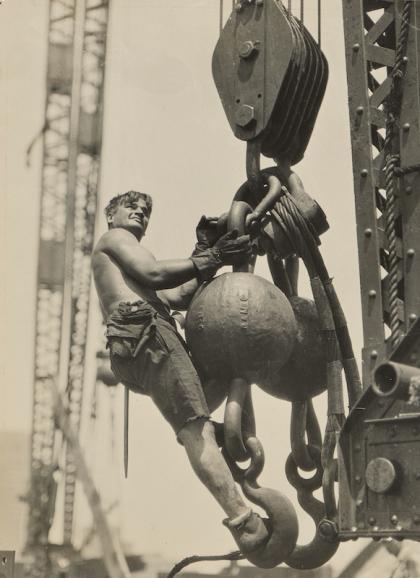
Lewis Hine focused on the builders, heroising steel workers like Victor Gosselin in pictures such as Riding the Ball High up on Empire State, 1930 (pictured above right) which shows him being hoisted up the Empire State Building – then the world’s tallest building.
They were the lucky ones – with jobs. In White Angel Breadline, 1933 Dorothea Lange documents the unemployed queuing at a soup kitchen in San Francisco during the Great Depression. Aaron Siskind photographs shabby men entering a 20 cent flophouse on the Bowery and Immogen Cunningham records a homeless man sleeping Under the Queensboro Bridge.
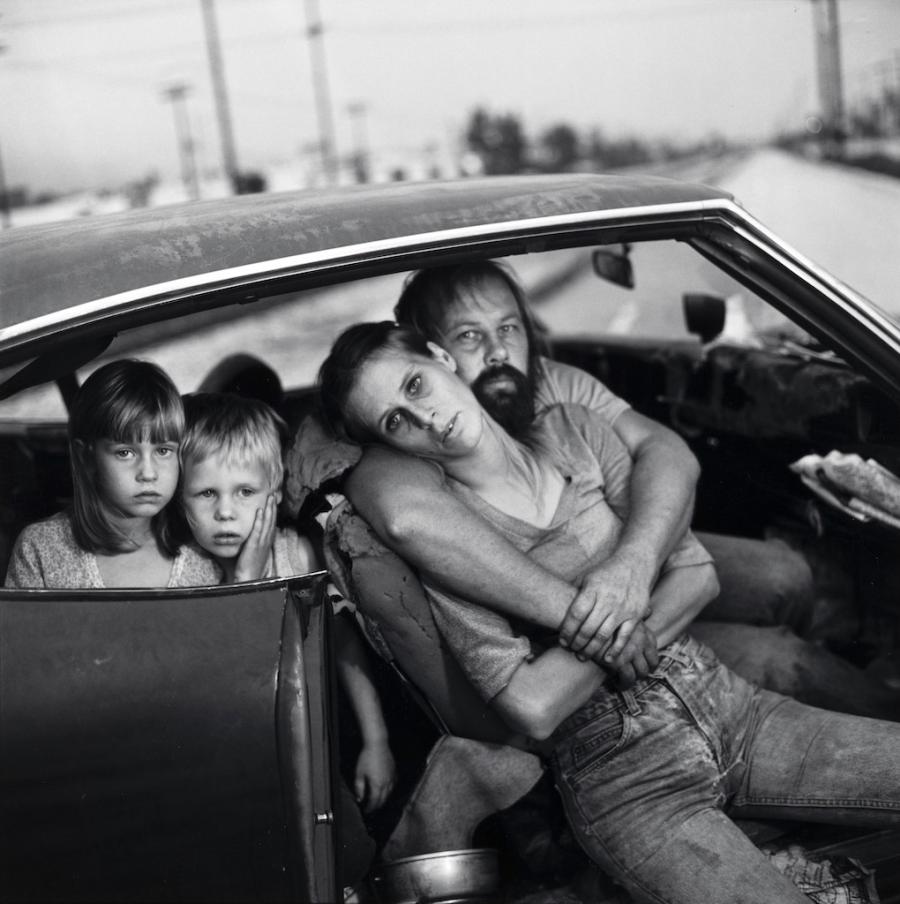
Homelessness, squalor and deprivation are recurring themes, and not just in the 1930s. As late as 1987 Mary Ellen Mark photographs the Damm family living in their car in Los Angeles (pictured above). The dark rings round Linda’s eyes and the forlorn gaze of her children attest to the strain they are under.
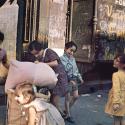
Not all is doom and gloom, though. In black and white then later in beautifully subdued colour, Helen Levitt photographs children playing in the streets of Harlem and the Lower East Side (main picture) where their joyous energy is offset by the dilapidation of the places the children call home. Later she turned to film and her wonderfully sympathetic documentary In the Street 1948 shows kids in Spanish Harlem energetically getting on with life despite their filthy clothes and squalid surroundings.
Roy DeCarava was the first black photographer to receive a Guggenhein Fellowship. His photographs of the dingy interiors of Harlem’s tenement buildings show the depressing circumstances that drove people onto the streets to find joy wherever they could.
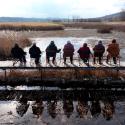
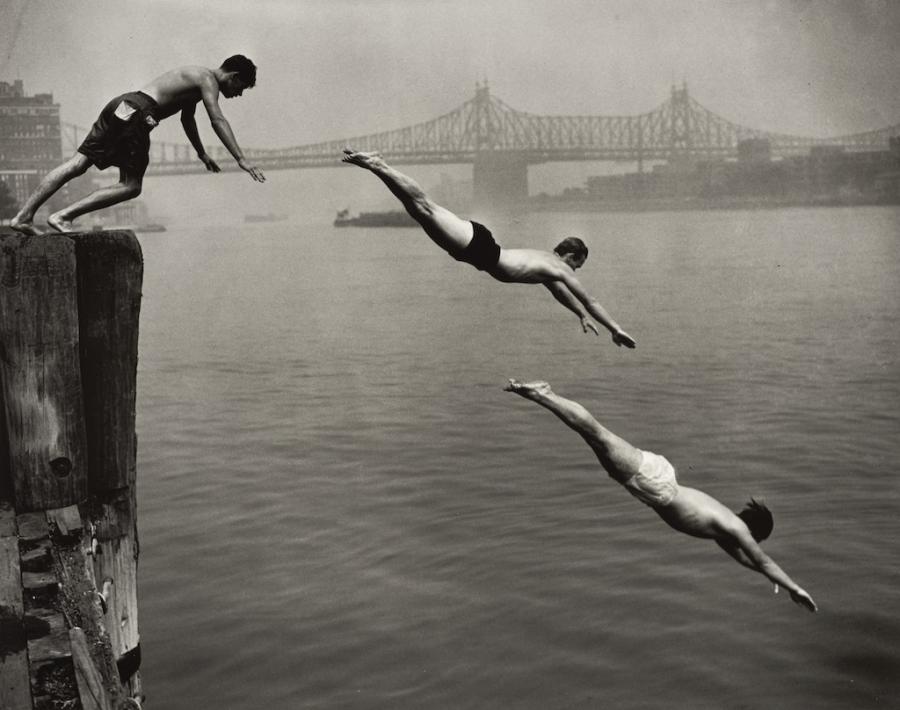
Arthur Leipzig’s 1948 photograph of lads diving off wooden pilings into the East River (pictured above) feels like a leap to freedom. Coney Island was where the working class went for a good time. Lisette Model’s photograph of a big fat mama enjoying the beach in her baggy swimsuit provides a glimpse of the spirit that kept people going through hard times.
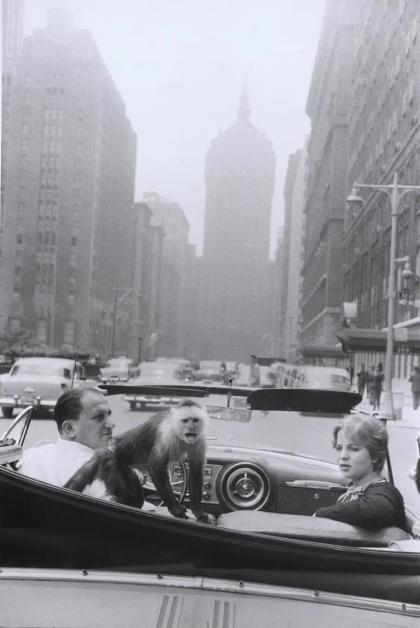
Wandering the streets on the lookout for something interesting, strange or bizarre, Garry Winogrand spotted an open-top Chevrolet cruising down Park Avenue with a howling monkey leaping about behind the driver (pictured left). "There is nothing as mysterious as a fact clearly described", he said of his pictures which were all snapped on the hoof.
Where there’s poverty, inevitably there’s crime and, working entirely at night, Weegee specialised in recording murders and other crime scenes. He became so famous that in their August 1946 issue Life Magazine published a feature on him demonstrating how to photograph a corpse (using dummies)!
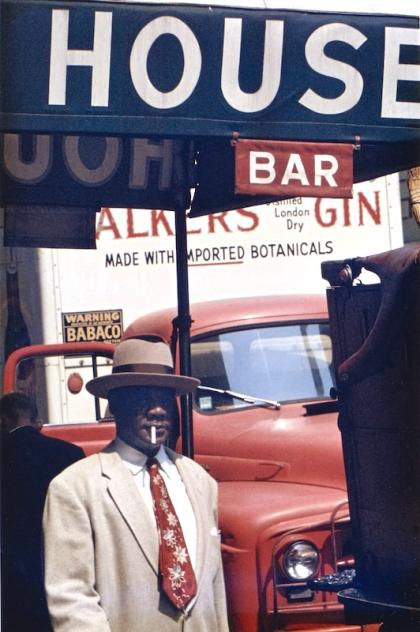
Saul Leiter found beauty within two blocks of his apartment in the East Village. Before turning to photography, he’d studied painting and developed an incredible eye for colour which became the main subject of his exquisite pictures. Harlem 1960 (pictured below right) captures a black guy walking under the awning of a bar; the view of the street is blocked by a lorry so creating a shallow space complicated by signage on the lorry and awning. The man’s white shirt, cigarette and crimson tie play a part in creating a visual poem in red, white and black against the backdrop of the lorry’s crimson cab.
Leiter remained virtually unknown until the 1990s, so the man who put colour photography on the map was William Eggleston. Focusing on Memphis Tennessee where he was born, he took pictures of ordinary life; but through the use of saturated colour, mundane scenes are made uniquely strange. Untitled, Memphis Tennessee 1970 shows a gas station offering customers used tyres. Propped against a pile of old tyres, a sign reading “USED TYRES” has been turned blood red by the evening sun – to assume a menacing glow.
Colour is also paramount in the work of Bruce Davidson which fills the last room. In the 1980s he spent five years riding the New York subway documenting the graffiti and smashed windows and the characters that made it feel challenging or downright dangerous. Seen from outside through the bars of carriage windows, the passengers look like inmates in an overcrowded prison. Two black women sit nervously clutching their handbags; s black dude in a bright red jacket and hoodie holds a gun to man’s head; two guys with guns over their Guardian Angel T shirts stand guard in front of doors emblazoned with the sign “Please Keep Hands off the Doors” which makes the best shot of the series even more humorous. Two arms – one dressed n red the other in black – try to force open the door for a guy who is stuck half in and half out of a carriage.
In this glorious show, two things become evident. America has always been a land of extreme inequality, with many of the poorest being immigrants. A large number of the photographers featured here were also immigrants, and their sympathy for the people their subjects shines through. This is a portrait, then, of a country whose identity is constantly being reshaped by new arrivals. Their energy and their appetite for change is almost tangible; it’s what makes this exhibition so exhilarating.