Berlin always makes a flavourful setting for labyrinthine stories of betrayal and deception (see Le Carre and Len Deighton for further details), and it doesn’t disappoint in this absorbing German-made thriller. Writer Paul Coates and director Lennart Ruff have constructed a taut and twisty narrative that gradually pulls together various themes dating back many years, set in a cool and chilly-looking Berlin.The city’s notorious Wall has ceased to exist, but ghosts and murky echoes from the old East-West past still haunt the protagonists.
The action kicks off with the arrival of an unknown man, who deliberately stabs himself and gives himself a gunshot wound in the leg in order to ingratiate himself into the household of Meret and Simon Schäfer (Susanne Wolff and Felix Kramer). Although Meret and Simon are in the middle of throwing a 16th birthday party for their daughter Nina (Maja Bons), the unknown arrival is aware of the security protocol that will convince them of his authenticity, and Simon agrees to come and pick him up. He then takes him to a safe house, complete with medical facilities, and sets about tidying up his wounds.
However, though Simon seems prepared to accept the visitor’s bona fides, Meret is more sceptical. She studies him via hidden surveillance cameras, and it isn’t long before he reveals that his intentions are far from innocent. Her attempt to interrogate him ends badly… for him.
We learn from this encounter that somebody has the Schäfers on a hit-list, that they are two highly experienced secret agents, and that whatever is going on is related to an undercover operation in Belarus 16 years earlier. Over six episodes, the ramifications of this are teased out and subjected to forensic inspection. Eventually a litany of lies, conflicting loyalties, political skulduggery and even some noble intentions is dragged reluctantly out into the light. Note how the show’s title elides “family” and “liar”.
The spy thriller is a well-worked genre, but Unfamiliar feels fresh by virtue of the tautness of the writing and the way it’s mirrored in Ruff’s lucid direction, in which nothing happens without a reason. A splendid cast completes the package, with powerful performances on display at every level of the drama.
Wolff and Kramer are superb as the central couple, who clearly share a deep-rooted empathy even when it comes under immense strain as some devastating facts from the Belarus affair are finally revealed. Still, anybody involved in the spying racket is living a lie in any case, so learning to juggle multiple identities and malleable versions of the truth is kind of an occupational necessity. As it happens, Simon’s new career as a chef and restaurateur seems to suit him very well, though there’s a sense that Meret’s addiction to the spying game is incurable.

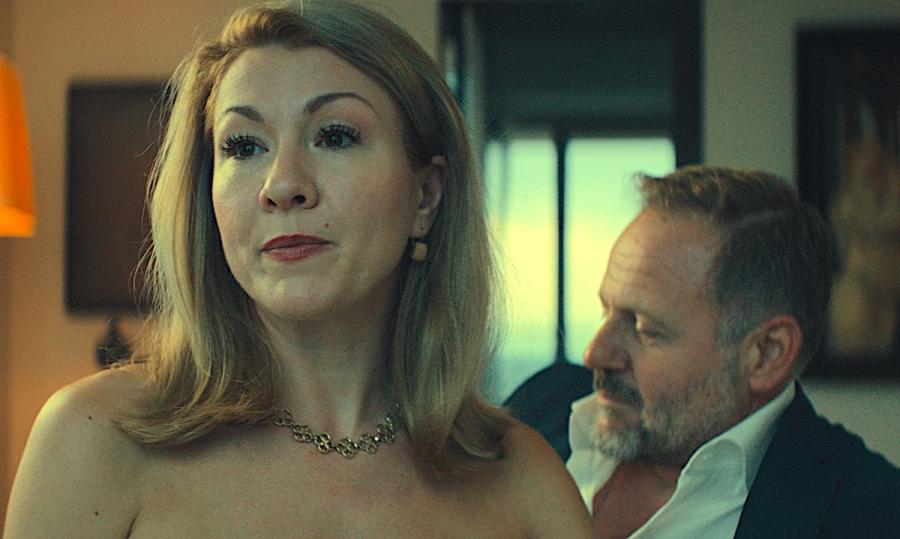
In the bad-guys corner we have the despicable Josef Koleev, a veteran of Russia’s GRU military intelligence agency. He’s on the trail of the Schäfers, seeking delayed-action revenge, and is played by Samuel Finzi with a toxic mixture of hideous sadism and malevolent cunning. It’s rather satisfying that he has met his match in his wife Vera (Genija Rykova), who’s angling to become Russia’s ambassador in Berlin and proves herself a very nifty player of political chess (the Koleevs pictured top). Some of her husband’s excesses prove too much even for her.
A tip of the hat, too, to Seyneb Saleh’s portrayal of Julika Ritter (pictured above), an agent in the German BND intelligence service. She’s determined and single-minded, and is going to follow her instincts rather than be patronised by her rather sinister boss Ben Krüger (Laurence Rupp). One suspects that there could well be a series two in here.