

Whatever you think of Friends, you have to concede it was good in the sack. If there were jokes to be had about sexual fantasy, sexual abandon and sexual incontinence, they were had. The one with free porn, the one with Rachel dressing as Princess Leia for Ross etc. The one area they avoided was sexual inhibition. It was all very refreshing, all very welcome, unless you happened to be watching with addicted youngish daughters. I was appalled at all the sex. No doubt this was a case of conditioning: in the sitcoms I grew up with sex was a dirty word. Naturally they were all British.
The British sitcom if it’s about anything is about the purgatory of eternal stasis, where desires are forever thwarted, horizons never widened; it's about not getting what you want - not getting it. For decades sex was reduced to this neuter pronoun, as if it itself were sexless. Mildred didn’t get it from George (pictured below). Terry didn’t get it from June. Mr Rigsby didn’t get it from Miss Jones. It’s a wonder there were ever any children in sitcoms – and come to think of it, there weren’t many, and they were always the adult products of a distant sepia-tinted coition. No it please, we’re British.
Anyway, where Channel 4 has all those Top 100 shows riddled with talking heads, the BBC’s favoured way of recycling a whole wodge of old clippage has always been through the medium of the sitcom. Sex and the Sitcom sounded as if it might have been just another trip to the vaults, this time to rummage around for sauce. It turned out to be something much more engaging – a well-made tele-essay about the British in bed, from soup to nuts. (Apols: it's catching. Innuendo for the British, reckoned Jonathan Harvey, “is a comfort blanket”.)
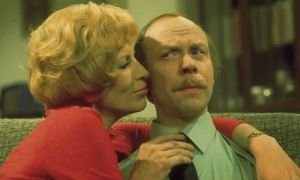 The central thesis was that on the one hand we’ve come a long way from essentially coy shows like It’s Awfully Bad for Your Eyes and The Ladies Man. In His and Hers they waggle sex aids about the way Barbara Good used to swing a pitchfork: somewhere underground Mrs Whitehouse will be on a fast spin cycle. On the other hand, nothing’s changed since what one contributor called "the midlife crisis" that was the Seventies. The leads of The Young Ones and Gimme Gimme Gimme and even Ab Fab got no more sex than their sitcom ancestors. In Peep Show there is much talk of vaginas but the sex, when it happens, remains awkward and dysfunctional.
A cast of greybeards and handpicked clever clogs walked us brightly through the history. Among them were actors, writers, commissioning editors, academics, critics (including theartsdesk’s Bruce Dessau), plus the agony aunt Anna Raeburn who was on hand to explain how the pill changed everything. Not quickly, mind. In The Liver Birds, Nerys Hughes played an old-fashioned husband-hunter who just happened to tease cock a little more overtly than her frigid forebears. Even Carla Lane, who wrote it, conceded that it has dated horribly. Leslie Phillips, star of Casanova ’73, was on hand to explain ruefully that these days you can get away with anything. You couldn’t quite tell what he regretted: the decline in moral standards, or the fact that it didn’t happen on his watch.
There was a nice little section on wanking, a form of entertainment of which, at a guess, Phillips’s Lothario had no need. Again, Britain and America were two cultures divided by a common language on this one. Men Behaving Badly celebrated Christmas one year with the sight of spunk-stained tissue glued to Caroline Quentin’s cheek. So classy. Meanwhile in Seinfeld the four main characters had a bet to see who could go the longest without taking advantage of themselves. Julia Louis-Dreyfuss’s Elaine lost the wager. I'll have a wager of my own that no British female sitcom character has ever allowed a finger to wander downstairs (with the possible exception of Yootha Joyce's hot-to-trot but terminally unpleasured Mildred). Please do tell me if I'm wrong.
Anyway, we can guffaw now at the infamous clip of Malcolm Muggeridge declaring that, without love or when not done for procreation, “sex is a very horrible thing”. But when all is said and done, that is the joke which underpins British sitcom. Maybe not the act itself, but the toe-curling preamble and the hideous fallout - the anxiety, the desperation, the shame, the frustration: the horror, the horror. All of which are hilarious. To us. Apparently.










Add comment