Sequel-itis has spread to the stage. There’s no caped crusader, but the troubled quartet of Neil LaBute’s latest will be familiar to anyone who caught Reasons to be Pretty at the Almeida in 2011 – as will Soutra Gilmour’s industrial crate set. We even begin the same way: in the middle of a foul-mouthed shouting match between relentlessly combative Steph and sometime-paramour Greg. But nostalgia value aside, this melancholic reprise is generally a case of diminishing returns.
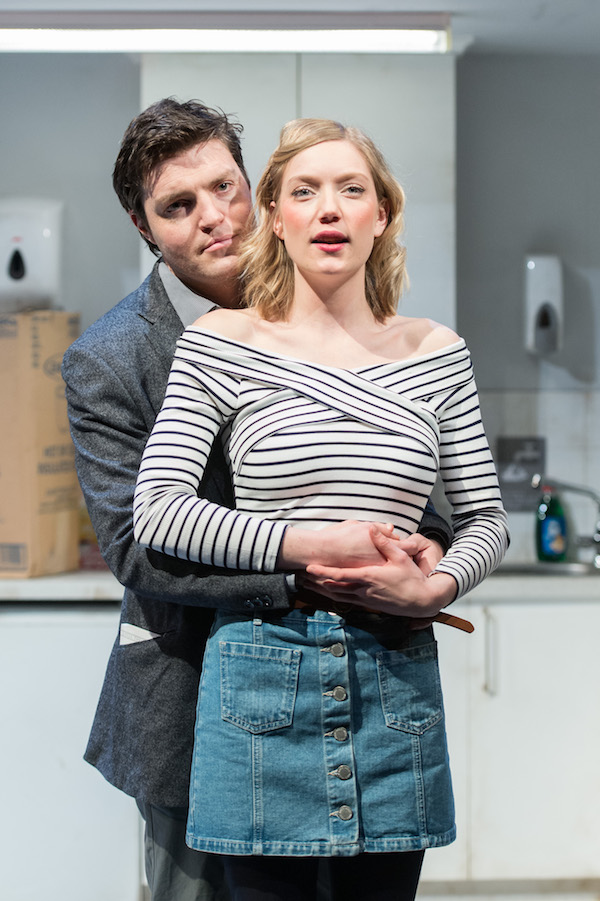
Three years have passed, and Steph (Lauren O’Neil) and Greg (Tom Burke) are now exes. The source of her fury is the revelation that Greg has begun dating her friend Carly (Robyn Addison, pictured below with Burke) – never mind that Steph herself is married. Carly’s ex-husband Kent (Warren Brown), formerly Greg’s close friend, is equally enraged. “That’s like practically incest,” he protests, though in both cases, the anger is really fuelled by the snuffing out of a potential romantic reunion; this is a group mired in unfinished business. Cue a leisurely series of two-handers, which, with their love triangle quandaries, feverish secrets and even an unplanned pregnancy, follow a too-familiar soapy route.
 The most interesting element is Greg’s ambivalence towards his small Middle American hometown. His enduring attraction to Steph reflects a reluctance to let go of this place, even as he pursues an upward mobility that separates him from his friends. Thanks to a college education, he’s progressed from factory work to teaching, while the others remain in the same roles: Carly a security guard, Steph a hairdresser, and Kent still hauling boxes. But it’s a point made bluntly and with little development, essentially limited to Greg brandishing paperbacks so the others can gripe about his reading and reveal their intellectual inferiority.
There’s a similarly simplistic reading of masculinity – alpha male Kent, convincingly embodied by Brown, is all football, fists and sexual slurs – which LaBute only partly interrogates. Kent’s jock behaviour is shown to be a destructive force, affecting his job and relationships, but he’s still capable of definitive action, while bookworm Greg is a ditherer for the ages. His desire to choose the right words stifles his speech, as he deconstructs “love” rather than declaring it, and his passivity inflicts hurt upon everyone in his orbit.
Burke, the only returning cast member from Reasons to be Pretty, gives a richly informed reading. He strikes a convincing balance between Greg’s weaselly abdication of responsibility and earnest pursuit of happiness – that elusive state for which he may have to sacrifice all others. However, LaBute’s positioning of him as essentially decent, even heroic, creates a problematic imbalance in a piece sometimes framed as a battle of the sexes.
 While nominally an ensemble drama, the play belongs to Greg. There’s room for his male bonding with Kent (pictured left), but Steph and Carly’s supposed great friendship is an offstage affair, and neither is afforded much interiority. Their main function is to be objects of desire and/or possible routes for Greg on his journey; though both call him on his self-absorption, they remain secondary to it. A couple of poignant moments aside, O’Neil is stuck with a wildly unreasonable nag, while Addison’s Carly is a sweet, attractive victim – apparently these are the only options.
LaBute’s ear for dialogue is the work’s major asset, and Michael Attenborough’s unfussy production allows the verbal tics and naturalistically inarticulate speech to take centre stage. The constrained spaces of Gilmour’s versatile, evocative set are also highly effective. But this feels very much like the middle play in LaBute’s proposed trilogy: too reliant on what’s come before and too concerned with leaving room for more.