
In the Next Room, St James Theatre | reviews, news & interviews
In the Next Room, St James Theatre
In the Next Room, St James Theatre
Sarah Ruhl’s warmhearted sex comedy about vibrators in the Victorian age fails to climax
Friday, 22 November 2013
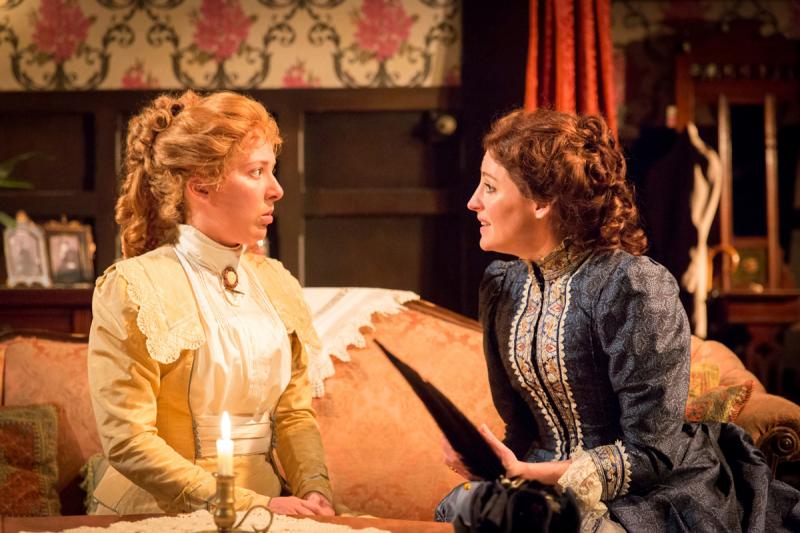
What’s it feel like?: Natalie Casey and Flora Montgomery in ‘In the Next Room’ Johan Persson
Is there a danger that a show can be oversold? Sarah Ruhl’s In the Next Room sounds innocuous enough — until you read its subtitle: The Vibrator Play. Marketed as the most provocative drama of the year, its theme is female sexuality in the Victorian era, and yes, it’s all about the discovery of the joys of orgasm.
Now premiering in London, after a Broadway production that garnered Tony nominations, does this production, which is directed by Laurence Boswell, live up to the hype?
Set in a wealthy spa town just outside New York at the end of the 19th century, the story dwells in the home of one Dr Givings, who treats many women, and even some men, for hysterical symptoms. What’s amazing is that he uses an electric vibrating machine to give his patients orgasms, or in the language of the time “paroxysms”, and thus relieve the pressure on their wombs (yes, the science really is pretty dodgy).
This is basically a documentary dressed up as light entertainment
Not only are his patients, such as Sabrina Daldry, sexually frustrated, but so is his wife Catherine, a new mother whose milk is inadequate, which means that a black wet nurse, Elizabeth, has to be employed, thus adding the issue of race and class to that of sexuality. Into this comedy of manners other characters, notably the nurse Annie and the painter Leo, drift in, elaborating the themes of more overt sexuality, both gay and straight.
Much of the comedy comes (oops) from our image of the Victorians as a straight-laced people, with the women especially naive and repressed. From the perspective of our more knowing age, they seem like creatures from a different planet, the women ridiculously innocent and the men absurdly patriarchal. This provides a lot of simple laughs and the transformation of Sabrina from chilly depression to blooming joy is heartwarming enough.
 The case of Catherine is more complex. Seeing the effects of the new wonder machine on her husband’s patients, she naturally wants to try out the medicine. But Dr Givings says that his medical principles won’t allow him to treat his own wife. So Catherine decides to sample other avenues of exploration, and there are some interesting and tender scenes of female friendship to give the comedy some depth. Yet none of the psychology is convincing, and I had my doubts about the writing too.
Ruhl’s writing has a stilted, awkward style, part declamation and part archaic formulation. This might be her attempt to evoke a long-lost age, or to get a sense of comic brio from deliberate decorum, but to me it just feels as if no one ever spoke like this. Unbelievable as it is, the language has the advantages of clarity, if not of subtext and subtlety. The play is basically a documentary dressed up as light entertainment.
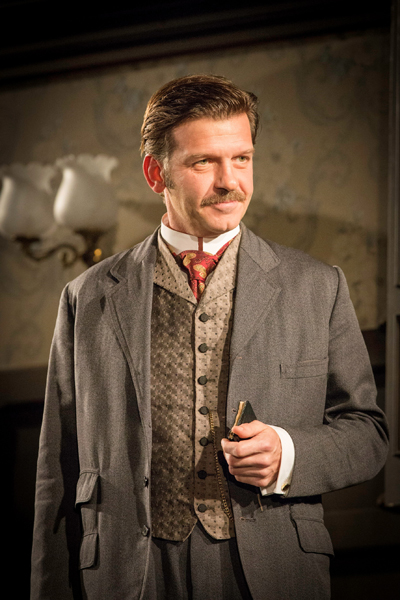
Still, Boswell’s sprightly production has a charming delicacy and the jokes are crisply delivered, and neatly wrapped up. On Simon Kenny’s split-level set, with the doctor’s surgery symbolically pressing down on the family’s living quarters below, a solid cast is led by Natalie Casey as the kooky Catherine and Flora Montgomery as the awakened Sabrina. Good support from Jason Hughes as Dr Givings (above right) and Sarah Woodward as Annie and Madeline Appiah as Elizabeth. But the play feels too long, too sunny and too superficial to deliver any real paroxysms. Definitely over-rated.
But the play feels too long, too sunny and too superficial to deliver any real paroxysms
rating
Buy
Share this article
Subscribe to theartsdesk.com
Thank you for continuing to read our work on theartsdesk.com. For unlimited access to every article in its entirety, including our archive of more than 15,000 pieces, we're asking for £5 per month or £40 per year. We feel it's a very good deal, and hope you do too.
To take a subscription now simply click here.
And if you're looking for that extra gift for a friend or family member, why not treat them to a theartsdesk.com gift subscription?
more Theatre
 Sappho, Southwark Playhouse Elephant review - a glitzy celebration of sapphic love
Too much camp and not enough content in this tribute to the Greek poet
Sappho, Southwark Playhouse Elephant review - a glitzy celebration of sapphic love
Too much camp and not enough content in this tribute to the Greek poet
 Twelfth Night, Regent's Park Open Air Theatre review - burlesque overwhelms the darker notes in this mixed revival
Queer themes and music take centre stage in a café setting
Twelfth Night, Regent's Park Open Air Theatre review - burlesque overwhelms the darker notes in this mixed revival
Queer themes and music take centre stage in a café setting
 Multiple Casualty Incident, The Yard Theatre review - NGO medics in training have problems of their own
Sami Ibrahim's play examines ethics in a war zone, but pivots to a gimmicky love story
Multiple Casualty Incident, The Yard Theatre review - NGO medics in training have problems of their own
Sami Ibrahim's play examines ethics in a war zone, but pivots to a gimmicky love story
 Spirited Away, London Coliseum review - spectacular re-imagining of beloved film
Growing up with Chihiro/Sen is overwhelming, enlightening and beautiful
Spirited Away, London Coliseum review - spectacular re-imagining of beloved film
Growing up with Chihiro/Sen is overwhelming, enlightening and beautiful
 Laughing Boy, Jermyn Street Theatre review - impassioned agitprop drama
Strong ensemble work highlights the plight of people with learning disabilities
Laughing Boy, Jermyn Street Theatre review - impassioned agitprop drama
Strong ensemble work highlights the plight of people with learning disabilities
 Minority Report, Lyric Hammersmith Theatre review - ill-judged sci-fi
Philip K Dick’s science fiction short story fares far better on screen
Minority Report, Lyric Hammersmith Theatre review - ill-judged sci-fi
Philip K Dick’s science fiction short story fares far better on screen
 Two Strangers (Carry A Cake Across New York), Criterion Theatre review - rueful and funny musical gets West End upgrade
A Brit and a New Yorker struggle to find common ground in lively new British musical
Two Strangers (Carry A Cake Across New York), Criterion Theatre review - rueful and funny musical gets West End upgrade
A Brit and a New Yorker struggle to find common ground in lively new British musical
 Testmatch, Orange Tree Theatre review - Raj rage, old and new, flares in cricket dramedy
Winning performances cannot overcome a scattergun approach to a ragbag of issues
Testmatch, Orange Tree Theatre review - Raj rage, old and new, flares in cricket dramedy
Winning performances cannot overcome a scattergun approach to a ragbag of issues
 Banging Denmark, Finborough Theatre review - lively but confusing comedy of modern manners
Superb cast deliver Van Badham's anti-incel barbs and feminist wit with gusto
Banging Denmark, Finborough Theatre review - lively but confusing comedy of modern manners
Superb cast deliver Van Badham's anti-incel barbs and feminist wit with gusto
 London Tide, National Theatre review - haunting moody river blues
New play-with-songs version of Dickens’s 'Our Mutual Friend' is a panoramic Victori-noir
London Tide, National Theatre review - haunting moody river blues
New play-with-songs version of Dickens’s 'Our Mutual Friend' is a panoramic Victori-noir
 Machinal, The Old Vic review - note-perfect pity and terror
Sophie Treadwell's 1928 hard hitter gets full musical and choreographic treatment
Machinal, The Old Vic review - note-perfect pity and terror
Sophie Treadwell's 1928 hard hitter gets full musical and choreographic treatment
 An Actor Convalescing in Devon, Hampstead Theatre review - old school actor tells old school stories
Fact emerges skilfully repackaged as fiction in an affecting solo show by Richard Nelson
An Actor Convalescing in Devon, Hampstead Theatre review - old school actor tells old school stories
Fact emerges skilfully repackaged as fiction in an affecting solo show by Richard Nelson
Add comment