With the total loss of its Arts Council funding, Hampstead Theatre’s future as a specialist new writing venue is in doubt. But before anything drastically changes, the playwrights and plays developed by Roxanna Silbert, who was edged out as artistic director in December last year, are still coming through.
One of them is Ruby Thomas, whose Either, her 2019 drama in the studio here, was thrillingly experimental. Boy, can she write! Her latest, this time on the main stage, is Linck & Mülhahn, a historical queer love story which features a gender-pioneering couple.
The scene is Saxony in the early 18th century, and the central characters are twentysomethings Anastasius Linck and Catharina Mülhahn: the former is a soldier turned clothmaker’s assistant; the latter a daughter of a solid middle-class family, whose finances have been under pressure since the death of her father. Understandably, her mother wants Catharina to get a husband, even though she cannot afford a dowry, but the young woman has other ideas: she wants to read, discuss ideas and have adventures. When she meets the charming Anastasius, the couple fall in love. It’s tender, sweet. They marry. So far, so conventional. Only one thing: Anastasius was born a girl.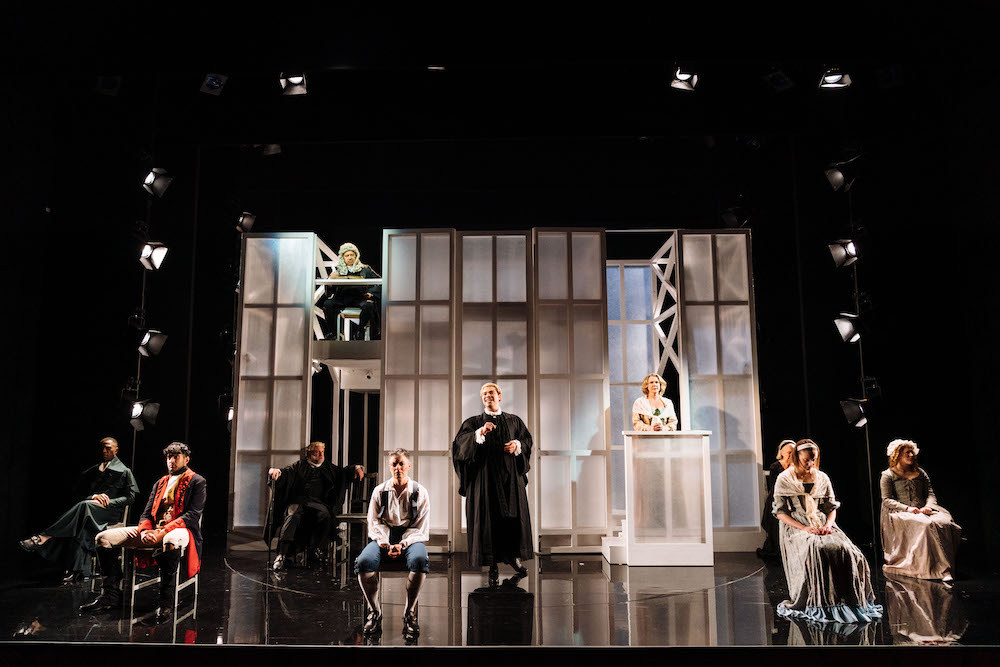 Based on true events, and the transcript of the 1721 court case that occurred when Catharina’s mother denounced the couple, Thomas’s play offers a radically simplified version of the story (as the programme note shows). As reimagined for today’s audiences, the love affair is beautifully passionate, psychologically realistic and emotionally true. The early scenes are written with an exciting wit and a palpable pleasure in word play: at one moment, Catharina declares, “Joy is like a bucket with a hole. One must keep filling it over and over”, then adding suggestively, “The hole is its greatest pleasure.” The dialogues between the pair buzz with mutual attraction. The mix of formal speech and modern idiom really rocks.
The second half, however, following Mother’s denunciation, is a courtroom drama, with a more static staging (pictured above) and an uncertain blend of horror at the repressive nature of state and church in 18th century Germany and the playwright’s account of the farce of the legal proceedings. One of the problems is that while the past had little comprehension, and no sympathetic vocabulary, for gay, trans and non-binary individuals, our current sensibilities read historical material in just this way. We like to attach labels in different ways to the past’s naming and shaming of sodomy and “lying together”. So while Thomas’s play is great at uncovering the hidden history of gender fluidity, giving the play a fine queer character, the historical facts keep asserting their ugly reality.
It must also be said that the love story, however thrilling, also has, in Thomas’s version, its own problems. If Anastasius has really not revealed their birth gender to Catharina, doesn’t this raise difficult issues about consent? I was reminded of Michaela Coel’s I May Destroy You, where a man’s concealment of their gayness was challenged by the woman who consented to sex with him under the impression that he was straight. I was also puzzled by why the two defendants in the Linck court case didn’t, as is mentioned in the text, simply claim to be living as sisters. But perhaps the point is that the state and church authorities were obsessed with their sexuality. Hence the tragedy.
Linck & Mülhahn has some wonderful moments, fuelled by a soundtrack that includes 1970s punk and David Bowie’s “Modern Love”, and there are some fascinating discussions about the nature of love, Enlightenment philosophy, the feminism of Mary Astell and the performativity of our personal identities. But although it is great to see a distinctly queer consciousness that dissolves the stale binaries of rigid ideas about gender, the playwright cannot resist including a kind of “coming out” speech at the tale's climax, which is overly didactic. It is also sad to think that the assertion of queerness today cannot just revel in its pleasures, but has to emphasise a history of persecution. As if suffering is always needed to validate identity.
Directed by Owen Horsley, and designed by Simon Wells with a versatile revolving staircase, Linck & Mülhahn has two attractive performances by Helena Wilson (a vigorous and vivid Catharina) and Maggie Bain (a charming and wry Anastasius), although the self-sacrificing nature of the latter's character is off-putting. Lucy Black is suitably ghastly as Mother, while Marty Cruickshank is engaging as the Spinster in the show’s framing device. If the scenes with soldiers and the ball, as well as the court, feel a bit underpopulated, with cartoonish acting, the intimate exchanges work really well. Despite its problems, a beautifully provocative and engaging show.