From the creators of the much-lauded The Oh F*ck Moment comes I Wish I Was Lonely, a participatory look at modern communication and the human psyche. Flouting the rules of mainstream theatre, this by turns poetic yet provocative piece encourages the audience to keep all mobile phones on (imagine!), to answer whatever calls may come through, and even to use Twitter and Facebook to our hearts' delight. And having provided our mobile numbers on a piece of card, we receive the number of an anonymous member of the audience in return. So begins a newly fragile, temporary connection to a stranger we may or may not choose to keep in touch with.
The audience sits higgledy-piggledy in chairs laid across an upstairs room at BAC, with no set, basic lighting, and a microphone tucked away to the side. Here, theatremakers Chris Thorpe and Hannah Jane Walker stride across the floor delivering a poem that becomes both a laid-back conversation and a serious lecture. As they talk, they welcome us into their friendship, all the while dissecting the actions that we take online. "Assad won't read your retweet," Thorpe tells Walker. "And you are not Trayvon Martin," comes the reply - a reference to our technology-led sense of involvement in an issue that isn't actually on our turf.
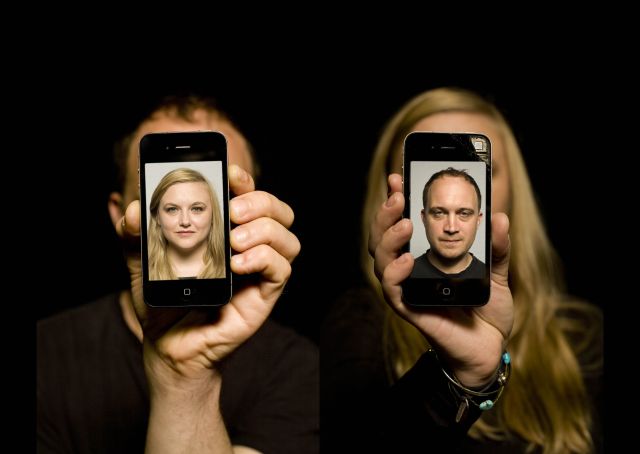 The wished-for loneliness acknowledged in the title hinges on the notion that our friends are always in our pockets or our handbags demanding that we answer their calls, refusing to let us miss them. From this point, Thorpe and Walker (pictured right, photo: Martin Figura) take our perpetual internet use to darker and darker corners. Our presence online, they argue, is about needing to prove that we exist. They lambaste clicktivism and, in one of their interactive exercises, ask us to recite overheard nonsense at one another in a re-enactment of mindless information sharing. While that request works as a memorable bit of participatory theatre, the piece nonetheless requires us to assume that there are no nuances to our behaviour or to our use of technology.
This, for me, is where the show really loses its way. By ignoring the idea that humans are selective creatures who can use technology in creative ways, the piece makes us all into a distracted, screen-tapping crowd that can't bear to look at one another directly. "We crowd source our values," we are rather judgmentally informed as Thorpe and Walker peer directly into the eyes of the consumers sat before them. "And if you `like' someone else's revolution on Facebook," the show's practitioners remind us, "they can still get shot."
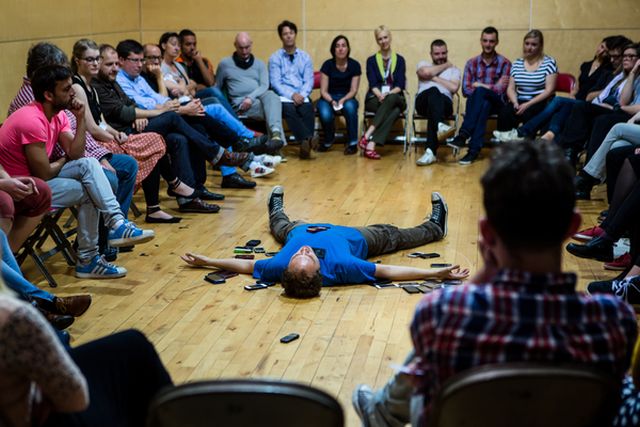 An additional exercise involves getting the whole audience to call each other and leave voicemails. We're only trying to connect with one person but the moment unleashes a cacophony of sound, sending signals hundreds of miles just to talk with someone in the same room. When the show returns to its chummy conversational format, Thorpe (pictured left encircled by the audience, photo: Richard Davenport) and Walker take care to mention those moments of beauty that modern technology can make possible: the surgeon, for instance, who saves a child in the Congo by delivering instructions over the phone or the suicidal man who calls a friend to talk him down from a cliff.
But these more hopeful instances are few, and a feeling of gimmickiness takes hold across 70 minutes, with no interval. How you feel about the show may depend on whether you think you have a degree of control over your mobile phone use, or feel guilty when you choose not to answer a call, or are selective with the information that you share online. Whatever your response, you'll find plenty to argue with here, not least that perhaps you don't wish to be lonely after all.