Watching the stricken faces on the split screen, I felt at times like callow Farfrae in Hardy’s The Mayor of Casterbridge: when faced with Henchard’s account of his blackest misery, the young man replies “Ah, now, I never feel like it”. Well, hardly ever. It’s impossible not to be held captive by the eyes and words of the six actors sharing the roles of estranged father, mother and son in Nobel Prize winning Norwegian writer Jon Fosse’s Einkvan (Everyman).
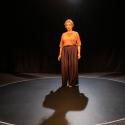
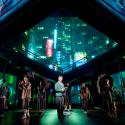
Fosse is a bit like Beckett without the laughs, which is still something; all credit to the Norwegian Embassy and the AKO Foundation for giving the UK a chance to see this radical piece of work - half installation, half living theatre - from Oslo's Norwegian Theatre (the distinction between it and the National Theatre is one between Norway's two different languages, Bokmål, "book-tongue", and Nynorsk, "new Norwegian". On one visit I was lucky to see a radical Peer Gynt at the National and an equally startling Hamlet at Det Norske Teatret, in which a real-life couple played Hamlet as a woman and Ophelia as a man). Fosse's style tends to the repetition of banal but meaningful phrases, aspiring to the condition of music, which is how I first experienced it in Georg Friedrich Haas's operatic adaptation of Morgen und Abend at the Royal Opera.  Not everyone gets it - see the comments at the end of theartsdesk review - and there was some stirring and tittering when one of the archetypal characters in Einkvan asks "when will this end?" An hour is as much as Einkvan needs, but despite the fact that we see the faces only on screen, apart from when one of the sons comes to the front of the stage, still behind the curtains (pictured above by Monica Tormassy) - there could have been more of this - the shifts of word, character and vision are carefully placed.
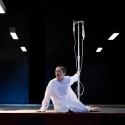
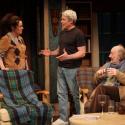
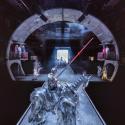
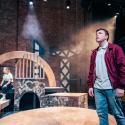
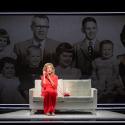
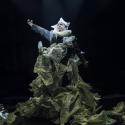
The son is in the bath when the "action" starts. He's disconnected from his parents and won't speak to them when they meet. We learn slowly that the "friend" with whom he's conversing is himself (the two are played by Preben Hodneland and Vetle Bergan), an artist suffering a present block. The parents (Marianna Krogh and Hilde Olausson as the mother, pictured below by Tristram Kenton, Jon Bleiklie Devik and Per Schaanning as the father) similarly seem unable to communicate with a second self. All are isolated until a violent action brings the two sons together on one screen, and keeps them there for the end (the bleakest words, but the possibility of loving oneself at least hinted at in the visuals). 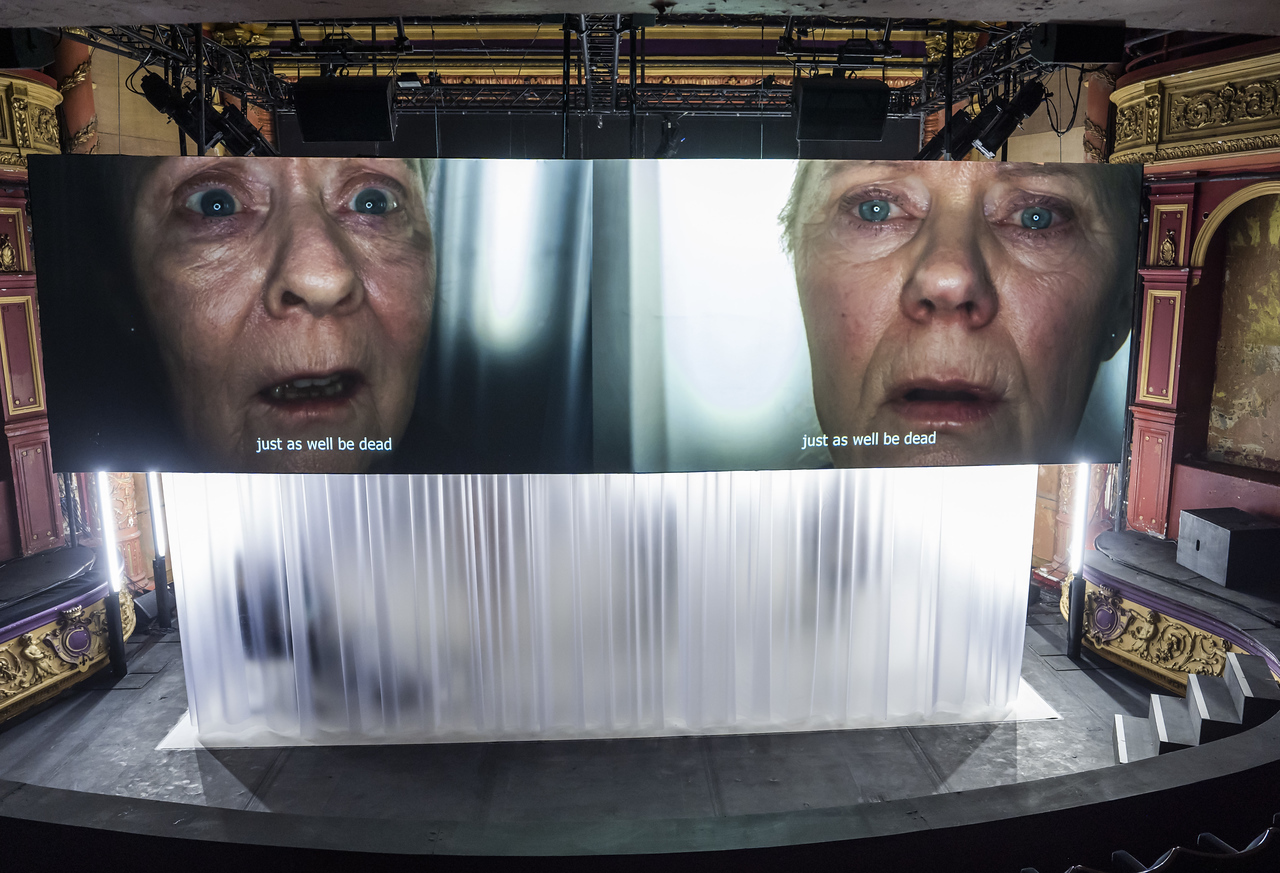 The film could be placed in an art gallery, with the spectator able to visit portions of it at will, but that would be to lose the live theatrical dimension. At the end, the actors finally reveal themselves for the curtain call along with the camera operators, Mads Sjøgård Pettersen, also an actor, and Borgar Skjelstad. That we've not seen them at work dispenses with an overused device of contemporary theatre. The realisation by Det Norske Teatret's Artistic Director, Kjersti Horn, keeps the elements in balance: Oscar Udbye's lighting plays its enigmatic but always atmospheric part, and though the non-stop score by Erik Hedin seems as if it might be stuck doodling around a single minor chord, it, too, shifts and develops. Love it or hate it, this is modern drama of the utmost integrity, and an honourable sequel to the Coronet's hosting of Ibsen and Strindberg in Norwegian.