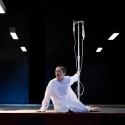
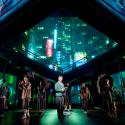
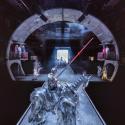
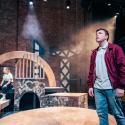
You can’t question Javaad Alipoor’s ambition. Ancient Mesopotamian empires, geological layers of chicken bones, the half-life of polysterene cups, Thomas Gainsborough, Susan Sontag, Iranian political history, gold iPhones, mallwave – all that and plenty more gets crammed into the mere hour of his breathless Rich Kids: A History of Shopping Malls in Tehran at the Traverse. And that’s even without mentioning the wordy narration, video projections, Instagram feeds, live video and multipanelled set he employs to get his ideas across.
It all leaves you more than a bit bewildered. And indeed, if Alipoor’s intention had been simply to baffle and overwhelm you with an excess of information – and of ways of receiving that information – then Rich Kids would have married form and content to brilliant effect. But no: Alipoor has a story to tell, and it’s an important one to understand. It’s about how huge historical forces have shaped the Middle East over millennia, and how an obsession with emulating European values has led to the cocaine-fuelled, champagne-quaffing, Instagram-obsessed offspring of today’s Iranian elite. It’s about how our rampant consumerism is ravaging our planet. And it’s about a coked-up car crash in Tehran, Alipoor and co-performer Peyvand Sadeghian’s starting point.
It’s difficult not to be impressed by Alipoor’s magpie intellect as he flits from topic to topic, establishing unexpected connections between the remotest issues, restlessly zooming in and out of temporal perspectives to see his story across geological ages. But keeping track of where he’s got to is another matter entirely.
And top of the show’s issues is its reliance on Instagram – a nod, naturally, to the carefully curated images of rich kids’ lives of excess in Iran and around the world, but far more problematic in the context of the show. Download the app and you can participate in the performance, scrolling through images as the performers discuss them, and even watching a live stream of what’s happening on stage in front of you. Great ideas, but they only add to the confusion – whether that’s flipping between a smartphone screen and the live stage, or processing a dense polyphony of voices as dozens of mobiles all around you repeat what’s being said on stage, all microseconds out from each other.
As a theatrical embodiment of excess and confusion, Rich Kids is a sprawling, chaotic masterpiece. But as a dissection of history, of shifting cultural attitudes, and of our impact on the planet and on each other, it’s got some way to go.
- Rich Kids: A History of Shopping Malls in Tehran at the Traverse Theatre until 25 August
- The Edinburgh International Festival and Fringe continue until Mon 26 August
- Read more theatre reviews on theartsdesk