"You need to get better at communicating", says one character to another in Isley Lynn’s albatross. Indeed, the same advice would fare well with many of those in the Anglo-American Lynn’s new play, where miscommunication plagues a range of relationships and chance encounters
Structured as a loosely connected sequence of mostly two-handers, albatross. offers a panoramic look at the power dynamics coursing through everyday conversations among strangers and intimates alike.
This production is brought to the Playground Theatre by represent., a repertory company dedicated to working with actors from lower-income backgrounds. Fittingly, the play’s own interests resonate strongly with the causes underlying the company’s artistic mission: nearly all the scenes revolve in some capacity around experiences of precarity, insecurity, and stigmatization. Presented in succession, they make up so many intersecting narratives, each with a different focus and tone but held together by wider social realities.
 In one scene, a woman with a criminal record is refused participation in a charity trip. In another, a homeless porn star endures increasingly tactless questions by a stranger who turns out to have watched her work. We also encounter several romantic partners whose relationships variously stumble or fall apart. The framing narrative unfolds between Kit, a young tattoo artist in training, and Jodie, a homeless woman who requests an elaborate tattoo of an albatross on her chest and neck. Aware of the idiomatic motif of this threatening image, and of Jodie’s rough sleeping, Kit proves reluctant to give her the tattoo.
With one character from each scene passing into the next, albatross. relies upon a continuous and engaging structure reminiscent of Schnitzler's much-adapted La Ronde. Lynn’s scenes also come together around questions of permanence and irreversibility—especially in their double-edged nature as a blessing and a curse: tattoos, criminal records, scar tissues, online histories, and social stigmas are all mulled over by the characters as repositories of the past that insist on asserting themselves, for good or ill.
These internal echoes are occasionally drowned out by the prolixity of those scenes that overstay their welcome. With its bouncy quality, Lynn’s play would have benefited greatly from a punchier, less repetitive feel. Her otherwise neat dramaturgy is also muddled by the final encounter between Kit and Jodie, which awkwardly departs from the play’s realist approach to characterization.
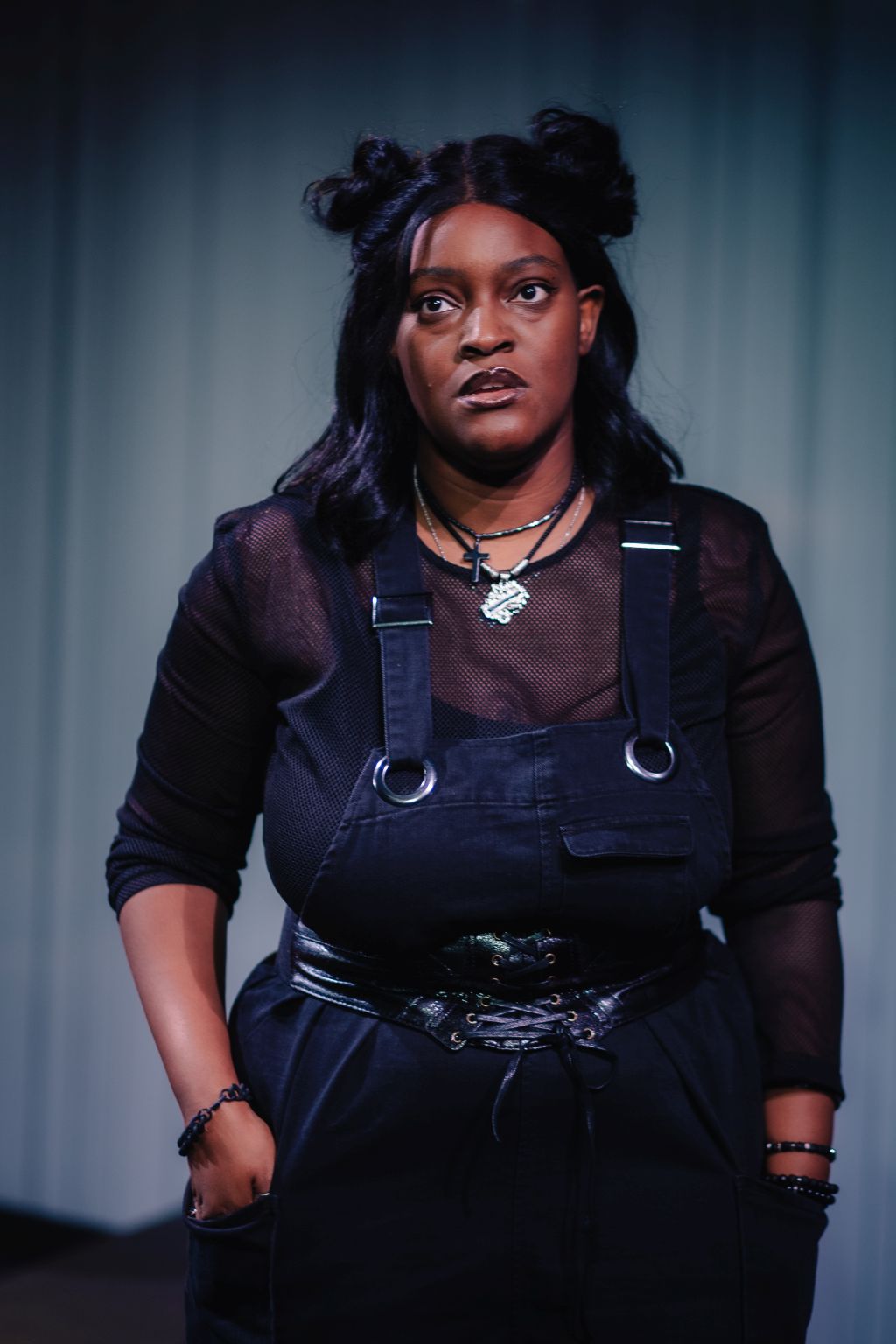
Despite these rhythmic lags, albatross. draws strength from Jessica Edwards’s playfully precise direction and her impressive cast. A confident ensemble of six tackle the play’s moving parts—physical and otherwise—with great finesse. Sarel Madziya (pictured above) is particularly memorable with her meticulously differentiated takes on Jodie and Ashleigh, Kit’s boss at the tattoo parlour. Nemide May, too, delivers two compelling characters, with her turn as the porn star Lucy being one of standouts of the evening. Louissin-Torah Pilikian similarly captures with aplomb each of her very dissimilar characters.
Catherine Morgan’s minimalist set design allows the interactions among the characters to foreground themselves. Bathed in Bethany Gupwell’s funky lighting and moving to contemporary tunes, the cast reconfigure during the transitions two bench-like platforms, giving each scene a different visual inflection. These encounters reinforce the play’s weblike quality, reminding us of the broader currents shaping their stories.
Stylistically, Lynn’s drama carries traces from the works of Caryl Churchill and Alice Birch, but ultimately manages to tilt these influences towards a duly original take on issues both personal and social. One-sided dialogue, delayed revelations, and shifting relationships make for a rich fabric stamped by class divisions and power differentials. Some necessary pruning would not go awry, but even in this form, and thanks to the cast, albatross. soars high.