Mark was teased about the fallout shelter at the bottom of his garden by his co-workers (that wasn’t the only thing – every friendship group has a target for micro-aggressions) but his foresight pays off when terrorists explode a suitcase bomb on a Friday evening. Louise, hungover after her leaving do, wakes up down there, Mark having rescued her from the rubble and sealed the door against the radiation. She faces 14 days locked down with him waiting for the air to clear.
When the director Lyndsey Turner planned her revival of Dennis Kelly’s 2005 two-hander, she could hardly have expected the news to be flooded with Ukrainians stuck in similar refuges, nor that Mark’s paranoia would look like wise preparation if there's a ratcheting up of international tensions. Cowering under the submarine-like escape hatch above Peter McKintosh’s bleak set feels less like a fantasy and more like a prediction for many Europeans just now. Confinement may be very 2020/2021, but existential fear is so 2022.
 We get Mark early on – the hole in the jumper, the nervous conversation punctuated by clunking non sequiturs and poorly judged jokes, the insistent passive aggression that puts him “in charge”. Louise takes more time. Sure she’s confident and personable, but we learn that she has led the office’s banter (sometimes crossing into personal abuse) and has been enjoying her status as something of a "mean girl" as she jabs away at her reprographics department victim, frequently underlining Mark’s lowly status. Since the play was written, we’ve learned a lot more about the impact of such behaviour on mental health, which helps us understand both parties rather more than we would have 17 years ago.
Not that Mark’s subsequent actions can be excused at all. After Louise’s refusal to play Dungeons and Dragons (a role-playing game, lest we forget), he goes full-on Petruchio in The Taming Of The Shrew and starts denying her food once his neurotic need for control curdles into a psychotic violence. And with still nothing but static on the radio.
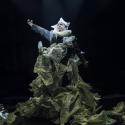
Nick Blood and Amaka Okafor (pictured above) are both splendid, circling each other, bodies always tight even in conversations that appear normal. They sustain tension for an exhausting 100 minutes.
Blood catches the pathos in Mark, revelling, for once, as the hero in his account of risking his own life to save Louise’s. So when his pathological jealousy emerges, it’s still monstrous, but his narcissism comes with a vulnerability to which we can relate: the loser who catches a break.
Okafor has the trickier job. She brilliantly conveys the contradictions in Louise’s character: bright, but not bright enough to submerge her complacency and (literally) read the room, she recklessly pricks an ego when stroking it would have been the only smart move, and she relentlessly underlines her social superiority in an environment in which it counts for nothing. Okafor succeeds in delivering one of theatre's trickier roles – the unsympathetic victim.
The main flaw in the play almost sinks it – Louise is surely too experienced and intelligent not to recognise her situation and to formulate a plan to deal with it. But Kelly’s dialogue and the quality of the performances, allied to Turner’s pacy direction and the very wise decision to run without an interval, just about keep our doubts at bay.
At the back of the set, we glimpse toilet rolls stockpiled against the wall. Who would have thought that two years on from those surreal weeks when fears of a virus emptied supermarket shelves, one man’s sense of entitlement might see them emptying again all over Europe. This play is a timely reminder of how male entitlement can fester and the damage it can cause.