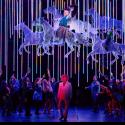
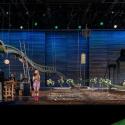
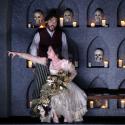
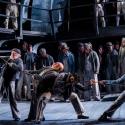
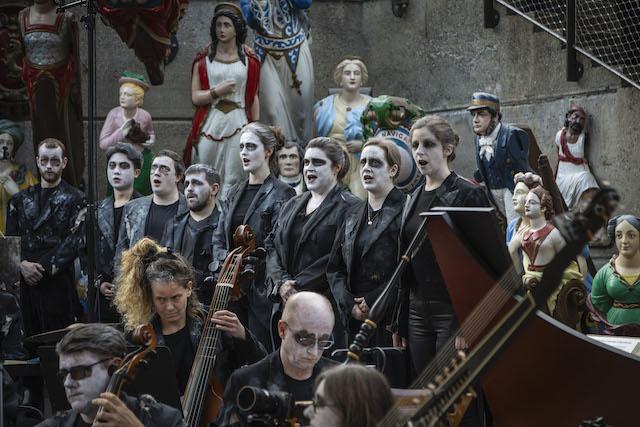
It began with a Gothic funeral procession. A drum beat ominously as a line of figures with shabby black suits, whitened faces, and jagged mascara around hollow staring eyes walked solemnly through the audience. We were sat in the dry dock of the Cutty Sark, dominated by the historic ship’s elegant copper-clad hull suspended three metres in the air, a permanent reminder that this would end with Aeneas’s departure across the sea. Ahead of us, the museum’s cluster of ship figureheads – including Disraeli and Elizabeth Fry – formed a simultaneously colourful and sinister backdrop to the drama about to unfold.
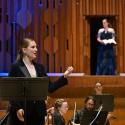
Andrew Staples’ provocative production – performed by the Monteverdi Choir and the English Baroque Soloists – drew on the themes of witchcraft and death in Dido & Aeneas to transform it into a macabre fantasy. We began not with the overture, but with Purcell’s Man that is born of a woman, from his Funeral Sentences composed for Queen Mary II. As the choir intoned, they ascended staircases that rose from either side of the dock towards a balcony, staring down at the audience like a frieze of malevolent angels. Conductor Jonathan Sells eked out the dynamic contrasts so that the whole venue resonated with swooping sound.
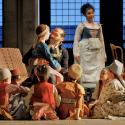
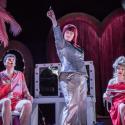
Following this arresting start, the mood changed as the overture to Dido & Aeneas itself began. The singers started whispering animatedly to each other, gazing out across the auditorium like groupies waiting for celebrities to arrive. As the stately adagio evolved into a breezy, scurrying allegro moderato, Dido and Belinda strode up the aisle, dressed like New Romantic rock stars in translucent white and synthetic black. Soprano Johanna Wallroth delivered Belinda’s opening exhortation to Dido to “Shake the cloud from off your brow” in richly vibrant tones.
As Dido, German-Egyptian mezzo-soprano Karima El Demerdasch made her agony explicit from the start, with a raw cry of horror before she began singing. The shift from uninhibited emotion to suppressed grief proved a little awkward, and some of the notes were slightly smudged before she settled into a warm and supple vibrato. As the choir sang the lively 3/4 chorus “When monarchs unite”, an atmosphere of crisp animation briefly presided. In the beautiful settling of the Cutty Sark’s dry dock, the extremely sensitive acoustic could sometimes make notes sound unduly harsh, but the skill of both the soloists and the ensemble made this less of a problem as the evening progressed.
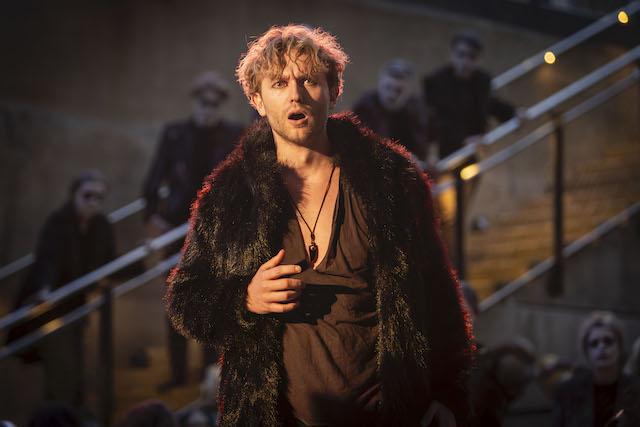
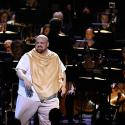
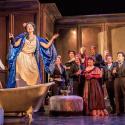
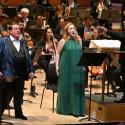
The sweeping arrival of Hubert Zapiór’s Aeneas (pictured above) in his black fake fur coat shifted the entire dynamic up a gear. His extraordinary baritone voice was so resonant, it sounded as if were coming from the depths of a vast schooner. Zapiór combined this with an acting ability that made it possible to see what a struggle it was for him to prioritise duty over his attraction to Dido. All too often Aeneas can come across as wooden and hypocritical in productions of this opera, but here there was no doubting the chemistry between the Roman hero and his Carthaginian queen.
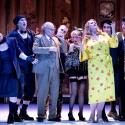
Throughout the evening, the Monteverdi Choir proved magnificently versatile, switching between optimism and foreboding with textures ranging from sparky agitation to the smoothness of silk. The English Baroque Soloists brought their characteristic nuance and delicacy to the doomed love story, though they were more than capable of adding their own gothic flourishes, not least in the downward glissandi that accompanied every crash of thunder.
This style of theatricalised classical music performance is becoming increasingly popular, not least since the highly successful collaboration between the Gesualdo Six and Fretwork on Secret Byrd. It seems no coincidence that the distinctive eye make-up worn by the choir and orchestra is similar to that sported by the Gesualdo Six in their critically acclaimed follow-up, The Death of Gesualdo. While, however, there were many inspired elements here, sometimes it felt as if Staples’ production was wrestling with too many ideas, and the tone was consequently uneven. Though the concept overall is a strong one, so it also feels more than possible that as it tours it will become more surefooted.
What was in no doubt was the glorious quality of the musicianship throughout. Demerdasch proved she was as commanding as she was eloquent as the evening progressed, and there was an extraordinary moment when Zapiór sang falsetto to echo the witches as they took over his mind. From the orchestra, Élodie Brzustowski in particular distinguished herself on the theorbo. Zands Duggan’s percussion injected all the requisite melodrama.
In an intriguing twist, following Dido’s Lament, Aeneas rushed back on stage too late to save her. It could have worked powerfully to have ended the production here – but instead we were left to reflect on our emotions as the drum struck up and the funeral procession went on its way again.