Trying to introduce children to classical music is a tricky business. The benchmarks are still Prokofiev’s Peter and the Wolf and Poulenc’s Babar – both characterised by witty, quirky music and strong storylines. Opera is a harder sell – there’s the slowness of it, the sheer lunacy of characters striding about on stage expressing their inner feelings at full volume, accompanied by a 70-piece orchestra. So credit is due to Opera North’s education department for commissioning Errollyn Wallen’s Cautionary Tales! in response to requests for family-friendly opera.
Aimed at children aged six and over, it’s staged in the beautiful Howard Assembly Room, an acoustically perfect wood-panelled venue high up in Leeds’s Grand Theatre. The raked seating has been removed, and the audience are seated on benches, close to the floor and to the action. There’s a refreshing sense of immediacy and intimacy, especially when the four-strong cast directly address audience members sat within arm's length.
Wallen has set five of Hilaire Belloc’s black-as-pitch Cautionary Tales, originally published in 1896, effectively creating five mini-operas together lasting less than an hour. Three of them work really well – Matilda (who told Lies, and was Burned to Death) meets her end in an imaginatively lo-tech fashion, enveloped in fabric flames stitched around a hula hoop. And Henry King (Who chewed bits of String) mooches about delightfully while gobbling strands of red wool to Katherine Broderick’s inspired vocalising. Wallen’s music works perfectly here – sparse, witty but never simplistic.
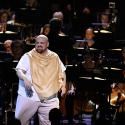
Best of all is the tale of Jim (Who ran away from his Nurse, and was eaten by a Lion). Geoffrey Dolton scampers around Madeleine Boyd’s set, filled with distressed school desks, meeting his maker via an unfortunate meeting with Mark Le Brocq’s glam-rock lion. He’s terrific - a vision in blue shiny fabric and Heseltinian blonde wig, playing air guitar with Jim’s dismembered leg. I smiled too at Wallen’s use of timpani glissandi, providing a perfect aural counterpoint to the zookeeper’s slow waddle. The prelude to the opening tale of Rebecca (Who Slammed Doors for Fun) feels overstretched and a little indulgent – the framing device using mortar-board-wearing teachers not sufficiently characterised – it took me several minutes to establish that we’d actually moved into telling Rebecca’s story. Similarly, the final section, telling us of George (Who Played With a Dangerous Toy) is hard to follow; while it’s fun to watch George transform into a slowly inflating balloon it’s difficult to make sense of exactly what’s going on. Rereading Belloc’s verses after I’d got home hinted at how hard it must have been to devise an hour’s entertainment from five poems which together take less than five minutes to read.
Anthony Kraus’s piano seamlessly melds chunks of Bach’s Well-Tempered Clavier with Wallen’s jazzier tendencies, and he’s beautifully supported by Mark Concar and David Burndrett on percussion and bass. It’s fantastic, too, to hear excellent singing at close range. But emotionally the piece doesn’t move. It’s a little too cold and chilly, the fault of the source material – the two young children I took with me were both moved far more by Opera North’s recent Pinocchio, where Dove and Middleton’s treatment of a strong, moving narrative was so much more effective, despite the grand scale of that opera’s production.
 Find Belloc's