Post-Covid British theatre has a crush on adaptations, especially those with a star actor. So it’s easy to see why National Theatre chief Indhu Rubasingham is staging the latest sparkling verse play by Martin Crimp, whose electric version of Cyrano de Bergerac with James McAvoy conquered the West End in 2019. This time Crimp revisits Molière’s 1666 masterpiece, The Misanthrope, with Canadian superstar Sandra Oh taking on the main role, her terrific performance turning the original’s Alceste into a very contemporary Alice – I couldn’t take my eyes off her.
Oh’s character, a Booker-Prize-winning author, is a truth teller, calling out the fake hugs and air kisses of today’s creatives, spitting crits online about the falsity of social conventions, and all the BS of both the woke and the anti-woke. Her friend John, a playwright, advises caution. But he can’t prevent tensions rising when her younger lover Stefan, an actor recovering from a messy divorce and a substance-abusing past, wants to take another high-profile part, while she’d prefer to embrace retreat. When Claire, his agent, and Indira, a reputation-management consultant, two of Alice’s pet hates, arrive, they have to cope with a digital pile on by Esmée, a young disgruntled novelist who accuses Alice of bullying. With the addition of Elaine, a conductor and Stefan’s ex, and Allen, Indira’s publicity-manipulating assistant, the sitaution is primed to explode.
While Crimp’s first version of this classic play, staged at the Young Vic in 1996 and West End in 2009, followed the gender roles of the original, this new adaptation is more radical, interrogating identity as well social mores. The playwright’s provocation is to challenge the idea that only women can write angry female characters, and to examine how the tradition of literary misanthropy applies to women. For if Alceste in Molière’s original is both ridiculous and right in his criticisms, Crimp’s Alice is less of a buffoon and more of a desperate creative suffocating under the miasma of social conformity. When John says she’s “self-destructive” as well as misanthropic, he has a point: it’s better to laugh with her than at her.
Crimp’s exuberant verse is utterly of today, and in this glittering satire, Alice spears the patronizing idea that women need men for validation, as well as a palette of ills such as “ritualized emoting” and anyone wanting to “indiscriminately embrace the entire human race”. She attacks “rich white girls” who appropriate suffering for themselves “at the expense of women of colour”, and assorted tech bros (no need to even name them). She hates “privileged hypocrites” who run digital empires, boosting inequalities for personal profit, and “the whole shit system” which reproduces “violence, loneliness and hate”. When she criticizes Esmée’s writing, she focuses on its clichés and lack of truth, its posturing and insincerity.
The arrival of Claire and her entourage of media types adds a lot of enjoyable farce, with Allen’s greed for sensational quotes from Stefan and later Indira’s hilarious scene-stealing speech about the film industry’s “new interest in sex” and its potential for publicity. As Allen argues, the real world is now actually all online. Meanwhile, on a more profound emotional level, Alice is less confident in her relationship with Stefan, who she suspects of infidelity, and she relies a lot on the friendship of loyal John. As a break from the high-octane satire, there’s also a much quieter scene in which Stefan discusses looking after their two kids with Elaine, the man coming off as untrustworthy and the woman exasperated.
Gradually it becomes evident that, for all of the bile directed at everyday sexism, celebrity vanity, billionaire-owned social media and likes-obsessed influencers, Alice is deeply unhappy. Love overturns her ideals: John points out that Stefan represents everything she despises. Yet she loves him. Oh plays both Alice’s energetic flashes of bitterness and her sadder, deeper anguish with powerful conviction. At some moments, she shows her character’s delight in the cruel, at others her longing for a life away from the cacophony of celebrity. But the final choice, between “I despair” and “I don’t care” is as bleak as any misanthropic scenario.
As ever, Crimp’s best writing here is double-edged: he shows clearly that for these people, and maybe for many in the audience, this is an era when it is increasingly difficult to do the right thing. If you express anger, it sounds clichéd; if you don’t, you’re complicit; if you retreat, you’re alone. With enormous flair, the verbal fire crackers and varied verse forms explore the ambiguity of contemporary life, by implication asking “What is truthful?” in an era of fakery, and “What do we really want from the people we love?” Equally sharp-edged are the many meta-theatrical moments, as when Alice is confused enough to ask: “I seem to be acting in a play I don’t understand.”
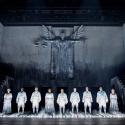
If Oh is the compelling heart of Rubasingham’s smartly directed entertainment, which is bright with laughter and then dips deeper into feeling, both are well served by designer Robert Jones, whose sets are as gorgeous as the costumes of the fancy-dress ball which triumphantly concludes the evening. Before then, this stylish modern-dress production features a well-grounded performance by Paul Chahidi as John who, like Alice, is a mixture of sincerity and insecurity. I’m less convinced by Tom Mison’s rather underpowered Stefan, but there’s a lot to love in the marvellous cameos: Imogen Elliott’s hilariously dreadful Esmée, Rina Fatania’s glorious Indira and Freddie MacBruce’s Allen. I also like the convincingly truthful performances of Abigail Cruttenden as Claire and Jemima Rooper as Elaine. The ending is a terrific coup de théâtre, with composer Anna Meredith’s final fanfares, and a deep stare into the void of darkness lit by chandelier glitter – surely an apt visual metaphor for where we are. Hovering on the brink.