

35 years ago, persona-now-non-grata John Eliot Gardiner revealed how performances of Mozart’s Idomeneo and La Clemenza di Tito allying period instruments with great voices could electrify in a new way. And here we were last night with Pablo Heras-Casado, a conductor as at home in Wagner at Bayreuth as he clearly is with the Monteverdi Choir and Orchestre Révolutionnaire et Romantique, stunning us with a consistently vigilant and alive Mozart Requiem.
The programme was typically inventive. It started with the ultimate joyburst, Bach’s Singet dem Herrn – “singet" as in zing it – with Heras-Casado drawing shapely phrasing with expressive, batonless hands and the choir paying attention to all the words, crystal-clear from the 35 singers. Perhaps the double choirs would have worked better spaced further apart, but any slight reservations were soon cast aside, and the fugal end crowned the work with supreme elan. 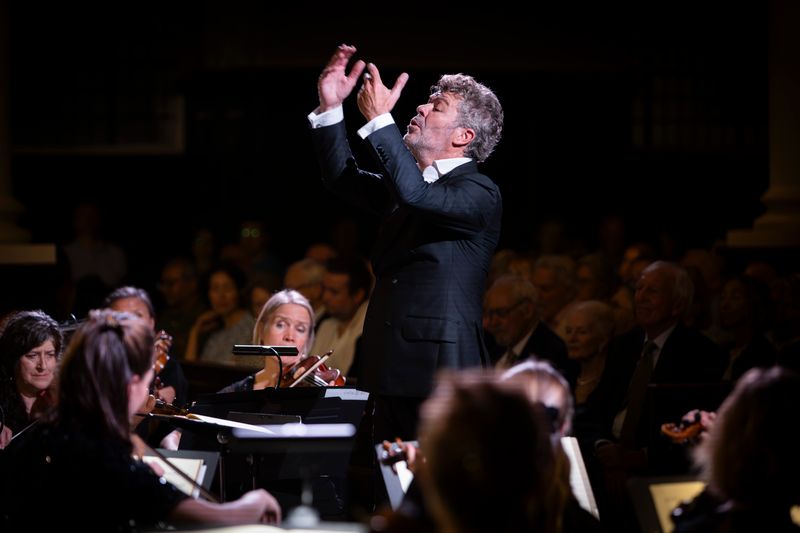 Mozart stood in awe of this polyphonic masterpiece, and Schubert revered Mozart, channelling him for delight and a bit of sturm und drang in the Fifth Symphony. Its pure-Schubert opening blitheness wasn't completely clear in St Martin's usually helpful acoustics - perhaps Heras-Casado took it just a bit too fast? - but all the more muscly music had plenty of attack, supremely so in that surprise minor-key scherzo. The players were a delight to watch as well and hear, going great blazes, one in particular (I won't embarrass him) expressing every emotion and with a rare eye on the conductor.
There was no need to worry about Süssmayr's completion of the Mozart Requiem when the full team proved as committed and compelling as this. The chorus again made the text meaningful, offering the greatest blaze on the "Rex tremendae majestatis"; period trombones and trumpets offered their unique cut and thrust; and the soloists (pictured below) were just perfect. 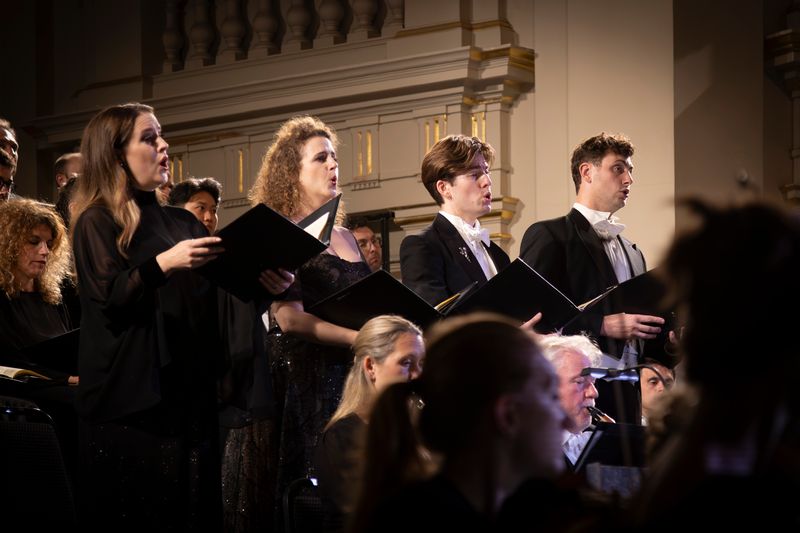 At either end of the spectrum, Louise Alder and William Thomas offered vivid operatic resonance; Laurence Kilsby, whom I remember as the best treble I've ever heard, "Choirboy of the Yes", is now a graceful, sweet-toned tenor, and the one I'd not heard before, mezzo Eva Zaïcik, had an opulence of which we need to hear much more. The Benedictus simply flew in the perfect blend of all four. Above all Heras-Casado, like another inspired interpreter of earlier works, Peter Whelan, kept the temperatures at a high level even allowing for a break in the middle. More from this team, please.






Add comment