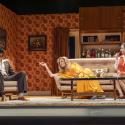
Teen spirit explodes time and time again in the intimate space of Bristol’s Tobacco Factory, with piercing electronic sounds, fierce lighting and a torrent of high-energy movement. The frenetic pace of Baz Luhrman’s film has left its mark on intepretations of Shakespeare's classic love story, and this isn't necessarily a good thing. There is more than enough youthful energy in Shakespeare at the Tobacco Factory's production of Romeo and Juliet, and the decision to place the action in the rebellion-torn 1960s feels misguided and undermines a show that nevertheless features some very good individual performances and sound directorial choices.
The costumes, a hotch-potch of flower-power and Mary Quant, head-bands and white boots, a party at which the wild teenagers don gasmasks and goggles, and a soundtrack that owes as much to the metal and rave culture as to the earlier times of Streetfighting Man, feel gimmicky and distracting. The parallel with 1968, which director Polina Kalinina writes about in her programme notes, isn’t valid or inspiring. West Side Story got it right by transposing the Capulet-Montague rivalry to the world of 50s New York gangs, but, even if the young lovers challenge the values of their elders, this isn’t a story of political revolt, but a tragedy of star-crossed love.
Much of the action takes place on and around a playground roundabout, a potentially versatile wheel – symbol of fortune’s ups and downs – that is barely exploited. It serves as a stage within a space that hardly needs one, but at times, the added focus works well, as when it evokes Juliet’s bedchamber, which, in a well-lit metamorphosis, becomes the Capulet family vault. The bed on which the lovers have consumed their love is also the setting for their deaths.
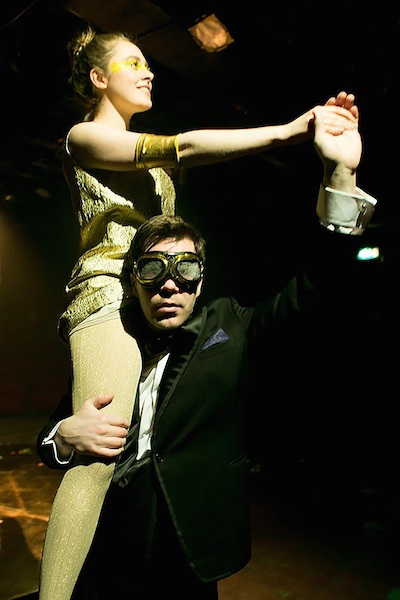 The two stars, Paapa Essiedu (Romeo) and Daisy Whalley (Juliet, pictured left with Jack Wharrier as Paris) are convincingly starry-eyed and innocent: the love story at the core of the play takes holdas they find refuge in passionate union amidst the turmoil of hormones and hostility that surrounds them. The lighting changes – not least in the “balcony scene” - work very well and highlight the emotional currents that make these moments of the play so memorable. Mercutio, the embodiment of silver-tongued verbal gymnastics, is played as a hyper-active and slightly unhinged binge-drinker by the wiry Oliver Hoare. The heavy alcohol consumption feels a little too 21st century, but his presence on stage is strong, and after he is killed by a slightly one-dimensional Tybalt (Craig Fuller), he is sorely missed. The other leading actors never engage us with as much force.
There is a moment, when Capulet loses it and screams at his daughter, that rings true and suggests that the violence of the young owes much to the repressed emotions of their elders. The Nurse (Sally Oliver), wears a scarf and Carmen rollers – one of many slightly bizarre costume choices – and Friar Lawrence (Paul Currier) is a yoga practitioner, doing his salutation to the sun as we first set eyes on him. In spite of these decidely odd devices, the two actors communicate well their impatience with the young lovers – a frustration that is tempered by tolerance and love.
But there are too many moments that touch on the caricature or comic book, as if the emotional highpoints were being played for sheer horror-effect or even laughs. Romeo’s slaying of Tybalt with a piece of metal piping feels unnecessarily gory and literal, even if the violence needs to be clearly stated. When the Capulet parents find their daughter drugged by the Friar’s potion, believing she is dead, their reactions are somehow ill-timed and all too predictable, as if the emotions were being aped rather than felt. With a play that is all about the overwhelming power of human passion, this production, for all its frantic movement and ear-splitting noise, feels surprisingly disengaging, The fault lies, however, as much with a work that fails to dig as deep into the complex world of human emotions as other Shakespeare texts. The perennial popularity of Romeo and Juliet owes much to this lack of depth, a box office pleaser that stirs but doesn’t fundamentally shake.