

Operatic hit parades have always been subject to fashion. For people of my parents’ generation, the famous number from Delibes’s Lakmé was the heroine’s coloratura Bell Song, immortalised at the movies by Lily Pons and Kathryn Grayson. Now it’s the Flower Duet, courtesy of British Airways. But there are other numbers equally worthy of attention in a glorious score stockpiled with the kind of thing the French call la mélodie eternelle. This is an opera that outside France has been in need of singers and a not too violent concept to do it justice.
opera reviews
stephen.walsh

The gable end of Martin Graham’s converted barn opera-house at Longborough is surmounted by statues of three composers: pride of place, not surprisingly, to Wagner – the festival’s raison d’être – and with Verdi and Mozart on either side. It’s true one approaches Italian opera here with somewhat less confidence than Wagner. But it’s refreshing to have it at all, and the new Rigoletto, though patchy, has enough good points to make it worth the visit, if not the detour.
David Nice

It may only be a revival, but this is what the Royal Opera does best, above all in fielding a living legend of a Falstaff for Verdi's last masterpiece who’d probably be beyond the pockets of many other houses. Italian baritone, masterchef and filmstar Ambrogio Maestri is flanked by a good ensemble including two of the Jette Parker Young Artists Programme’s finest graduates, with top orchestral standards for Verdi's most elaborate score under the perfectly-pacing Danish conductor Michael Schønwandt, and a staging high on style, culminating in a dazzler of a final scene which is a return to good stagecraft after the fitfully clever, sometimes inept Guillaume Tell.
One still gets the feeling that Robert Carsen, whose 2012 production is revived here by Christophe Gayral, wants everything to fit too closely together – that if he could he’d set the whole thing, rather than just four-and-a-bit scenes out of six, in a 1950s luxury hotel a long way from Windsor’s Garter Inn (“alla Giarrettiera” in Boito’s brilliant Shakespeare adaptation, rendered back into flavoursome English in the excellent surtitles). Bearing in mind this production also had to make its mark at the Met and La Scala – the ideal house for Falstaff’s fine-tuning is really Glyndebourne – Paul Steinberg’s massive wood panelling will do for a vast hotel bedroom covered in trolleys of leftover food and drink, the leifmotifs throughout, and for Falstaff’s clubroom reception of Mistress Quickly and jealous Ford disguised as a Yankee Brook ("Fontana" in the Italian).
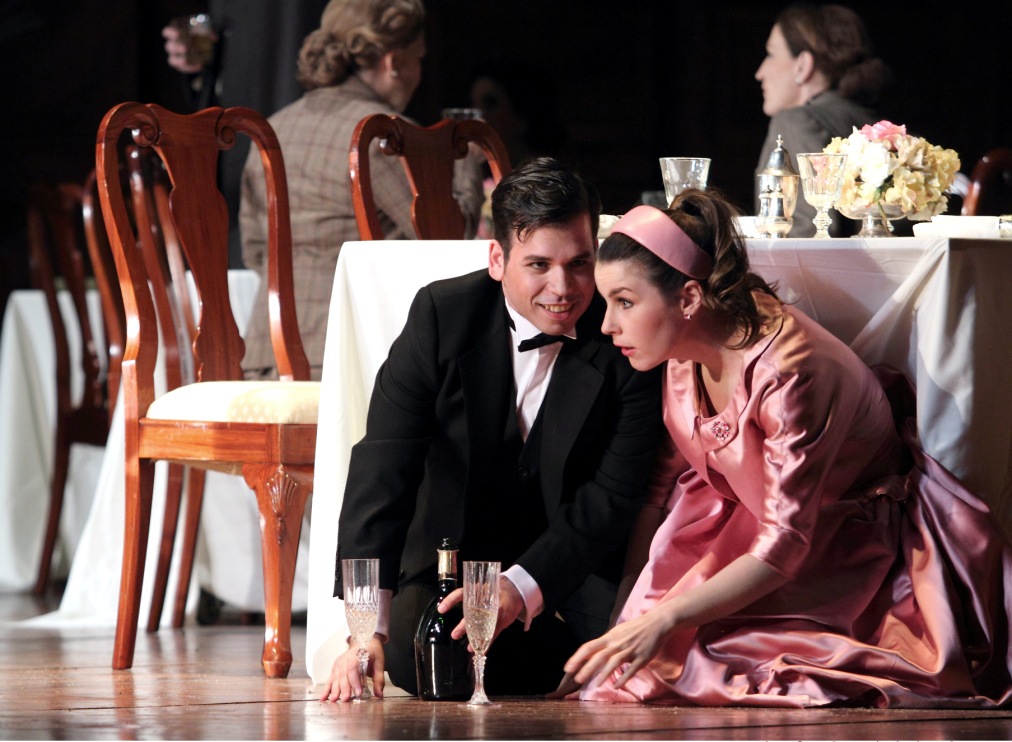 The setting has to work a little harder to place the gaggles of conspiratorial women and men in the dining-room; although both tables are downstage left and right (Luis Gomes's Fenton and Anna Devin's Nannetta under one pictured right), the main players can be lost among the diners – an expensive number of actors - at least from the distance of a balcony seat. Why, you find yourself asking, would they constantly be getting up and leaving their places, and would the other guests tolerate all that pacing? The logistics of the hunt don't work too well, either, if you take the timescheme too literally. Let’s just say Carsen expects us not to, but a degree of realism does rather encourage such questions.
Verdi’s first scene, which can often feel a touch dry, kicks off superbly given the well-upholstered élan of the Royal Opera Orchestra under Schønwandt, Peter Hoare’s clarion Dr Caius and the short-tall duo of Bardolph and Pistol (Alasdair Elliott in better vocal shape than Lukas Jakobski, who still has work to do on technique). The minute Maestri opens his mouth you know you’re hearing a Falstaff of supreme baritonal beauty, the real Italianate thing – expansive in phrasing, effortless in the upper register and (crucially) relaxed enough in his big body to be genuinely funny. The “honour” monologue is a masterclass in how to combine lyric phrasing with minutely-observed musical theatre delivery. Later, more miniature set pieces come with a fabulous vaudeville routine ("Va, vecchio John") and a very funny carving of two slices of roast chicken for Alice and the rest for himself ("Quand'ero paggio")
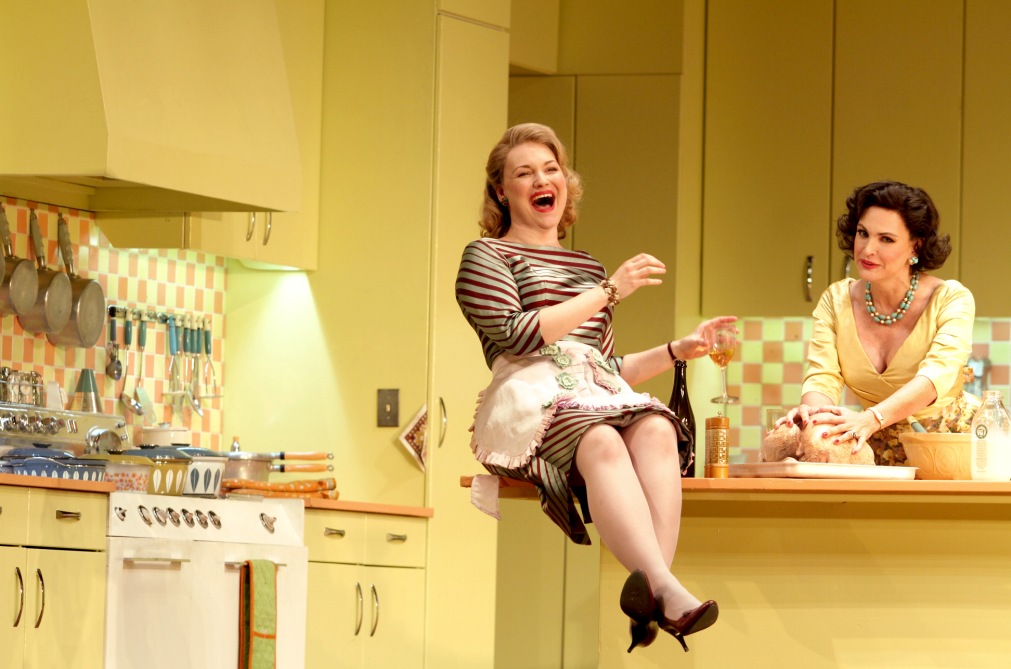 The merry wives with daughter and comic stooge in tow find the timing less easy; I don’t think it’s any fault of the hyper-alert Schønwandt, who likes to vary between featherlight precision and a more thoughtful, beautifully coloured vein, that on the first night the earlier ensembles weren’t quite spot on. Individually, two out of the four women are near ideal and one, Anna Devin as an especially determined Nannetta Ford, is superlative, floating every line with vivid sense of bel canto style and rising to the highest artistry in the Queen of the Fairies’ seriously beautiful song. Ainhoa Arteta’s glamorous if not vocally quite Italianate Alice Ford and Kai Rüütel’s fashion-plate Meg Page sport wonderful Fifties couture in the Act Two kitchen (pictured above), courtesy of the ever-inspired Brigitte Reifenstuehl, and convince us they’re having fun into the bargain; Agnes Zwierko’s Quickly gets plenty of laughs but hams up the over-reverent “female Mercury” delivering the deceptive messages to Falstaff and, though she certainly has the contralto extension, the voice swims in and out of focus.
You have to feel a bit sorry for Roland Wood, a Ford one would be very happy to see under other circumstances but outshone by Maestri’s sheer baritonal quality and physical ease in their scene together; it’s Maestri's voice you really want to hear at the peak of Ford's jealous diatribe. Luis Gomes, like Devin schooled on the Young Artists Programme and quick to shine there, takes a bit of time to open out up top as stock lover Fenton, though he’s very sweet as a quirky waiter in the Garter Restaurant and the moonshine serenade of the final scene is a perfect preface to Devin’s even lovelier number.
I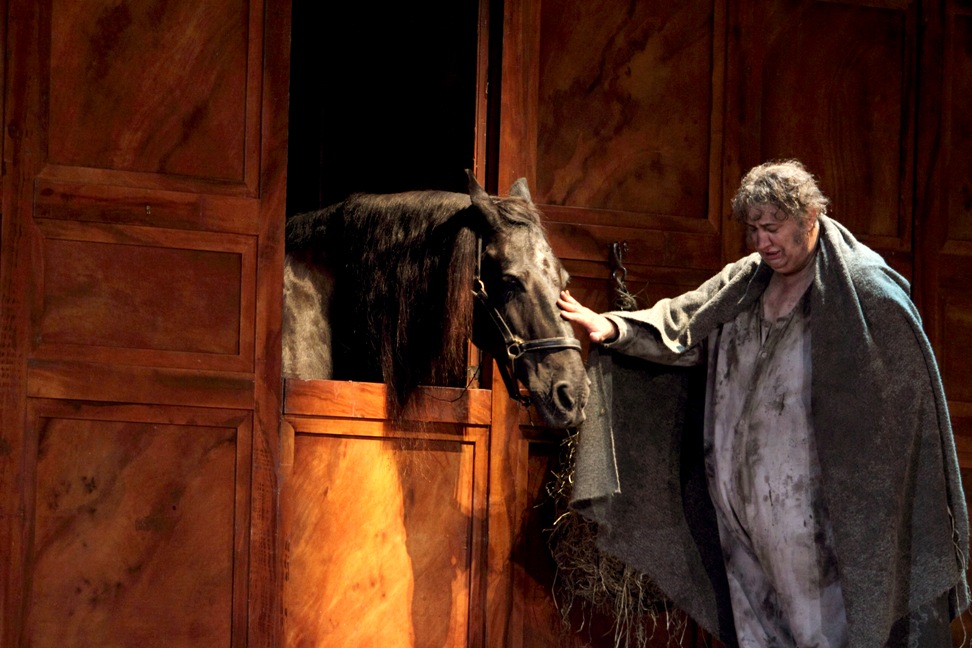 n fact everyone except Maestri, who's perfect throughout, saves the best until Verdi’s last, not least Carsen who, having pleased the simpler souls in the audience with a hay-munching horse in the stables where Falstaff is somewhat enigmatically sprawled after his dip in the Thames (Maestri pictured above with Louis), brings out his consummate gift for visual transformations in what’s usually the Windsor Forest scene.
For a start, dry ice is usually the sign of a director’s impoverished imagination, but here it becomes a choreographed character threatening the horned Falstaff before a squadron of similarly-clad "spirits" turns the tables on the old lech, literally, with Nannetta as Queen. You can see the directorial cogs at work, wheeling on the trolleys so the production’s keynote of food can be fed into a knife-sharpening crowd of spooks preparing to eat the fatted calf as he rolls down the length of a deftly extended table. To steer everything to a happy meal at the end, Carsen continues to exert all his elegant tricks of movement and lighting – he's the co-designer in that field too – up to and including the dazzling, perfectly together fugal feast. The end crowns the work, and all is finally right in the beleaguered world of the Royal Opera as it rolls out a very classy end-of-season show.
- Falstaff at the Royal Opera until 18 July
- David Nice's blog on Glyndebourne's 2009 Falstaff and Robert Carsen's Zurich production of Tchaikovsky's The Queen of Spades
Next page: get a sense of Maestri's fabulous legato in the Prologue to Leoncavallo's Pagliacci. Plus a risotto recipe.
stephen.walsh

Britten’s first chamber opera is very much a Glyndebourne piece; its world premiere in the old festival theatre in July 1946 was also the festival’s inaugural post-war production. It brought into being the English Opera Group, and led soon afterwards to the foundation of the Aldeburgh Festival. So it’s good, in principle at least, to have it back on the main stage here, after an initial airing on tour in 2013. I say in principle, because in practice the work and its staging present so many problems that I can’t ever recall seeing a production without wincing with irritation.
alexandra.coghlan

Some of the best nights of opera to be had in London come courtesy of students. It’s not something we talk enough about, possibly because, with four major music colleges in the city, the quality is so high that the performers can (and are) judged as professionals. The Royal College of Music’s Albert Herring is up there with the best of them – an ensemble show bursting with character, detail, wit and an abundance of joy.
David Nice

There are two operatic types who should leave Rossini’s epic swansong for the stage well alone. One would usually be a conductor who ignores many of the notes written by a master at the height of his powers, since even the least dramatic numbers have musical idiosyncrasy in them. Antonio Pappano still omits, among other things, Rossini’s superb Mozartian canon-trio for women's voices and wind ensemble; but what he does conduct is so focused and shapely that he must be forgiven.
Marina Vaizey

Antonio Pappano, artistic director and chief conductor of the Royal Opera House, is a polymath, for he is also a brilliant and persuasive narrator of the history of music. Here he embarked on a four part history of the operatic voice, starting at the very top – or how to reach those high Cs, the Everest for the soprano.
David Nice

Lagoon, miasma and scirocco may seem as far away as you can get from the rolling hills and pleasant airs of the Wormsley Estate in deepest home counties territory. Nor are the bleached bones of Britten’s bleak if ultimately transformative operatic swansong the usual culinary fare many punters might have expected to go with their fine wines and gourmet picnics.
Adam Sweeting

Verdi's La Traviata has become one of the best-loved and most-performed works in the operatic repertoire, but this is no thanks to sections of the English press.
Sebastian Scotney

From “Printemps qui Commence“ (spring is beginning) to “Springtime for Hitler"... that really is quite some intellectual leap. Patrick Mason, an experienced and respected opera director, has uprooted the tale of Saint-Saëns's opera from biblical Gaza, and has placed the first two acts in France somewhere around the time of Jean Renoir's La Grande Illusion, with Warsaw ghetto overtones.