

"You drink coffee, you smoke cigarettes, and you paint. And that’s it." So goes David Lynch’s memorable description of what he calls "the art life" in Jon Nguyen’s frank and engaging documentary. It’s a life that Lynch imagined himself living as a student and a young man – surrounded by the detritus of a disorderly studio, working all hours at his latest visual creation. And for some of his early life, at least, it’s exactly the life that Lynch lived.
film reviews
Matt Wolf

An isolated girls' school finds its hermetic routine shattered by the arrival of Colin Farrell, who wreaks sexual and emotional havoc as only this actor can. Playing a Civil War deserter with a gammy leg, Farrell's Corporal McBurney is at first rendered exotic, not to mention eroticised, by the distaff community into which he has stumbled in 1864 Virginia only in time to be eviscerated by them.
Adam Sweeting

There’s been talk about the way this latest instalment of the rebooted Ape franchise, and the one which brings the story of the brainy messianic ape Caesar full circle, is an allegory of Isis’s onslaught in Iraq or the rise of Donald Trump.
Matt Wolf

If you're going to cobble together an entirely pro forma film, it's not a bad idea to give Shirley MacLaine pride of place. At 83, this redoubtable pro is no more capable of falsehood now than she ever was. It means that, although individual moments of The Last Word may find you rolling your eyes, its central performance rivets attention from first to last.
Adam Sweeting

First introduced into the burgeoning “Marvel Cinematic Universe” in last year’s Captain America: Civil War, Tom Holland’s incarnation of Spider-Man is another triumph for this exuberant franchise (even if some might feel a pang for the fine and still-recent pairing of Andrew Garfield and Emma Stone under director Marc Webb's helmsmanship).
Nick Hasted

Baby drives like a deranged bullet. Edgar Wright’s “diegetic action-musical” choreographs the bank-heist getaways of angel-faced Baby (Ansel Elgort) as physically exhilarating pure cinema, a rush that’s rare.
Nick Hasted

Julian Assange’s white hair marks his public persona. To some he’s an unmistakably branded outsider, or a lone white wolf hunting global injustice. Hollywood would cast him as the coolly enigmatic superhero who’s revealed as the supervillain in the last reel.
Jasper Rees

Is meat murder? Will people eat anything if it’s cheap? Is the taste of bacon really what stops us half the western world turning vegetarian? Okja is a commercial stretch, a partly subtitled children’s fable from South Korea which unstintingly confronts all of these deep moral questions. But it does so in the most – if you will – palatable manner.
Nick Hasted

Isabelle Huppert isn’t just here for the nasty things in life. Her rape non-victim in Elle was one of the most iconoclastic performances even she’s given, enigmatic yet emotionally rich, rooted and moving. She won’t get nearly as much attention for her role here as Liliane, a singer who came second to Abba at Eurovision, who’s lured out of an anonymous retirement by a besotted, 21-year-old boxer who becomes her lover and manager.
Saskia Baron

It’s been quite a while since I’ve seen a movie as staggeringly awful as The Book of Henry. If it was just a touch more shrill it could have qualified as a so-bad-it’s-good camp classic, but unfortunately it teeters this side of tasteful in order to keep its 12 rating. How any studio executive ever read Gregg Hurwitz’s script and thought this was a viable scenario is truly baffling. What terrible atonement for sins in a past life led Naomi Watts to take the lead is another mystery, as is the question of how director Colin Trevorrow (Jurassic World) is going to live this debacle down and go on to helm the next Star Wars.
Jaeden Lieberher plays Henry, an 11-year-old genius who ramps up the value of his waitress mother’s stock portfolio from a phone box. He goes to a regular school despite his stellar IQ because, as he says, "It’s better for my psycho social development for me to interact with my peer group in a normal school environment." He has no father but does share his bedroom with a cute little brother (Jacob Tremblay from Room – wasted here). Henry’s not just brilliant at finances and uttering homilies in class, he’s good with his hands too – he’s singlehandedly built a huge Heath Robinson-esque den in the wood near their home. His ditzy mother Susan (Watts), is happy to have her finances run by her son as she’s addicted to videogames. She’s not pure slacker mom though - she dreams of writing a children’s book between shifts at the local diner and is really good at hugging.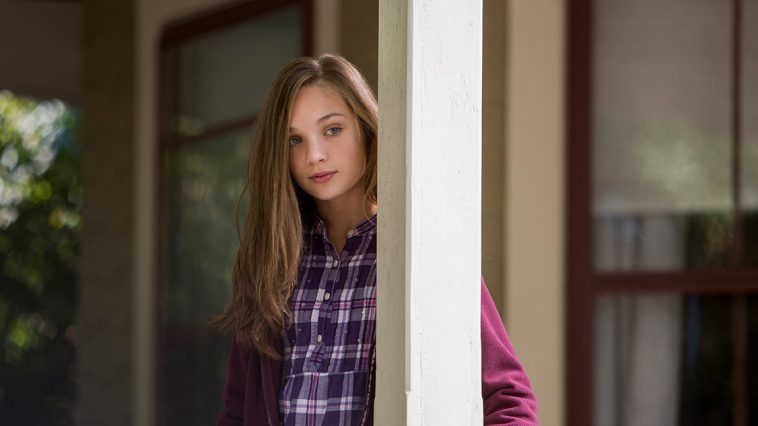 Susan's workmate/bestie is played by Sara Silverman, her bosom tormented by a pushup bra and smothered in tattoos. She has a tendency to flirt with Henry. Again, one wonders what induced an intelligent actor to take this part? The movie then mutates from quirky family comedy to psychodrama, Suffering silently in the house next door is Henry’s classmate Christina, a ‘tween beauty played by Maddie Ziegler (pictured above) who is most famous from regular appearances in the TV hit Dance Moms and a very dodgy Sia video with Shia LaBoeuf). Only Henry knows Christina's dark secret; she is being abused by her wicked stepfather (Dean Norris from Breaking Bad) who just happens to be the local chief of police so no one believes Henry when he sounds the alert…
The Book of Henry then switches genres again to become a disease-of-the-week weepie; it turns out the financial whizzkid is also an expert neurologist who knows which brain tumours are untreatable. At this point my regular 13-year-old movie companion muttered: "It’s now gotten really stupid that he is so clever". Never mind grief-stricken mom, there’s a toweringly hunky doctor (Lee Pace) waiting to cheer her up and Tremblay finally gets a chance to be cute in the school talent show.
The movie makes its final screeching handbrake turn, swerving from weepie to thriller as Susan turns vigilante avenger on behalf of Christina. Luckily, Henry has left detailed instructions (the book of the title) on how to talk tough and illegally buy a gun. He's also available on tape to talk his mom through target practice. Trevorrow cross-cuts between Susan and evil stepdad stalking each other through scary dark woods and the cloying talent show. In a final nonsensical twist, Christina's interpretative dance solo makes the scales fall from the headteacher’s eyes about the abuse allegations - she doesn't just win the talent contest, she gets a new family. By the end of the film, nearly everyone lives happily ever after – except us. The 13-year-old and I would quite like a refund on the 105 minutes we wasted on The Book of Henry. Please don’t make the same mistake.
Overleaf: watch the official trailer for The Book of Henry