

It’s over 50 years since men last landed on our orbiting space-neighbour, but director Greg Berlanti's Fly Me to the Moon transports us back to the feverish days in 1969 when Apollo 11 was about to tackle the feat for the first time. The film’s promo material rather misleadingly bills it as “a sparkling rom-com”, but it has a few other strings to its bow. For instance, it’s partly a satire on American capitalism and the advertising business, takes a few sideways glances at the Vietnam war, and has inherited some of the DNA of a political thriller.
It’s an eccentric mixture, but it works thanks to some smart casting and a slick screenplay by Rose Gilroy, while the meticulous Sixties period detail of clothes, cars, music and hairstyles lends it an evocative time-travelling aura. Most of all we have Scarlett Johansson to thank for her fizzy, feisty performance as Kelly Jones, a brash and ambitious marketing executive from New York who’s recruited by shadowy White House fixer Moe Berkus (Woody Harrelson) to carry out some image-massaging for the Apollo programme. She aims to make the astronauts “bigger than the Beatles.”
Though it was ultimately successful, America's race to the Moon suffered some serious setbacks, and hoovered up huge piles of funding that many believed could have been better spent elsewhere. Gil Scott-Heron’s “Whitey on the Moon” contrasted the social deprivation of black Americans with the bucks being sprayed over the space programme, but Kelly’s mission will be to schmooze sceptical congressmen and bedazzle the public. Above all, as Berkus explains, as far as President Richard Nixon’s administration was concerned, “it’s about watching America beat Russia on TV.”
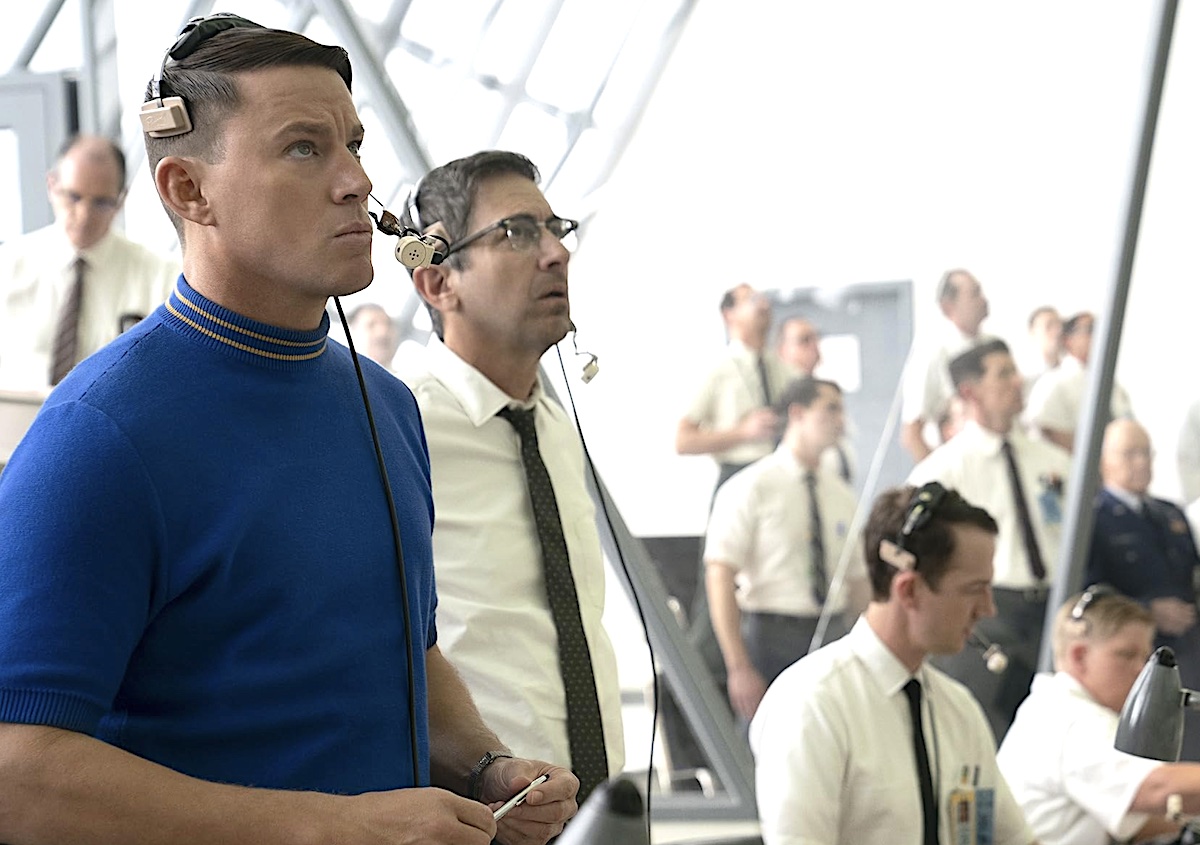 Kelly seizes the opportunity with both hands, and is soon deploying her promotional skills with gusto. After all, she’s proved herself great at selling cars, despite the boorish opposition of the male chauvinist dinosaurs of the motor industry, so why not the space race? The somewhat earnest and straight-faced NASA personnel are aghast when they discover that Kelly has been hiring actors to impersonate them and give interviews to the media, and she’s soon raking in partnership deals with the likes of Fruit of the Loom clothing and Tang soft drinks. Suddenly all the astronauts are wearing Omega watches.
Among those most outraged at Kelly’s antics is Cole Davis, who’s directing the Apollo mission and seems to be a fictionalised version of the real-life Deke Slayton. It was crafty to hire Channing Tatum for the Davis role, since he perfectly inhabits it as a prime hunk of square-jawed, rock-like American manhood, notwithstanding a rather strange hairstyle which resembles a slice of shiny black leather pasted onto his head.
He’s a former military pilot who’s been ruled out of becoming an astronaut because of heart arrhythmia, but now runs operations with extreme seriousness and diligence. Part of his regular routine is solemnly laying flowers at the memorial to the three astronauts killed in a launch-pad fire in Apollo 1. He does have a concealed romantic side though, which eventually emerges when he gives Kelly a ride in his lovingly tended P51 Mustang fighter.
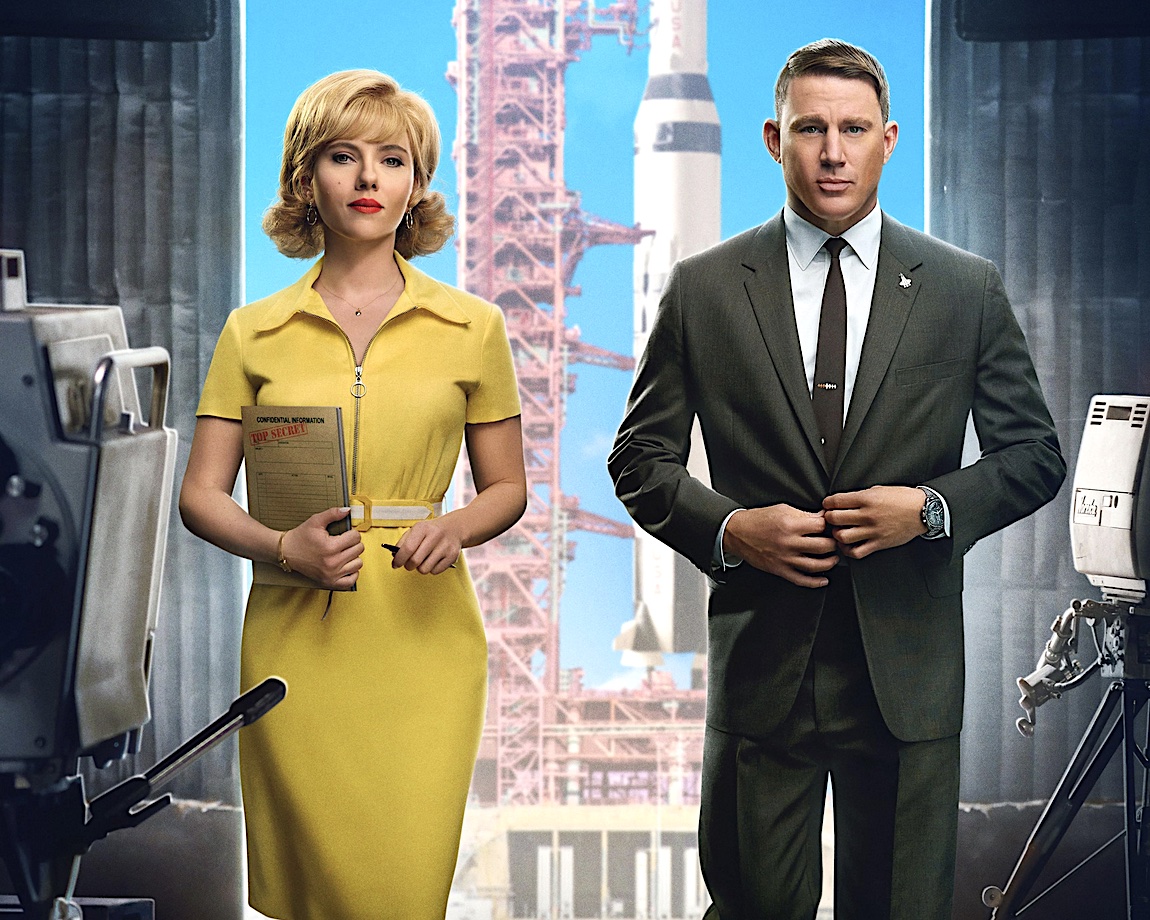 What gives the film the sting in its tail is the revelation that Berkus’s mission extends a little further than a mere marketing campaign into heinous and fraudulent propaganda. To guarantee the success of Apollo 11, even if it never gets anywhere near the Moon, the US government wants to hire a film crew to shoot a film of a fake moon landing (faint echoes of Peter Hyams’ 1978 film Capricorn One, about a bogus mission to Mars). If Berkus does his job properly, nothing can possibly go wrong and the world will see only the desired result.
This affords scope for a zingingly camp turn by Jim Rash as film director Lance Vespertine, tasked with creating the studio-bound Moon excursion. Festooned in vividly coloured waistcoats and ravishing scarves, Lance may well be channelling Stanley Tucci’s Nigel from The Devil Wears Prada, and he can barely contain his disdain for the low-calibre talent which surrounds him. “I think we should have gotten Kubrick,” Kelly mutters.
It’s a fast and funny film which scores some serious points within its chaotic progress, and there’s even a sly walk-on appearance by an enigmatic black cat. It could be the perfect summer movie, if we ever get a summer.


