

The clue is in the name: Selma, after the Alabama city that was the site of three crucial confrontations in the 1960s struggle for African-American civil rights, not King, after the eloquent spokesman and de facto leader of that struggle. Because director Ava DuVernay is more interested in saluting the power of a grassroots movement than in lionizing a Great Man of History, this inspiring, profoundly moving film avoids the pussyfooting and over-reverence that has afflicted biopics of other secular saints like Gandhi, Lincoln, and Mandela.
The moral courage of David Oyelowo’s Martin Luther King, a subtle but powerful performance, is never in doubt. But the focus here is on King the political strategist, which further humanises him. This is King the media strategist who decides to hold a voting rights march in a location where the governor, George Wallace, is an outspoken segregationist and the local sheriff is volatile because a previous march elsewhere that went off without incident did not attract enough coverage.
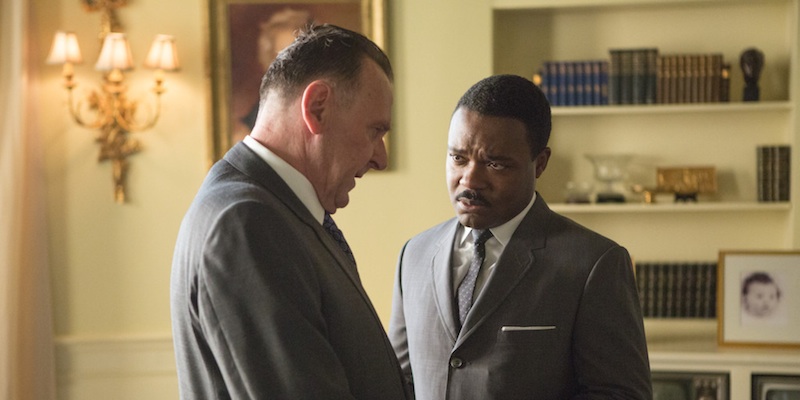 In fact, in its keen analysis of King’s maneuvering between the impatient young radicals of the SNCC and President Lyndon B Johnson’s go-slow approach, as well as its belief in electoral representation, Selma resembles a particularly angry, resonant episode of The West Wing. Anyone who takes a cavalier approach to voting should consider its depiction of people risking beatings and even death to gain the right to do so.
Selma’s characterisation of Johnson caused considerable controversy in the US, where some commentators felt it exaggerated his resistance to 1965’s Voting Rights Act. Unfortunately, drama arises out conflict, so if Johnson had been more compliant, the story would have been DOA if more historically accurate. The usually reliable Tom Wilkinson’s rather cartoony performance doesn’t help (Wilkinson with Oyelowo, pictured above) and Tim Roth as Wallace similarly doesn’t know how to play smart and good ol’ boy simultaneously, but fellow Brits Oyelowo and screenwriter Paul Webb acquit themselves admirably.
The numerous extras on the Blu-ray include a music video of the theme song by John Legend, a commentary by DuVernay and Oyelowo as well as one by the cinematographer and editor, deleted and extended scenes, a study guide, a tour of the National Voting Rights Museum, contemporary newsreels, and other features that flesh out the film’s historical context. Extras on the DVD are skimpy.


