Rainer Werner Fassbinder, the wunderkind of New German Cinema, worked at a prodigious rate. By the time of his death in 1982, aged just 37, he’d made over 40 feature films and directed over half as many stage plays. He also made films specially commissioned for television, something that was certainly looked down upon by both mainstream and avant-garde film-makers in the Seventies. Treating his television projects with no less commitment, Fassbinder was an arthouse film-maker who broke the mould in many ways, though his output must be said to be of vastly variable quality.
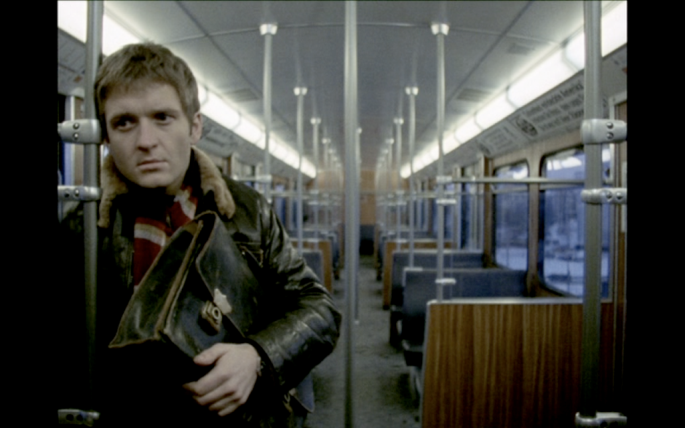
I Only Want You to Love Me, 1976 is his first television venture. It’s also said to be his most autobiographical film, and certainly his most Freudian. It tells the story of a naïve young man, Peter (Vitus Zeplichal, pictured below), a builder by trade, who builds a house for his parents but cannot win their love. In an early flashback scene that sees him as a little boy, he is beaten by his mother for bringing her flowers pilfered from a neighbour’s garden. Later we find him lavishing gifts on his young bride, and he soon spirals into debt. His eventual mental collapse leads him to kill a man who is the double of his father (both parts are played by Alexander Allerson).
 The idea of the doppelganger is taken further in the more stylised Despair, 1978, an adaptation from a 1934 Nabakov novel, with a screenplay by Tom Stoppard. It was Fassbinder’s first English-speaking film (he made three) and the first in which he used international stars, working with a budget that exceeded his first 15 films together.
Dirk Bogarde plays Hermann Hermann, a chocolate magnate in 1930s Berlin, whose marriage to the vacuous, child-like Lydia (Andrea Ferréol) has gone sour, along with his business. He meets a good-looking vagrant (Klaus Löwitzch) who he is convinced is his double. He is soon hatching a plot to murder the vagrant in the hope of stealing his identity and so gaining freedom.
Where the earlier film strives for a more accessible naturalism, Despair - despite some sophisticated camerawork involving mirrors and screens - feels more clunky and dated. Bogarde, who apparently regarded his acting in the film as amongst his best work, does a comic-tragic turn but piles on the camp a little thickly. A few too many stilted tableaux and swooping dramatic zooms, which, whilst paying homage to early cinema, eventually begins to pall.
However, the extras on both films are very good: two absorbing documentaries on the making of each film, with some rare footage of Fassbinder talking about art and madness, and frankly looking completely stoned.
Watch the trailer for Despair (contains nudity)