It’s 1952 on Manhattan’s Lower East Side, seven years after the Enola Gay dropped a bomb on the Japanese empire, but one skinny New Yorker is still waging war against it, armed with street savvy, a motormouth and a traditional table tennis paddle.
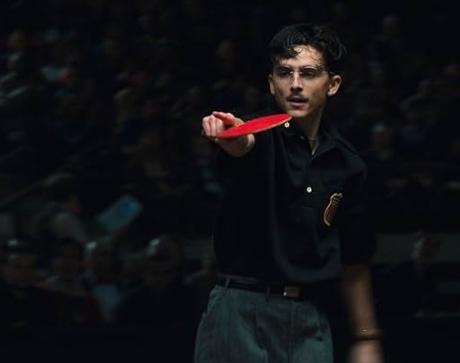
This is the unlikely subject of Josh Safdie’s first solo directing release, Marty Supreme, loosely based on elements from the life of Marty Reisman (here called Mauser and played by Timothée Chalamet). Most Japanese sportspeople had to observe a post-war travel ban, but not the low-level celebrities of the table tennis world, which was barely considered a sport in the US. So at a local tournament Mauser unexpectedly comes up against a Japanese player of immense skill (played by real table tennis champion Koto Kawaguchi), who wields a new kind of bat and a reinvented playing style, in which the bat is foam-coated on one side and held like a pen, delivering balls with killer spin.
Marty Supreme, like Endo's bat, doesn’t deliver the traditional goods, though. The familiar arc of the sports film plot underpins it, of the player who overcomes many obstacles to dominate his sport, but it’s overlaid with a welter of subplots and characters (Abel Ferrara crops up; David Mamet is in there somewhere, briefly, a former table tennis club habitué). It becomes a romp through the low-lives of the period in downtown Manhattan, the denizens of the seedy basement clubs where players like Marty hustle for their daily bread. Reisman was a supreme example of this type, reportedly, who always played for money and featured novelties and tricks in his routine. He was a genuinely gifted player, a multiple World Championships medal winner in the late 1940s, when the sport was dominated by Eastern Europeans.
Safdie’s Marty is a more recognisably American hero, a fatherless Jewish kid who has had to grow up tough, living on his wits while coping with a manipulative mother, a hot married girlfriend and a burning ambition. We meet him when he needs big money to get to the World Championships in Tokyo and is working full-time in his uncle’s shoe store to raise it. On his final day, when his uncle stalls about giving him the back-pay he needs for his trip to Japan, he takes matters, and a gun, into his hands to get the cash – and triggers a chain of chaotic events that involves gangsters, a fading movie star (Gwyneth Paltrow, pictured below, reminding us she is a creditable character actress), a scheme to develop orange tennis balls, a chase through New Jersey after a runaway dog. Think One Battle After Another with pingpong bats.
This ragbag plotting teeters on overload, but somehow manages just enough rest-breaks for the audience to get their breath back before it explodes back into life. It’s a relentless watch, even so, the camera typically pressing into the actors’ faces and hands, following behind them so closely that the backs of their heads fill the frame and their facial landscapes are unforgivingly exposed. The music regularly swells into big dramatic climaxes – none of it authentically 1950s, most of it redolent of New York in the 1980s, with heavy disco beats and stylings. Marty’s Japanese opponent is a mechanic rendered deaf by an air raid, who finds the silence aids his concentration, but Marty’s life is all sound and fury, erupting into violence in that characteristic Safdie way.

Yet the film manages to be engaging even when it seems to be noisily outstaying its welcome (it’s 150 minutes long). The script is full of zingers, delivered with huge skill by Chalamet, a charismatic ball of energy from start to finish who convinces you he really could become a table tennis world champion off-screen, whomping smashes onto the little table that is his arena. His Marty is supremely confident and enterprising, or, as his mother puts it, a “narcissistic prick”. He sees himself as a force that can make others’ lives more meaningful, along with his own, by promoting table tennis as a globally appreciated sport. “I have a purpose,” he solemnly intones, to much audience laughter.
The fate Marty is resisting, which he announces early on he will not accede to but is forced into by lack of funds, is to be a sideshow on the Harlem Globetrotters tour, where among other tricks he picks out tunes on the backs of saucepans with pingpong balls and plays with six at once, a performing seal who even has to play against an actual one. However obnoxious his behaviour, his desire to be a champion is nevertheless genuine, even oddly sympathetic. He seems to grow in stature professionally the more he has to apologise and take his punishment, and a new maturity enters his game. And also his personal life, where he moves – rather too swiftly – from smart-arse punk to blubbing new dad.
Along the way, the film asks us to stomach some jarring material, though, not just brutality and violence but brusque remarks about the holocaust that Marty swats away by saying he’s Jewish so is allowed to make them. In another scene, his playing partner, a survivor of Auschwitz-Birkenau, tells a tall tale about his beekeeping at the camp, in which he slathers himself in honeycomb for the other prisoners to lick off, a grotesque spin on a Madonna. With directing verve, it seems, can come a giddy tastelessness that even Chalamet’s Puckish huckster charm can’t quite smooth away. For raw energy, though, it’s ace.