The latest brainwave of director Richard Linklater is wonderfully simple: don’t do another remake of Jean-Luc Godard’s debut film, A bout de souffle (1959), make a movie about the making of the film that nails what the movement he helped launch, the nouvelle vague, stood for. And make it with a French cast and crew.
The result is a film that’s a must-see for all lovers of the original. This isn’t pastiche, it’s an academically sound love letter to the nouvelle vague and all who sustained it. Linklater carefully captions these contributors on their first appearance. The resemblances in some instances are so marked, you have to pinch yourself and check you aren’t watching archive footage. Jean-Jacques Le Vessier, the actor playing Jean Cocteau, for example, seen avidly watching François Truffaut’s Les quatre cents coups, is an uncanny lookalike.
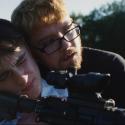
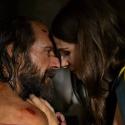
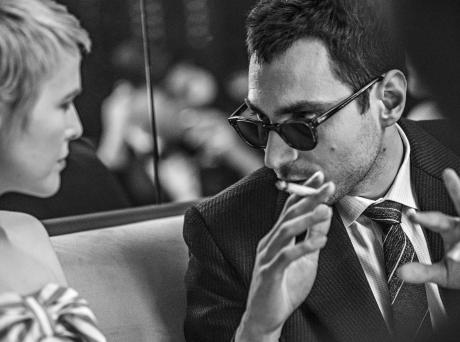
Linklater recreates not just the faces of the Cahiers de Cinéma contributors – all the names that gave the movement its ballast: Truffaut, Jean-Pierre Melville, Agnès Varda, Jacques Rivette, Claude Chabrol, Bertrand Blier, Éric Rohmer – but also the heated debates they regularly had about their profession. Among those around the conference table at the Cahiers office, only one restless man in tinted specs has yet to direct a full-length feature film, he complains: Godard, played with impeccable but unforced accuracy by Guillaume Marbeck (pictured below with Zoey Deutch).
The 26-year-old Godard’s modus operandi is now seen as standard-indie, a style of no-budget guerrilla film-making that projected all the authentic spontaneity and verve of the movement and made it cool. He pulls off the feat of filming 58 set-ups in 20 days, including a detour to the rural setting of the motorcycle cop’s murder that sets his protagonist in motion.
The original shoot used the streets of Paris and their denizens, cheekily including footage of a President De Gaulle motorcade, as well as deploying friends and colleagues in cameos and bit-parts. Godard himself appears as a pipe-smoking man who betrays his leading man’s whereabouts to the police. (You can’t help conjuring a smirking trumpet playing at low volume under that scene.)
Marbeck captures all of Godard’s wayward tendencies, his mercurial moodiness, his impatience and snappiness, as well as his comic refusal to adopt conventional procedures such as multiple takes, special lighting, even make-up. When a scene plays out, he doesn’t miss a beat – “Coupe!” Continuity, too, goes out the window, as cups mysteriously disappear and reappear between takes, much to the props manager’s distress. Godard disappears, too, as soon as his ideas run out, sending cast and crew home for the day after just a few hours’ work. He is delighted to have left his baffled editor with the resulting ragbag of footage, as it obliges her to invent the jump cut.
His brusque treatment of his team is fully displayed, especially his disregard for the comfort and sensitivities of his American lead, Jean Seberg, portrayed with total authenticity by Zoey Deutch, right down to her painful American-accented attempts at speaking French. Deutch’s Seberg has exactly the build, the looks, the pixie hairstyle, the temperament; also an ambitious French husband, François Moreuil (Paolo Luka Noé) in tow.
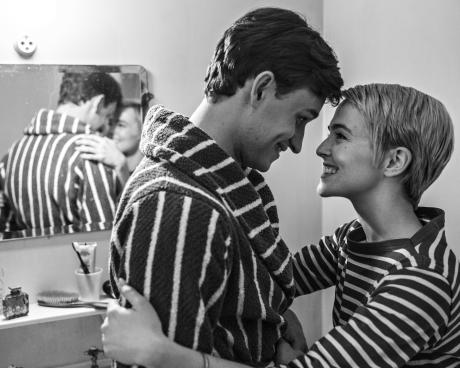
Opposite her, Linklater has cast an actor with few of Jean-Paul Belmondo’s physical characteristics beyond his heavy lips and muscular build. Aubry Dullin (pictured below with Zoey Deutch) is taller, rangier and less rugged. But he still conveys the laidback charm and athleticism of the former boxer with a broken nose who would go on, the yang to Alain Delon’s yin, to epitomise France's reinvention of male beauty.
The script, like most of Godard’s, is a series of epigrammatic zingers, which won’t please those who have a low tolerance for French philosophical fisticuffs. It accentuates the smug cockiness of some of the Cahiers crowd, as they bicker away about the meaning of cinema, love, life and reality. But that would be to miss the warm affection Linklater clearly has for this bunch of well educated mavericks. Their chief hero, especially for Godard, is Roberto Rossellini (Laurent Mothe), depicted as a wise old owl who tells the assembled film makers he believes cinema is a moral medium but in no way mystical, urges them to shoot fast and cheaply, then begs them for money and pockets the buffet’s leftover tartines as he leaves.
Linklater joins in the games in this cinephiles’ playground, peppering the action with references to Bergman and Fellini. I am assuming his reconstruction of what happened on set is accurate, such as the inventive no-budget ways Godard and his now-celebrated cinematographer, Raoul Coutard (Matthieu Penchinat), devised for getting maximum impact with a simple Camiflex portable camera. Coutard had learned his craft with one covering hostilities in Vietnam. He pops up in all manner of undignified poses – being pushed in a pram for travelling shots, hidden in a postal cart along with mocked up parcels addressed to Nicholas Ray and Howard Hawks, dragged around by Godard in a wheelchair. One lovely moment has the team going down into the Métro to film, only to find Robert Bresson and his film crew already there.
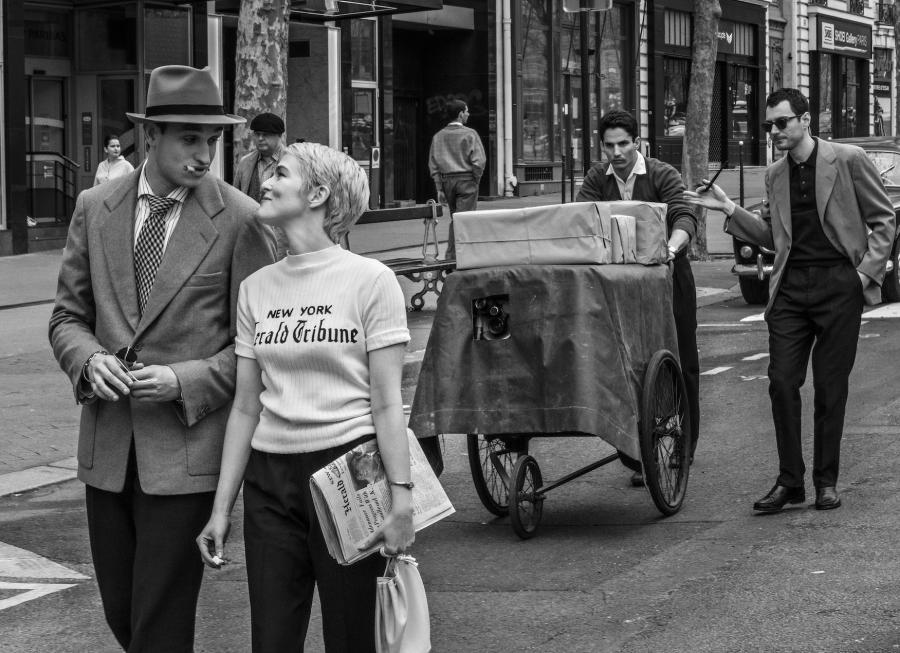
Meanwhile, Seberg and Belmondo become amusingly sharp mimics of Godard’s dictatorial style, battling him for some creative control, especially insisting on needing to know how the film will end, which he can’t decide upon. Because Godard isn’t using sync-sound, the two of them babble away, chatting to passers-by, even during the final showdown.
Linklater has pulled off the feat of setting up the pretensions of the nouvelle vague for ridicule, while endorsing the aims of their movement. The film is both a corrective to current big-budget practices, where nothing is “real”, concocted by computers and played out in front of green screens, and an advertisement for cinema made in the moment, fresh and spontaneous.