The German theologian, pastor and anti-Nazi dissident Dietrich Bonhoeffer (1906-1945) was a saintly, courageous figure, of major historical significance. Those are good reasons to ensure that his story gets told and becomes better known. At a time when fanatical violent nationalism is on the rise and religion has been commandeered to support it, Bonhoeffer's work and his contribution to ideas have a renewed relevance.
It is one thing to tell the story of Bonhoeffer's life, and quite another to tell it well and accurately. The film's director, Todd Komarnicki, who has been accused of misunderstanding Bonhoeffer's ethical positions, unsurprisingly admits to being awestruck by his subject, describing him as “one of the greatest heroes of all time”.
The first film that the playwright, novelist, and filmmaker Komarnicki has written, produced, and also directed is clearly the fulfilment of a personal ambition. Despite Komarnicki's claim that it is an anti-fascist work, it has been controversially co-opted by Christian nationalists.
Komarnicki presents Bonhoeffer as a hero compelled to commit to dangerous acts of bravery to defend the values he believes in, though his tangential participation in July 20 plot to assassinate Hitler in 1944 had been the source of a moral dilemma for him.
The real Bonhoeffer was an intellectual who had already completed his doctorate, establishing a systematic theology of the spirit by the age of 21. He thought and wrote massively, and was in active dialogue with the leading theologians of his day. As played by Jonas Dassler – a 28-year-old German stage and screen actor – he comes across as innocent, impressionable, and gullible. He often stumbles into situations where he appears dumbstruck. (Pictured below: Jonas Dassler as Bonhoeffer, right)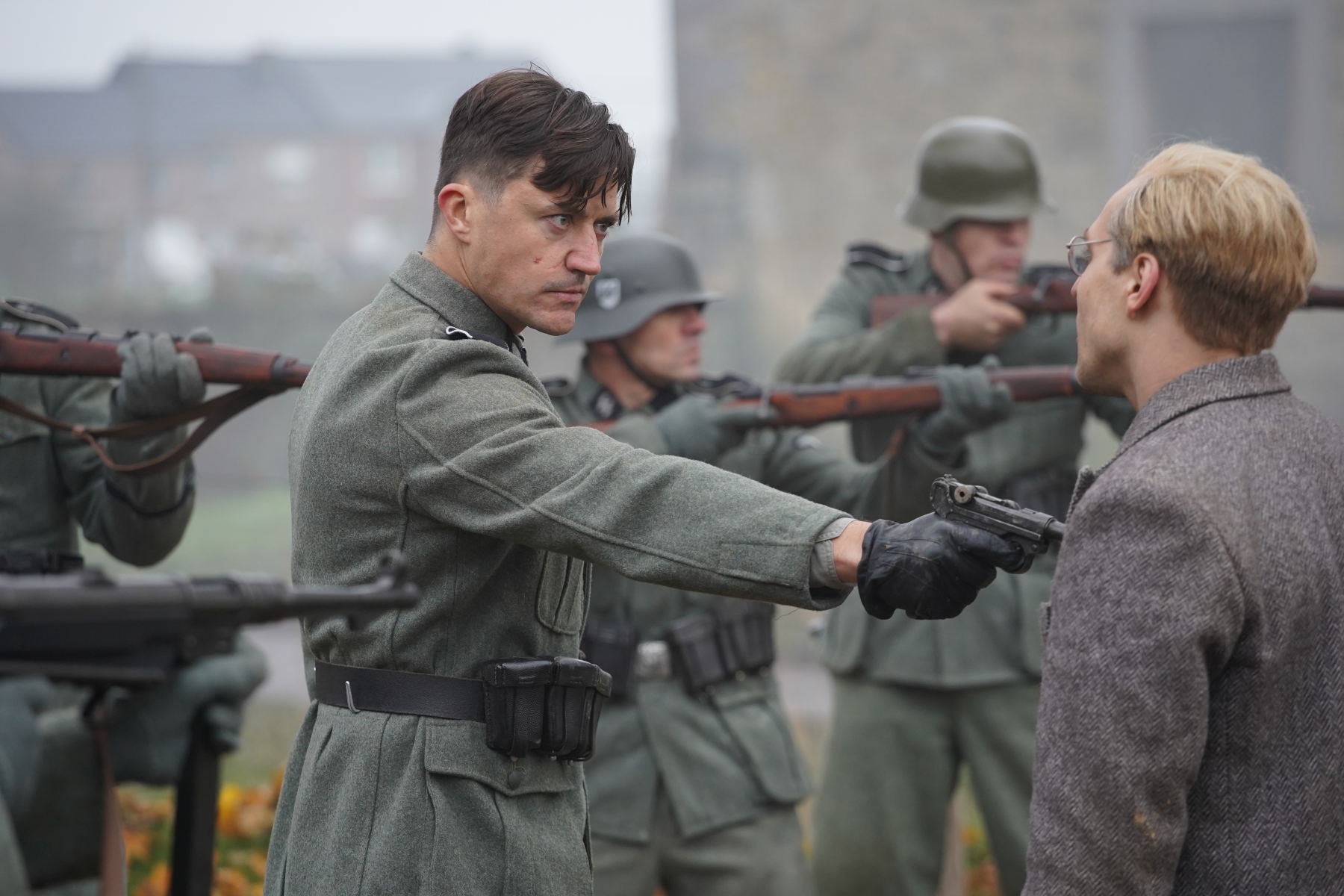 Shot in Ireland and Belgium, the film frequently flashes forward from different points in its sequential account of Bonhoeffer's life to his final, dark days as a prisoner at the Flossenbürg concentration camp before he was hanged by order of a Nazi SS judge – his journey underscored by Antonio Pinto and Gabriel Ferreira's brooding, portentous soundtrack music.
Some evolutions in the story that Komarnicki chose to write have a ritualistic quality, notably when Bonhoeffer is recruited by his brother-in-law, the resistance fighter Hans von Dohnanyi (Flula Borg), to become an undercover agent in the Abwehr, Germany's military intelligence agency. Von Dohnanyi persuades him with a sombre metaphor: “Words aren’t words any more, Dietrich, they’re nooses, bullets, knives.”
Another episode in Bonhoeffer’s life that drew the Philadelphia-born Komarnicki like a moth to a flame was the pastor's experience of witnessing religious activities among black communities in America and hearing jazz and gospel music. It is moot whether this had quite the significance in the formation of Bonhoeffer’s beliefs that Komarnicki wants it to.
Other viewers of this film may not have a problem with the accents used in the film, but I quickly tired of the German cast's approach to English intonation patterns: it might be generously described as experimental – their experience of acting is overwhelmingly in their native language – but it grates on the ear.
Bonhoeffer opened in the US in November, a couple of weeks after Trump's election, and its release has been engulfed by controversy, because the German pastor is a figure who has been appropriated by the religious and nationalist right. This response has been much to Komarnicki's chagrin, because, he has noted, his intention was to portray Bonhoeffer – rightly – as an anti-racist and anti-fascist figure. However, in choosing to portray him above all as a saintly hero who has the disadvantage of speaking his lines in a second language, the message of what Bonhoeffer stood for has been diluted.