

Elena Schwarz was back in Manchester to conduct the BBC Philharmonic only just over two weeks since her visit to the Hallé, and again conducting some mainstream heavyweight works in which her clarity of beat and fresh approach brought rich rewards.
She showed in her debut concert with the Philharmonic in 2021 and a repeat visit the following year that she can handle new music with equal assurance, and the central work in this programme was a relatively novel one: Dani Howard’s Trombone Concerto, written for and again this time performed by Peter Moore. Written during the Covid shut-down, it had its first performances soon after concert life resumed, won a RPS award and was recorded last year by the Royal Liverpool Philharmonic.
The experience of life under restriction was the generating force behind this concerto, its three movements each bearing a single word title that refers back to that time: “Realisation”, “Rumination” and “Illumination”, the first reflecting the thought that everyday people in “ordinary” jobs were becoming heroes just by carrying on. Its style is approachable and attractive, the opening driven by energetic rhythmic figures. When the solo instrument gets into its stride, and ultimately finds its song, the result is glorious.
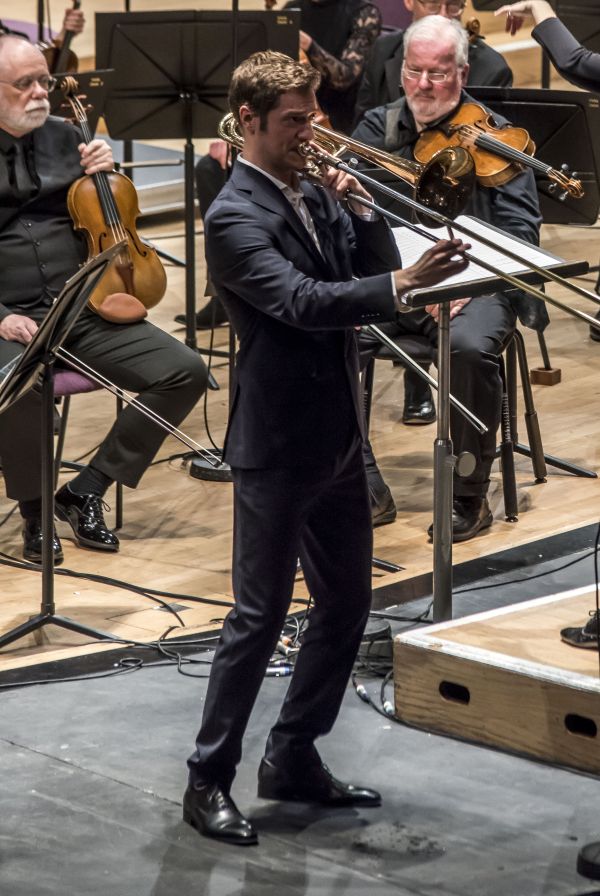
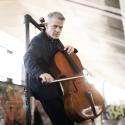
One of the interesting things about the textures Dani Howard creates so skilfully is that the orchestral trombones are used as accompaniment to the solo – muted in the second movement, and more prominently in the third, where they become almost an extension of its sound. There are slowly changing harmonic progressions in the “Rumination” movement, and pedal points – even something very like a perfect cadence – amid the warmly euphonous clashes that accompany the soloist’s thoughtfully resonant contributions… all ruminative indeed, even in the agricultural sense of the word. The finale is about freedom restored, beginning with a sustained chordal tapestry with the soloist bounding over its landscape, developing with greater rhythmic energy over pedal points and richer textures, and ending with plenty of virtuoso display. It was given with the impeccable nobility of tone and agility that are the trademarks of Peter Moore’s technique (pictured above) and Elena Schwarz was ever-attentive to his role and supportive in her direction of the orchestra.
There was logic in the choice of Debussy’s La mer and Mahler’s First Symphony to be on the same bill, as both require a really large orchestra: Debussy scored for three trumpets and two cornets-à-pistons – Mahler asked for four trumpets with the first part doubled in the loudest passages and would undoubtedly have been happy with the extra trombone for his finale (the Debussy benefitted from an extra cello, too) – it was all about richness of sound.
Under Elena Schwarz’s baton the first movement of La mer (“Dawn to Midday on the Sea”) made good use of the resources afforded, the Philharmonic horns in fine form, leader Zoe Beyers providing evocative solos, and the music flowing seamlessly from tableau to tableau and achieving a glorious climax. The second – “Games of Waves” – acquired real momentum from a strong rhythmic base; the third – “Dialogue of the Wind and the Sea” (which Debussy originally conceived as a “dance of the wind and sea”) – not only provided the most literal sound-painting, with all its rumble and shimmer, but had a sense of surging strength again, and those 11 cellos (led by Peter Dixon) had their moment of prominent and incisive playing, joined in intensity by the violas’ jagged figures near the end.
“Mahler’s ‘Titan’” was the marketing title for the concert as a whole – it’s a good line to use, even though he dropped the name for his Symphony no. 1 when it was published – but the important thing to remember is that it was the hero of Jean Paul Friedrich Richter’s novel that he had in mind, rather than Greek mythology: a man of harmony and maturity who learns from others and assimilates their best qualities without their faults, a blend of classical and romantic ideals. But it’s still a structure that leads over a 50-minute timespan to a victorious paean of positivity, and its glories throughout lie in the subtlety of the writing and its orchestration.
Elena Schwarz brought a keen observation of every significant detail to its realization. Her opening was audibly schlepping (i.e. dragging a bit, in this context), the strings sweet and gossamer-delicate to begin with, the tempo changes smoothly controlled, the sense of propulsion exciting. The second movement’s emphatic pulse was close to dance-like, the articulation as clear as orchestral confidence could make it, the horns in full cry; and its trio had a genuinely Austrian-style lilt and sinuous grace. The slow third movement was distinguished by the swaying motion of the klezmer-like interlude – and then the finale proved a wild ride indeed. Its second subject was gorgeously phrased, warm and appealing and varying its dynamic quite clearly from fortissimo to pianissimo as required.
At the close there was still room for sweet violin tone, recalling that of the first movement, and again the violas’ role was not forgotten. The brass chorale, of course, carried all before it and brought the symphony to a summit of optimism.
· To be broadcast on Radio 3 on 18 November





Add comment