The Tenebrae service of Maundy Thursday sees Satan's removal men take over holy duties. Crosses are veiled, lights are extinguished, songs of wailing erupt. Stravinsky's Threni (receiving its Proms debut last night) is a setting of these wails - the Lamentations of the Prophet Jeremiah - and is carved out of a dark, unforgiving orchestra and a suffocating choral weave. For the atheist, if not for those of a religious bent who might prefer the succour of François Couperin or Thomas Tallis's settings, there can be no better depiction of the asphyxiation of despair.
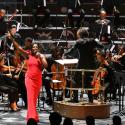
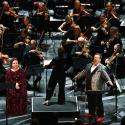
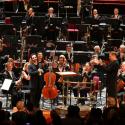
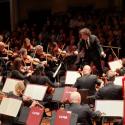
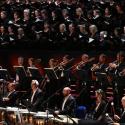
Last night's rendition by the London Sinfonietta, the BBC Singers and an assortment of top-notch British singers, all under the careful eye of David Atherton, went some way to summoning up this vision of hell. Alan Oke threw out the opening exclamatory questioning - "How is she become as a widow!" - with power and plangency, a thin, deathly flügelhorn stalking his thematic line, as it would continue to do to the end. Sounds that would normally belong under rocks or in ocean trenches bubbled up from the orchestral bowels. So far, so hellish.
But there was one missing ingredient: airlessness. One should feel as if one is choking on the relentless suffering. In the Royal Albert Hall, such feelings couldn't reach us. An encircling drama was beginning to emerge in the BBC Singers' whispered introductions to the verses but we still needed more edge. The syncopation needed to harass the audience not just offer up rhythmic interest. The many close-knit serial canons needed to feel like boa constrictors winding themselves around your chest inexorably, squeezing the life out of your lungs.
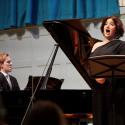
The soloists nearly had us in their vocal pincers in the second part, De Elegia Tertia, which rises up to a canonic sandwich of voices and souls in the verses, VAU and ZAIN, that are coloured by the low persistent industrial plant-like rumble of the four male voices: John Tomlinson, David Wilson-Johnson, Andrew Kennedy and Alan Oke. Surprisingly, there is light at the end of the Threni tunnel, though of a distinctly weak, bled sort.
It was nothing like the endless glimmering rays of warmth that radiated from the preceding Bach Choral Variations on 'Vom Himmel Hoch', BWV 769, in Stravinsky's arrangement. It literally outshone the opening organ performance by Daniel Hyde of Bach's original Canonic Variations on 'Vom Himmel Hoch', BWV 769. Both in heaven and in hell, Stravinsky appeared to be running rings around Bach.