CPE Bach: Cello Concertos Elinor Frey (cello), Accademia de’ Dissonanti (Channel Classics/Outhere Music)
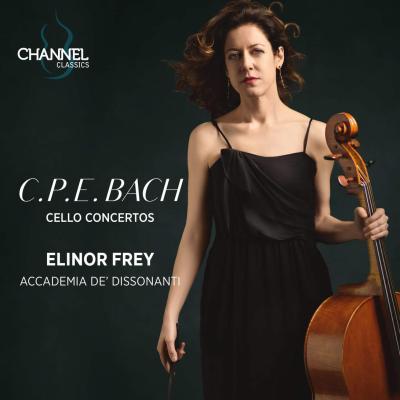
Canadian/American cellist/gambist and scholar Elinor Frey has made several important albums, shining a light on fascinating and little-known repertoire. Her Early Italian Cello Concertos (Analekta, 2022) was a truly remarkable disc which went on to win a much-deserved Canadian Juno Award. Her explorations of Giuseppe Clemente Dall’Abaco (Passacaille, 2024) were equally persuasive, not just as the fruit of researching primary sources, but above all as totally convincing performances.
Rather than continuing her highly effective advocacy for the unfamiliar, this album of CPE Bach concertos sees her venturing onto much more frequently trodden paths, with several noteworthy recordings of these three concertos already in existence. In the past decade, for example, both Nicolas Altstaedt and Jean-Guihen Queyras have won awards for their CDs of the three concertos (to be accurate, Queyras recorded just two of them). There are also recordings by baroque specialists/pioneers such as Anner Bylsma and Christophe Coin.
In her liner note, Frey explains that her approach has been knowingly individual and different, and she also provides ample evidence of the research-based reasons for that. In essence, she has looked at the historical evidence of soloists of the mid-eighteenth century thinking far more like composers than their modern counterparts are inclined to do. She has examined their specific and documented strategies to “personalise” their performances, the extent to which ornamentation can move towards re-thinking the pieces. And the deeper one listens, the more those individual choices prevail. What we hear on this recording therefore, is “her” concertos rather than “the” concertos. And that philosophy is carried through to the cadenzas. As she remarks: “my final cadenzas should [..] reveal me with my voice.”
The first things one notices about these performances is that they have an appealing urgency, energy and drive about them, particularly in the faster outer movements. The Accademia de’ Dissonanti (who, curiously, are not named individually in the album materials) reinforce her vision, and that sense of this being Frey’s personal approach has gone right through into the later stages of production: she has a separate credit for having edited the album, alongside Passacaille’s regular, Swiss-based producer/ recording engineer Jean-Daniel Noir.
The most salient example of Frey’s urge to be personal and to be alive to the contrasts and contradictions of these concertos comes in the ‘adagio’ central movement of the Bb concerto. Whereas Christophe Coin’s vision is a vision of calm and transcendence, Frey takes the opposite approach. She has the bassist aggressively digging into her/his strings and being confrontational, and where Frey’s solo line has some sly sliding in the ornamentation, Coin prefers to be smooth, unrushed, almost tantric. Frey’s interpretation of these concertos never stops being truly alive to their often surprising possibilities. Sebastian Scotney
Poulenc: Monk and Knave – Improvisations, Napoli, Nocturnes Michael Bell (piano) (Sheva Contemporary)
Poulenc: Music for Two Pianos Antony Gray & Rob Hao (Divine Art)
I can never listen to enough Poulenc, and the more I hear, the more convinced I am that he was one of the greats. Michael Bell’s solo piano anthology has critic Claude Rostand’s famous sobriquet as its subtitle, ‘the implied duality and paradox’ clearly discernible in the 15 Improvisations which open the disc. Poulenc could be dismissive of his solo piano music though he did admit to liking his first two sets of Improvisations. These appeared between 1932 and 1934, the spikier ones reflecting Poulenc’s fondness for Stravinsky, though the harmonies and are always echt-Poulenc. Try No.3, a brilliant 90-second encapsulation of the composer’s style, Bell’s bright, clear playing exactly what the music needs. He relaxes beautifully into the longer, more romantic No.7. Nos 11 and 12 were composed in occupied Paris, Poulenc smiling through gritted teeth, and the final three appeared in the late 1950s. It’s good to learn that 13 and 14 were written in an upmarket Cannes hotel, and No. 15 is an affectionate Edith Piaf tribute.
Bell includes Poulenc’s 1923 travelogue Napoli, its unsettling central “Nocturne” hinting at Poulenc’s introspective side and concludes the disc with the sequence of eight more Nocturnes, composed during the 1930s. I love the limpid C major opener, another utterly characteristic jewel, and Bell suggests that No. 3’s nocturnal church bells are an evocation of insomnia. Especially moving is the final one, completed in 1939. As single-disc Poulenc piano compilations go, this one is excellent, and it’s beautifully recorded.
Antony Gray and Rob Hao’s fabulous two-piano album contains possibly my favourite Poulenc piece ever, the sublime Élegie, directed to be played “as if you were improvising it, a cigar in your mouth, a glass of cognac on the piano.” Listen carefully and you’ll notice the syncopated chordal accompaniment moving between the two pianos, both players getting a shot at the tunes. The main draw here is the rarely heard two-piano version of the Concert champêtre. Poulenc liked to perform the solo harpsichord part on piano, and there’s a superb recording of it by pianist Mark Bebbington on the Resonus label. Gray and Hao’s performance strips things back even more. But, ‘as the musical material is so strong, and the reworking so clearly thought out’, who’s complaining? It sounds magnificent and really should be a part of two-piano repertoire. This performance is great: try the quicksilver opening of the finale and marvel at the pair’s coordination, and to how well the judge the concerto’s introspective closing minutes.
The other large work here is the Sonata for Two Pianos from 1953, a big-boned, emotionally rich four-movement piece. Gray’s booklet note includes Poulenc’s own introduction to the sonata; it’s fascinating to read that he thought of the earlier Concerto for Two Pianos “as blithely bravura, whereas the sonata has the gravity of a string quartet”. This is an occasionally sombre work with some exhilarating fast music – Gray and Hao tear into the opening of the second movement, and the “Epilogue” is both exciting and deeply moving. Light relief comes in the form of L'embarquement pour Cythère, a fizzy waltz taken from Poulenc’s score to the 1951 film Le Voyage en Amérique. The manuscript of the entire score hasn’t survived, but we do get 17 short, effervescent cues transcribed directly from the soundtrack. Accordionist Alise Silina joins the pair for a recap of L'embarquement and the physical disc ends with soprano Helen Miles singing the delightful “Adieu Maison”, also extracted from the soundtrack. A fantastic collection wonderfully well played, and, if you go for the digital version, you also get the Sonata for four hands, the Capriccio and the Valse de musique de soie.
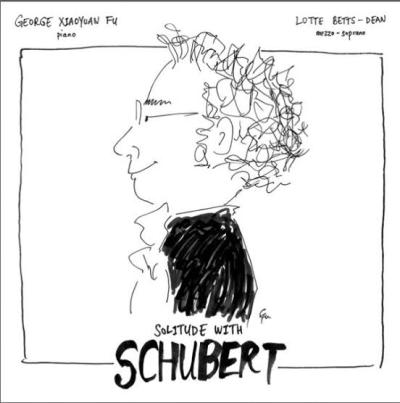
Solitude with Schubert George Xiaoyuan Fu (piano), Lotte Betts-Dean (soprano) (Platoon)
This album is a 21st century Schubertiade, pianist George Xiaoyuan Fu’s programme inspired by the intimate gatherings held in early 19th century Vienna to celebrate Schubert’s music. Venues varied according to audience size, Schubert variously improvising, introducing new works and accompanying singers. Fu’s enjoyable booklet note includes a quote from the composer’s friend Moritz von Schwind, who recalled that “there could be no happier existence… we hadn’t a penny but were blissfully happy.” Fu’s sequence consists of a weighty sonata and a selection of songs, bookended by two short pieces, and it succeeds brilliantly. Schubert’s late piano sonatas can sprawl and feel unwieldy, but this performance of No. 19 in C minor feels like a single take. The long “Adagio” has a Brucknerian sweep and the tarantella finale (“an unruly beast”) is a beguiling mixture of bleakness and exhilaration, Fu slamming the door shut with the final C minor chord.
Soprano Lotte Betts-Dean joins Fu for two numbers from Schwanengesang, the piano’s burbling accompaniment in “Liebesbotschaft” one of the loveliest things on this album. Betts-Dean is marvellous throughout, warm-toned and intensely communicative; her "Die Taubenpost" has an irresistible lilt. The six sections of Einsamkeit enthral here, the narrator’s opening request for peace and solitude set to music of spare beauty, Fu and Betts-Dean sounding as one. Each verse’s distinct mood is perfectly characterised, the restless piano writing at the start of the second section brilliantly played. A deceptively weighty “Allegretto in c minor” is an effective curtain raiser, and Fu ends proceedings with the D.817 Hungarian Melody. Performances and production values are impeccable, though it’s a pity that no texts or translations are included. Still, Fu’s booklet illustrations are a delight – look out for the pigeon on the final page.
Joby Talbot: Piedra de sol Conspirare/Craig Hella Johnson, with Thomas Burrit (marimba) (Divine Art)
I was first aware of Joby Talbot back in the 90s as the arranger for the Divine Comedy in their brilliant early albums, on which he also occasionally appeared as that most rare of beasts: a pop oboist. He later graduated to TV and film work – including The Hitch-hiker’s Guide to the Galaxy – as well as three full-length ballets for Covent Garden. In 2005 he wrote the extended choral piece Path of Miracles, originally written for Tenebrae and widely performed by them, and later also recorded by the US group Conspirare. This extraordinary piece has a good claim to be the finest choral piece of the century (it was sung by the BBC Singers in the Proms this August).
Now, more than 20 years later, comes a second large-scale choral work, co-commissioned by Conspirare (who have made this recording) and the BBC Singers, who will give the UK premiere on 24 September. Piedra de sol (“Sunstone”) is a 70-minute meditation for choir and marimba setting the surrealist poem of the same name by the Mexican Octavio Paz, whose work Talbot discovered while writing his last ballet. The poem, according to the booklet, meditates “on cyclical time and the possibility of breaking its grip through poetry and love”, and Talbot had been struck by the “hugeness of the poet’s vision; the cosmic immensity of the imagery”. He has responded with music that has a single-minded intensity, while following the whimsical metaphors of the words wherever they lead. It is a technical challenge for the composer – all the lines have 11 syllables and the accentuation needs to be spot on – but the music never slips into predictability.
The 25-voice Conspirare sing beautifully and with complete artistic sympathy, which comes directly from their director, Craig Hella Johnson, the guiding force behind the piece’s commissioning. Piedra de sol is a serious piece – like Path of Miracles it is contemplative and challenging – but its harmonic weight never gets clogged, and the moments of textural clarity when they arrive are revelatory. The choir is complemented with a marimba – which is nominally optional but feels integral – playing tremolos that colour the timbre, but very much sitting within the choir. The solo voices that emerge from the choir are a strength of Conspirare.
This is a major new addition to the choral repertoire and I am sure it will be taken up by lots of choirs. It is a fine work and very well sung. I have listened to it a number of times, and its merits become more apparent with each hearing. For all the similarities, Piedra de sol is a different beast from Path of Miracles, in some ways more technically proficient and elegantly structured. But if Piedra de sol doesn’t quite have the breath-taking magic of the earlier piece, it’s fair enough to say: what does? Bernard Hughes

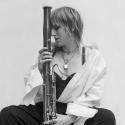
Righteous Rage Rebekah Heller (bassoons) (Cantaloupe Music)
I was drawn in by this album after just a few seconds, Rebekah Heller’s arrangement of Julius Eastman’s The Holy Presence of Joan d'Arc one of the most arresting things I’ve heard in ages. Eastman wrote this 18-minute work in 1981 for ten cellos, Heller recasting it, brilliantly, for ten bassoons and playing all the parts herself. Rhythmically propulsive and harmonically rich, Eastman’s chugging ostinati slip in and out of focus, the ten parts occasionally sounding like voices in a choir. And what’s with the ending, Eastman’s dissonant chord ringing out like a warning? Heller’s album is ‘a love letter to bassoonists’, part of her project ‘to create a deep and varied repertoire for bassoon choir to be performed with myriad voices’. Steve Reich’s Grand Street Counterpoint follows, an enchanting reimagining of his Cello Counterpoint, Reich co-producing this recording. Jessie Cox’s Sonic Cartographies is one of three newly commissioned pieces, a deep woody bath of sound, punctuated by bird calls and the clicking of bassoon keys.
Nurture (for Ingram) by Fay Victor pays tribute to the late jazz singer Ingram Washington, an extended sequence of mellifluous chords and jazzy riffs, and Brittany J. Green’s Righteous Rage began as a cello piece inspired by the Eastman work, this angry but exuberant call to arms a brilliant closer. This disc succeeds on every level - it's magnificently played and superbly engineered. Dive in.