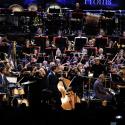
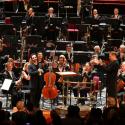
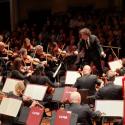
Accolades first for the deep sound in Strauss of The Met Orchestra, newcomers to the Proms, under its Music Director Yannick Nézet-Séguin, who has been in the Albert Hall ring many times, and for the flamethrowing Salome of Elza van den Heever. Only days ago I lamented not catching the finer nuances of mezzo Jamie Barton in Das Lied von der Erde from the side; sitting closer to the back of the hall, it was amazing to hear the phenomenon of a rich, full voice serving a detailed dramatic characterisation, something we never give up hope for in a capricious colosseum.
Disappointment in the choice of works surrounding this most luscious-violent of operatic final scenes - along with Strauss's sequel in Elektra - probably puts me in a minority. Nézet-Séguin is a very serious great among conductors, so why choose the Suite (probably stuck together by conductor Artur Rodzinski) from Der Rosenkavalier? The wayward sex scene of the Prelude and the waltzes allowed us to catch the deep sound of the Met strings, the shining glory of its horns. But the music-minus-two-and-three of the purely orchestral Presentation of the Rose and Trio/Duet always seems a travesty to me, especially when the slow-then-sprint approach of Nézet-Séguin made both drag (a one-off black mark in otherwise superbly paced Strauss). What would I have preferred? The Four Symphonic Interludes from Intermezzo, which include a Bavarian waltz sequence and don't make us long for the singers.
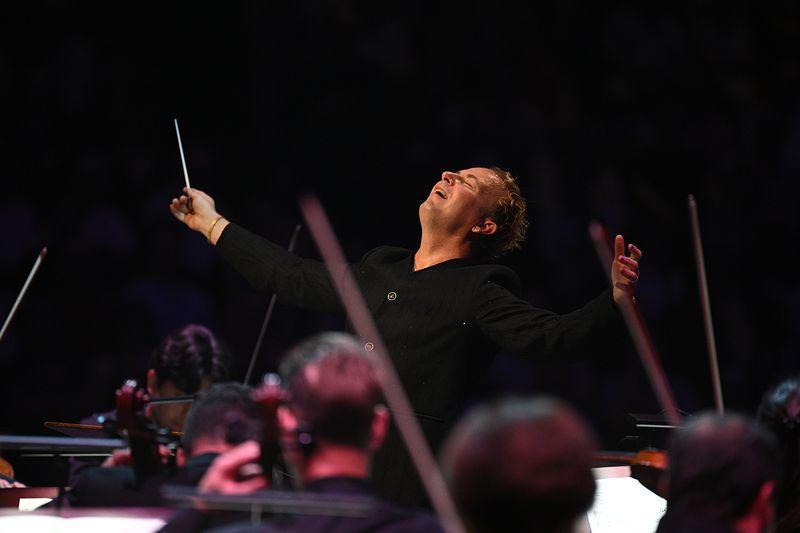
The more finely observed the interpretation of Ein Heldenleben (A Hero's Life), the more I wonder what Strauss really wanted here. Flanked by the total masterpieces of Don Quixote - which YNS has conducted superbly in London - and the severely underrated Symphonia Domestica, this admittedly well-structured, through-composed symphonic poem wavers between mocking the spirited self-portrait and his adversaries the critics, and wanting us to take the nobility seriously.
That was all the more pronounced once Nézet-Séguin got to the "Works of Peace" - a sublimely woven tapestry of Strauss's works up to 1900 - and "The Hero's Retirement from the World", magically hushed and with an outstanding lead-in from principal horn Eric Ralske (I presume - Brad Gemelnhardt is listed as the other). The Berlin or Vienna Philharmonics could not surpass this. Earlier, the spiteful enemy was dashed off by the woodwind at lightning speed, helping to move on a difficult sequence including the depressed response, and the battle-in-waltz-time rattled and crashed. Between them, concertmaster Benjamin Bowman rather charged off the infinite variety of "The Hero's Companion", a portrait of Pauline Strauss, well met by the rest of the orchestra; had he played outwards rather than to the rest of the orchestra, those of us at the back might have caught more detail. Working through Ein Heldenleben in a course on Strauss's orchestral works, I could see how well-worked the themes are; but in performance the interest still comes and goes.
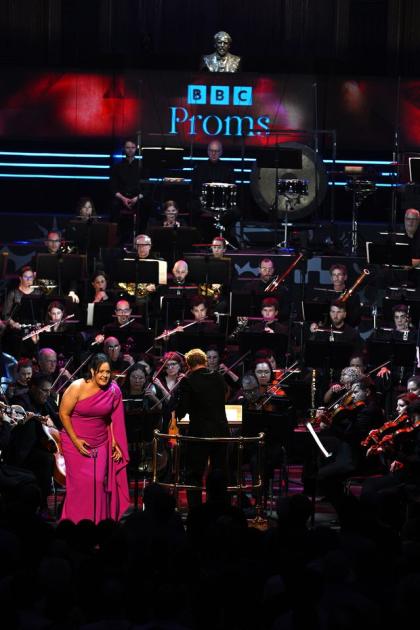
Never is that the case in Salome, textbook of pioneering orchestration and thematic ingenuity. Van den Heever has been acclaimed for her Met portrayal of the teenage princess who, desire thwarted, asks for John the Baptist's head on a silver platter. Here she was in the zone from the start of the final scene, which YNS made sure started with the tension of awaiting the execution, those pinched high double-bass notes over low drum-roll which Strauss took from Berlioz's Treatise on Instrumentation shocking a not-quite settled audience into stunned silence.
Severed head once produced, van den Heever traced it somewhere among the mushrooms hanging from the Albert Hall roof - definitely of the magic variety in vision accompanied by sound - before bringing it close to snarl and snap at its silenced tongue. Her gestures ran the gamut the music does, from imperious triumph to self-doubt and aching nostalgia. No top note failed to soar above the magnificent orchestra, however loud; we also heard the woodwind detail in the welter. The final act of consummation before Salome is crushed beneath the shields of Herod's soldiers - the Tetrarch and his hideous consort, Salome's mother Herodias, being necessarily absent here - had maximum impact. No-one who was present will ever forget Nina Stemme's vivid Salome in the complete opera at the Proms, conducted by Donald Runnicles; this took us straight into the heart of the beast.
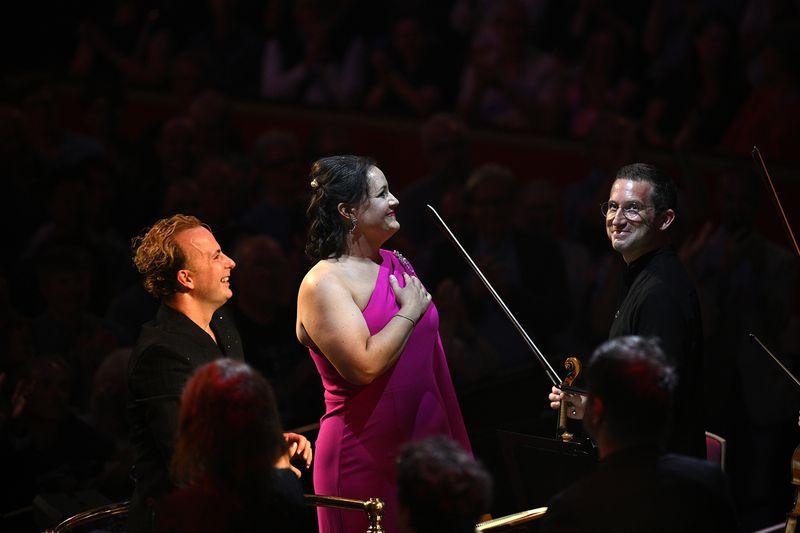
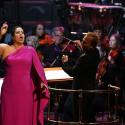
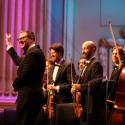
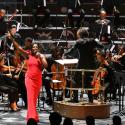
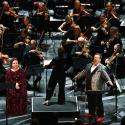
Van den Heever (pictured abovewith Nézet-Séguin and Bowman) made a surprise reappearance after Ein Heldenleben. Sheer professionalism made us only love her and her conductor all the more when she forgot the words to the rapturous Strauss song "Zueignung" ("Dedication"), held up that authoritative hand to her amiable companion on the podium, and started again with fresh refulgence. I hope they keep the episode in for Friday's television broadcast; it was delightfully handled. Van den Heever, at least from my privileged place in the hall, can give the glorious Lise Davidsen a run for her money. I'd love to hear her in the Four Last Songs; but I don't imagine Natalya Romaniw will disappoint at the Prom on 9 September.
- Listen to this Prom on BBC Sounds and watch on BBC Four on Friday 28 August
- More classical music reviews on theartsdesk