

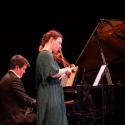
It seems that the gradual leakage of avant-garde-post-classical-call-it-what-you-will music from the rarefied environment of concert halls and into the spaces traditionally inhabited by alternative and club music is now inexorable. And violinist Aisha Orazbayeva is one of the instrumental (pun intended) figures in this move from trickle to flood. As one quarter of the organising team for the London Contemporary Music Festival (along with erstwhile classical editor for theartsdesk, Igor Toronyi-Lalic), she has helped bring Parmegianni, Schwitters, Radigue and other 20th/21st century composers into venues more normally associated with warehouse raves.
A similar process takes place on this record. The PRAH label, an offshoot of leftfield pop imprint Moshi Moshi, is focused on boundary breaking, and following killer albums of drone (Bryce Hackford) and cello (Oliver Coates) experiments, they let Orazbayeva demonstrate the cultural range of her voice and instrument. The opening shot is perfect – 16 minutes of the multitracked repetitions of Steve Reich's “Violin Phase” die away, then comes a performance of Elvis Presley's “Harbour Lights” entirely for voice and pizzicato. There's no dramatic conceit to the juxtaposition, no post-modern smirk, just a musician's ear for how an album should be programmed to keep the listener's interest.
So it goes on. Two parts of Morton Feldman's “For Aaron Copland” are made up of single, isolated, stroked or scraped notes – yet with a subdued and intimate romanticism to them. A vocal solo of John Cale's “Baby You Know,” showing off a fine soul-pop voice, goes into the mechanical drone abstraction of “Aloise,” then returns to an instrumental version of the Cale song to end the album – and again, it makes sense, not for the outlandishness of the combination but for the absolute naturalness of it. We should be thankful to instrumentalists and curator like Orazbayeva for constantly pushing home the fact that disciplined playing and fierce intellect are no barriers to music that works on a very basic, pleasurable level.
Overleaf: Hang Out With Aisha Orazbayeva and see her play "For Aaron Copland"





Add comment