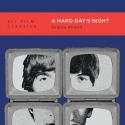
Books about The Beatles are apt to prompt questions on whether there is anything left to say about them. Depends who’s doing the saying. We will each of us have had The Beatles seep into the fabric of our lives in a way that feels unique to us; but only a minority will be able to turn that into a story that’s compelling to others. Samira Ahmed achieves this rare feat by dint of being something of an outsider, but also in many ways an insider.
As the child of immigrants, Ahmed’s assimilation of The Beatles was inflected by a certain “outsider status”. For her, The Beatles “existed as a kind of deep folklore in black and white”. Key to her burgeoning identity, her immersion in Beatles lore also helped ignite her fascination with visual media: “I found film and television culture a vital part of understanding the small island nation of my birth and its remarkable cultural power.”
That small island was undergoing some tumultuous cultural changes, at the time A Hard Day’s Night was filmed. “In all my work”, Ahmed says, “I’m fascinated by the intersection of pop culture, politics and social change.” Cultural intersections don’t come much more socio-political than mid-Sixties Beatles. Astute on the feedback loop between the counterculture and the zeitgeist, and just how shocking these changes were for much of the population, Ahmed imagines people feeling “a bit like aliens in their own land at the takeover of Beatlemania”.
The England that Beatlemania exploded into was so socially repressed and culturally atavistic, a time-traveller from the Edwardian era would have felt right at home. Nebulous, convoluted Establishment hierarchies rigorously enforced class boundaries, guarding the status quo like the crown jewels. Deference was accorded an almost religious status. The proles were expected to doff their caps; instead, as Ahmed puts it, the Beatles “cocked a snook”. Their winking, inclusive irreverence was a huge part of their image, and is at the core of this film’s appeal.
As a journalist and broadcaster, Ahmed is a media insider, and she’s adept at delineating the ways in which the film gently satirises itself. Her book is rife with insights about the role of TV, which is where films have their afterlife and, for many, where this one was first encountered: “a significant part of the charm of AHDN is as a period snapshot of the interplay between old and new cultures through the box in the living room.” Today, she writes, A Hard Day’s Night is “that impossible thing: an exhumed memory of a lost era, like Tutankhamun’s tomb, but still alive, fizzing with energy.”
The longest and fizziest section of Ahmed’s book – “Watching A Hard Day’s Night” – plays like a lively DVD commentary track. This structure risks collapsing into rote synopsis, but Ahmed’s chatty tone and warm, charismatic company enable her to easily avoid that trap. “This is not a dry book of film theory”, Ahmed says, and she makes good on that promise. It feels like watching the film with an old friend for the first time, over a bottle of wine, with her nudging you in the ribs, making jokes, and pointing out aspects you hadn’t noticed before.
Unsurprisingly, Ahmed is strong on the meta qualities of the film, the “full artifice of the studio set: arc lights, boom mics, monitors, cables and all”, and the mediating impact all this has on the subject(s) at hand. Throughout the film, she notes, “the Beatles are frequently reproduced through camera viewfinders, studio monitors, TV set backdrops of beetles and leaping life-size blow-ups.” She’s also good on the famous marketing agency sequence with George, and its “deliberate dive into the essence of fakery”.
Ahmed also has impeccable Beatles bona fides: in 2022, she discovered that a tape existed of The Beatles playing at Stowe private school in April 1963. That spool of tape captured a nodal point in the Beatles-assisted social changes of the 60s: here were the sons of the ruling class, face-to-face with their diametric opposites – and loving it. It signalled, says Ahmed, the end “of deference as working class culture epitomised by these young men, became admired – as heroes to the posh boys from the elite boarding school.”
Whether it really heralded “the end” is up for debate, of course. Ahmed mentions the Profumo affair in passing. Often mischaracterised as a sex scandal, really it was about class, and what it demonstrated was the efficiency of Establishment power structures in instinctively falling into lock-step - aristocracy, courts, parliament, police, press, etc. – to limit the damage, and to identify a scapegoat (society osteopath Stephen Ward) who they could hound to his death. Think that sort of thing doesn’t happen any more? Ask Dr. David Kelly. Or Jeremy Corbyn.
As someone who has had to sue the BBC for equal pay, Ahmed is well aware that a career in the media can be a two-edged sword for women. Her section on “Women in A Hard Day’s Night” offers a refreshing perspective, not least in recognising how 60s women were on “the frontline of cultural change”. The film’s supporting cast is studded with examples of “a generation of young female school-leavers” who were able to build careers that made them “core to the success of their workplace” and "trusted for their knowledge and ability”.
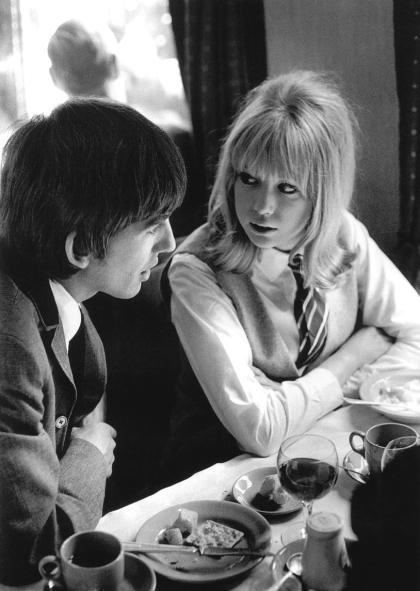
Generous about the film’s sexual politics, Ahmed does admit that the sequence featuring “knee-socked sixth-formers in school uniform tunics” is, “by modern standards, discomforting”. That said, Richard Lester’s film is “relatively innocent” compared with “the overtly sexualised way teenage schoolgirls were portrayed in mainstream culture at the time” – St Trinian’s and all that. Noticing Pattie Boyd looking a bit “gormless” at one point, with “fingers in mouth like a toddler”, Ahmed nonetheless accepts that this ”infantilised dolly bird cliché” at least constitutes “a rare example of a sexist stereotype in the film”. Overall, the Beatles’ film “never relies – in their encounters with females – on promoting the kind of stereotype that has dated so many socially realist films of its time.”
After a perceptive and detailed “making of” chapter, the book finishes with a brief section on the film’s reception and “What they did next” – in case you were wondering – and an overview of its legacy. Ahmed doesn’t shy away from calling out the vapidity of many of the film’s imitators – “most of them awful” – such as the “deeply inferior” Ferry Across the Mersey (1964) or the crass, moronic Spiceworld (1997). The ultimate lesson is that “AHDN was not a formula that could be easily replicated.”
“Perhaps AHDN’s greatest direct descendant”, Ahmed suggests, “its Irish grandchild, even, is the sweary, sex and drug-filled Kneecap (2024)”, which “combines exhilarating real concert footage with rich humour and a surreal sense of the political discomfort caused.” Certainly John Lennon would enjoy Kneecap, and would have been delighted when the vexatious charge of “terrorism” levelled against singer Mo Chara (for opposing Israel’s genocide) was ruled unlawful and thrown out of court.
A Hard Day’s Night is a truly great film. A miracle, even. All the stars aligned in its making. Ahmed’s book is an insightful companion to it. As with many cultural artefacts from the past, and the Beatles in particular, our enjoyment of it carries a bittersweet tang. Or, as Ahmed has it, for “a film driven by joie de vivre”, there is something “inevitably melancholic about watching” it, “and the four young men at its heart”. Still, the net effect is overwhelmingly positive. Times change, and we all grow older; but The Beatles of A Hard Day’s Night remain the same: always young, always there for us, forever cocking a snook on our TV screens.