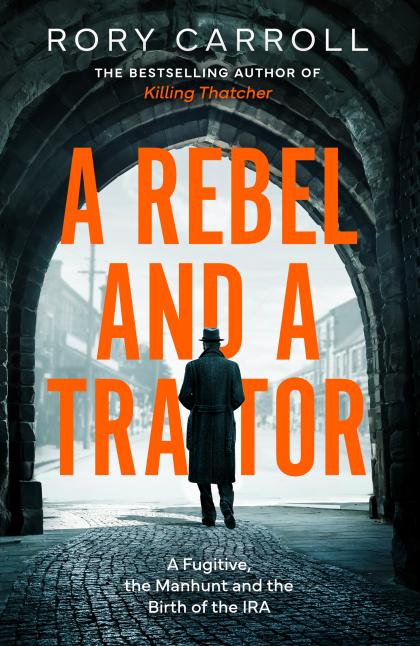
Rory Carroll’s previous book, Killing Thatcher, was terrific, and widely praised. It followed the IRA plot to murder the Prime Minister in 1984 and the subsequent police manhunt, telling the story with a journalistic degree of research and a novelistic eye for pacing and drama. For his follow-up Carroll’s gone back further into history to tell the story of the inciting event that ultimately led, along a winding path, to the Brighton bombing: the 1916 Easter Rising in Dublin. A Rebel and a Traitor: A Fugitive, the Manhunt and the Birth of the IRA is, in a different way, as gripping as its predecessor, combining a close narrative focus with an ever-present sense of wider context, telling the human stories at the heart of an epochal political episode.
As in Killing Thatcher there are two leading men, placed on a direct collision course. In the earlier book it was the bomber and the policeman who caught him. Here it is Sir Roger Casement, a distinguished British public servant plotting to bring about an independent Ireland, and Reginald “Blinker” Hall, battlecruiser captain turned director of Naval Intelligence. Casement, a highly-regarded bastion of the establishment, had always hidden his Irish nationalist sympathies (which he held despite being born in the north of Ireland and brought up a protestant) till he broke cover in the early days of the war and made his way to Germany in the hope that they would support, and even supply troops for, an independence uprising in Ireland. A man of conflicted loyalties, Casement also had what was at the time a dark secret: he was gay. And not only that, he also wrote graphic accounts of his sexual encounters all over the world in diaries – diaries that tick away like a long-fuse bomb throughout the book.
“Blinker” Hall, so called for a facial tic, was invalided off his battlecruiser and sent instead to Room 40, a covert intelligence-gathering operation he developed into a proto-Bletchley Park. He brought an energy and willingness to break the rules that must have made him a delight for Carroll to write about, and faced some of the same agonising decisions faced later at Bletchley: do you reveal your intelligence, thereby revealing to the enemy that you are intercepting messages? Or do you keep it to yourself, and possibly let people die?
Neither lead is an especially sympathetic person. Casement is intransigent, self-important, exasperating even to his friends, a bit pious and, in modern terms, an abuser of children. Hall in his turn is ruthless to the point of immorality, deceptive, heartless – and prepared to break wartime rules to ensure a full coal-scuttle in his office. But Carroll paints them with light and shade and, for the most part, steers clear of moral judgements that are invidious at this distance in time. His writing is well researched, but he goes beyond history by offering quasi-novelised accounts of conversations, starting with Casement’s arrival in Ireland in a German submarine, days before the Easter Rising. “Captain Raimund Weisbach peered into the night, uneasy… He weighed his options.” It brings the story to life, but it does go beyond straightforward history. For all that it adds colour, it is impossible to tell where attested fact blends into supposition or invention. It’s not a huge problem, though.
Carroll tells his story masterfully, keeping all the balls in the air, not just Casement and Hall, but other wonderful characters like Joe Plunkett, the rebel dying of TB but determined to be part of the rising, or John Devoy, the veteran rebel exiled in New York, with a well-stocked war-chest and deep suspicion of Casement. He has cliffhanger chapter endings, and builds tension brilliantly as we approach Easter Monday 1916, even though (spoiler alert) the Rising ends in utter defeat, and death for most of the rebels. There is conspiracy aplenty, but also a lot of cock-up, like the rebels’ confidence they could contact and delay a German boat which, it turned out, had no radio. There is also an authorial drive-by on the hapless Under-Secretary for Ireland who wrote in a memo “I see no indication of a rising,” the day before the Rising.
The account of the historic Easter Monday is genuinely gripping, even knowing how it turned out, and quite moving in some of its details. After those heights we descend to sad spectacle of Casement’s trial, at which point the diaries re-emerge like Chekhov’s gun, and the British establishment operates at its tawdriest. But in terms of the big picture Carroll shows how Casement quickly became established as a martyr of the cause of Irish nationalism, and a mere six years after the failure of the Rising, which had not had the necessary public support to ever make it successful, the Irish Free State was born.
It’s a page-turning book. Carroll is Irish-born and the Guardian’s Ireland correspondent, clearly comfortable on this home turf. There are times the writing gets a bit clichéd (there is a “burly policeman” at one stage) and overheated (“the usher rose and with an affected air of weariness called out "Oyez! Oyez! Oyez!", an archaic derivation from Norman French and echo from a more savage era”). But there are also some beautifully-turned scenes, like Casement’s final meeting with his cousin Gertrude Bannister, or Joe Plunkett’s last-minute prison wedding.
For me, Roger Casement and the story of the Easter Rising always sat at the edge of my consciousness: I kind of knew the outline, but very little detail. This book covers the politics – grand alliances, war, the forging of national identity – but through stories of people, fallible, difficult, and odd, revealing how these large-scale events were shaped by their actions.
- A Rebel and a Traitor by Rory Carroll (Harper Collins, £22)
- More book reviews on theartsdesk