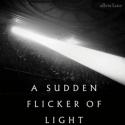
The pre-publication scuttlebutt on this book suggested that not only would it be David Thomson’s last, but also that it marked a dramatic reversal in his attitude to the medium he has spent his adult life enthusing about. We were given to believe that Thomson, probably the world's most famous film critic, author the canonical New Biographical Dictionary of Film - a man who, should he cut himself, you’d expect to bleed celluloid - had fallen out of love with cinema.
We can only speculate as to whether this really will be the great man’s final book - “the capstone to a distinguished career”- but as for the reversal, it resolutely fails to materialise. Yes, he explores the dark side of cinema, but Thomson’s enthusiasm for the experience of watching movies has long been leavened with an ambivalence about just how good for us consuming all those moving pictures may have been. The book’s subtitle, “A Revisionist History of the Movies”, is a decent marketing hook; but by enumerating the negative aspects Thomson ascribes to the medium, he is revisiting, not revising, points he has been making for decades.
As far back as 1978, with his book America in the Dark, Thomson was alert to the potentially negative societal impacts of cinema. Even some of the very specific points he makes here - for instance the idea that a ‘cut’, as in a way of transitioning from one cinematic scene to another, can be considered a type of violence - were made back then. As for the erosion of our ability to tell reality from fiction, wasn’t there always a double meaning to that title, America in the Dark? Its subtitle even made this explicit: “Hollywood and the Gift of Unreality”.
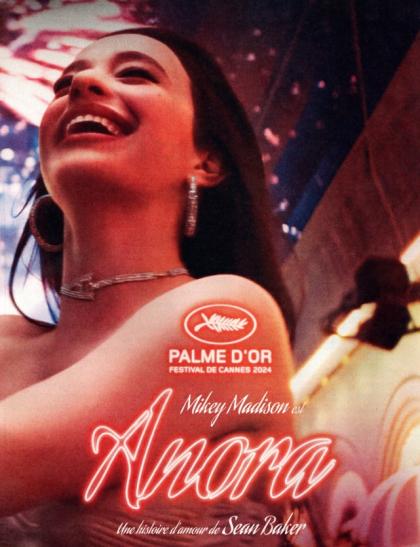
Instead, A Sudden Flicker of Light is really just another lively Thomsonian canter through cinema history, focusing overwhelmingly on Hollywood and its relationship with America. We follow a familiar trajectory, from Eadweard Muybridge starring in his own motion studies (“naked but for a white beard, striding into the future”), via George Méliès, Fritz Lang, DW Griffith, Eric Von Stroheim, Hitchcock, Hawks, Capra, Jean Renoir, Humphrey Bogart, Marilyn Monroe, French New Wave, the 70s Movie Brats, all the way to the Coen Brothers, PT Anderson, Netflix drama Adolescence, and Sean Baker’s Anora.
Fans (or detractors) can have fun playing David Thomson Bingo along the way: we tick off Citizen Kane, Cary Grant, Pierrot le Fou, Julia Roberts, Nicole Kidman, etc. The usual suspects. At one point, Thomson staples Henry James and Virginia Woolf even appear on the same page. James provides the book’s title, and Thomson skillfully spins this into one of his trademark extended metaphors. Literature also provides Thomson with one of the book’s key motifs: the idea that the “white space” around the text offers readers the opportunity to bring their own thoughts to bear. For Thomson, it’s these “prospects in the white space around the black words” which “the emphatic but enclosed nature of screens” works against.
Thomson may be getting on in years, but he can still turn a mean phrase. The assassination of Moe Green in The Godfather, prone on the massage table, putting his glasses on “so the bullet can go through the lens and his eye” is like “sinking a putt, putting it in the hole.” Charles Foster Kane mutters his dying word, “Rosebud”, Thomson says, as if “sniffing his own bloom.” Martin Scorsese’s “intoxication with the swagger and talk” of his Goodfellas hovers “between nausea and ice cream.” Gone With The Wind “wears the Civil War like a party dress.”
The publisher’s blurb claims that with this book, Thomson “confronts the dark side of the movies”, illustrating how the medium’s indulgence of our passivity, voyeurism and identification with “the bad guys”, has led to a coarsening “of the larger culture, including our political life”. There’s a fair bit about Donald ‘Quiet, Piggy’ Trump: “a Lecter who could not read”, “a pit of monstrousness, and an anthology of meanness”. Trump, Thomson says, “shat upon us in the knowledge that all of life had become a movie, so that we could never muster the resolve or the wit to take him seriously enough to decline his offer.” But that accusation could be more persuasively levelled at TV, or the news media, than cinema. And if you wanted to convince me that something is deeply amiss with a populace willing to elevate a malignant fiction to high office, I’d say you had me at Ronald Reagan. (The Biographical Dictionary entry on Reagan is one of the funniest - and most insightful - in its thousand-plus pages.)
The Godfather is a key film in this book. Thomson lauds the film itself as “a majestic achievement”, but also sees it as emblematic of our willingness to excuse all manner of unpleasantness in the name of entertainment. Worse, it appeals to the darkest side of our propensity for identification. “We want to belong to this dreadful family, and nothing in the trilogy of films ever deters that allegiance”, Thomson says. Channelling When Harry Met Sally, he laments how “there’s a part of us that wants to have what those guys are having.”
This syndrome “has always been there”, but “in The Godfather it was no longer possible for intelligent men to ignore how the potential of our species had been betrayed.” Thomson finds echoes of Richard Nixon in Pacino’s Michael Corleone: the numbing isolation and paranoia; the violence and misogyny; the reactionary worldview; the utter humourlessness. The gaudily besuited “made men” in Scorsese’s Goodfellas at least enjoy a good laugh; indeed that’s half the point: they may regard murder as “no big deal” and "only treat its women as a hot snatch, a slut, or a whiny nag”, but “aren’t they fun to be with?”
With Goodfellas, Thomson asserts, it was apparent “that Scorsese had stumbled on his commercial identity: to do comic horror on a gang of lowlife mobsters, scared of life but doing their thing to a jukebox of music.” Thomson says the Godfather series “wandered away from its proper course when it got into Vatican politics instead of honing in on Washington, DC: We deserve to have our criminality examined in its home base.” Donald Trump is literally a lowlife gangster, not to mention a betrayer of his species; but his psychotic inability to understand how humour works places him firmly in the Corleone tradition.
Thomson locates more nuance in Chinatown, with its convoluted plot like “water finding its way to be a stream”. The film, he says, had a mission: “to show how our weakness and our dreams burned us up”. It carried “a sense of history and politics such as movies were supposed to avoid”, not least how "the city had done a cruel deal with nature”.
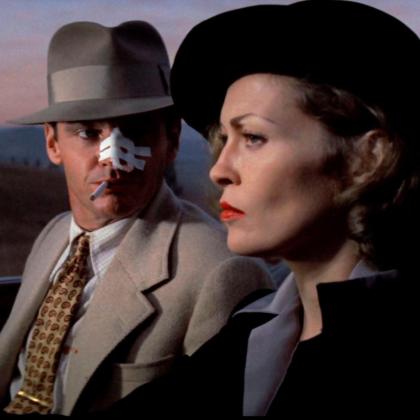
Stumbling through the dark backstory of “how LA has sweet sprinkled lawns to soothe the dread of consuming infernos”, Jack Nicholson’s Jake Gittes is “a very smart and charming wisecracker”, but “he’s going to be made a fool of”, with horrendous consequences. There’s a metaphor in there somewhere. There’s also another surfacing of the titular “flicker of light”, as Gittes notices the sun flashing off the spectacles in the koi pond.
On the casting of Faye Dunaway, meanwhile, Thomson points to the apposite humour in “the idea of Bonnie Parker getting to be as haughty as Lady Bracknell and then as sexy as… fill in the blank.” I did wonder, though, if Thomson was playing coy when he mentioned that, in favour of Roman Polanski’s selection as director, was the fact that he was “a guy who could do sex and horror”. Indeed, just ask Samantha Gailey.
Every now and again, some literal-minded ingénue picks up a copy of the Biographical Dictionary and, misled by the title’s seeming suggestion of dry fact, finds themselves shocked - shocked! - to discover critical perspectives therein. Thomson has always been highly opinionated and idiosyncratic. He can be dogmatic. Where others might offer an opinion, Thomson often delivers bald statements. His idiomatic, borderline surreal prose sometimes threatens to confound his readers. He pushes the envelope on what we may be happy to go along with: “Goodfellas exists in an emotional exhilaration where all the terrible energy comes from a lifetime of going to the movies.” Does it?
You don’t necessarily need to agree with Thomson’s views to enjoy reading his thoughts, though. And his way with words always serves the purpose of making a wider point. He can be a contrarian, even a curmudgeon. He can be doctrinaire, even exasperating. Yet his pugnaciousness is always entertaining. He’s like that friend who rocks up at your house on a weeknight toting several bottles of wine, over-stays his welcome, launches a number of vicious polemics at your most cherished artists, kicks your dog, vomits in the kitchen sink and then, as you finally usher him out the door, you can't help asking: “Same time next week?”
Another negative aspect of cinema, particularly modern movies, is its seemingly irreversible decline into infantilism: the erosion of boundaries between films for children and what should be adults; all those franchises and the Marvel “universe”, etc. One of the ironies of the “Movie Brats” era was that, perhaps unsurprisingly, the more thoughtful filmmakers lost the commercial battle with their less cultured colleagues. Bob Rafelson’s films, such as Five Easy Pieces, were “indelible character studies of American failure”. But Spielberg and Lucas - working to the formula that says “a + b x c = Wow!” - birthed the “blockbuster” and inaugurated the sharp decline of “the theory of lonely art, indifferent to rewards".
Thomson doesn’t mince words; he doesn’t even slice them. Spielberg “may be the most decisive figure in the history of film”, Thomson reckons, “a guy who came upon an art experimenting with difficulty or doubt, talked it in off the edge, and advised those un-American urges to shut down.” This strain of “dullness” and “lack of personality” deepened with George Lucas (never mind that he had once been a protégé of Coppola), whose “comic book space adventure” Star Wars "could be the best film ever made if you were going to stick at being eleven.” The trouble is, a lot of people do.
On the other hand, Thomson is far from thrilled by the 2022 Sight and Sound poll having elevated Chantal Ackerman’s Jeanne Dielman, 23 Quai de Commerce, 1080 Bruxelles (snappy title) to the Number 1 slot. It’s a film in which “narrative does not seem to obtain”, and Thomson reports how many people he knows who have found the film only because of the puzzling poll result, “were beyond dismay” when they watched it. I’ll admit that I was one of them.
Ultimately, Thomson doesn’t despair. He even lists some recent(ish) films that give him solid hope for the future of “mainstream cinema”, among them The Lives of Others, Moonlight, The Piano Teacher, Ida, and The Zone of Interest. But these are art, he says, and “the movies once were more and less than that. They were a hope for the great mass of us”.
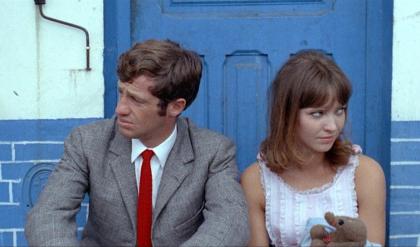
Perhaps his most downbeat moment comes, ironically, when discussing one of his favourite films, Pierrot le Fou: “The white spaciness of it all flows like blood. Still, the answer is nailed on the church door: The movies were just a flash in the pan. Fool’s gold.”
Well, aren’t we all still happy fools for the lure of cinema, entranced by that flicker of light on the big screen? Donald Trump, easily the most egregious of the grotesques elected to run America - what Thomas Pynchon called “the succession of the criminally insane who have enjoyed power since 1945” - may immolate humanity at any moment. Europe is on fire. AI threatens to either turn us into paperclips, or merely blow a financial bubble so big that when it bursts the economic crash will make 2008 look like good times, and we’ll find ourselves extras in a real-life version of The Road. So who can blame the great mass of us for clinging to fantasy?
David Thomson may find his love for film fading, but as Jeanne Moreau says in another Thomson favourite, Jules et Jim, one is “never completely in love for more than a moment”. Let’s enjoy that moment while it lasts.