In what ways was the Northern Renaissance distinct from the Italian one? When we look at a painting by Holbein we’re struck by the painting’s rich surface: we admire the finely delineated weave of a Turkish rug, the individual hairs of fur lining a heavy coat, the intricate calligraphy of musical notation in an open hymn book. Since all is sumptuous surface and detail, our eyes feast upon the mass, weight and texture of objects firmly rooting us to the material world.
This isn’t to say that Italian Renaissance artists such as Leonardo, or Giovanni Bellini, aren’t enamoured by the finely wrought textures of the visible world. They are. But whereas our attention might be drawn to the way these artists are preoccupied by a subtle play of light, the expressive modelling of figures in light and shade, and in the delicate rendering of atmospheric effects, there is something so solidly physical and present in the work of the German artist that makes him an exemplar of Northern Renaissance art.
The Reformation produced a demand for images that glorified the secular
We think, too, of Holbein’s older German contemporary Albrecht Dürer, although both artists, in fact, learned a great deal from Italian art. Dürer twice visited Venice where Bellini was the presiding master, and his encounter with the aged artist drew his praise. “Though very old he is still the best in painting here," observed the ambitious young artist when he first visited the city from Nuremburg in the mid 1490s.
But one should make note of the far stronger Gothic influences informing the art north of the Alps. With an emphasis on linearity and a taste for filigree detailing, painting and printmaking of the Northern Renaissance carved out a distinct signature style, and this exhibition does a terrific job in drawing us into its world.
It’s a world in which portraits and mythological scenes have largely usurped religious ones, or else made religion appear a little more earthbound. In Germany it saw the arrival of the printing press 20 years before Dürer’s birth in 1471, enabling the artist to disseminate his engravings and intricate woodcuts and so spread his fame throughout Europe. And it’s a world in which the Reformation, in a decisive move away from idolatry, produced a demand for images that glorified the secular.
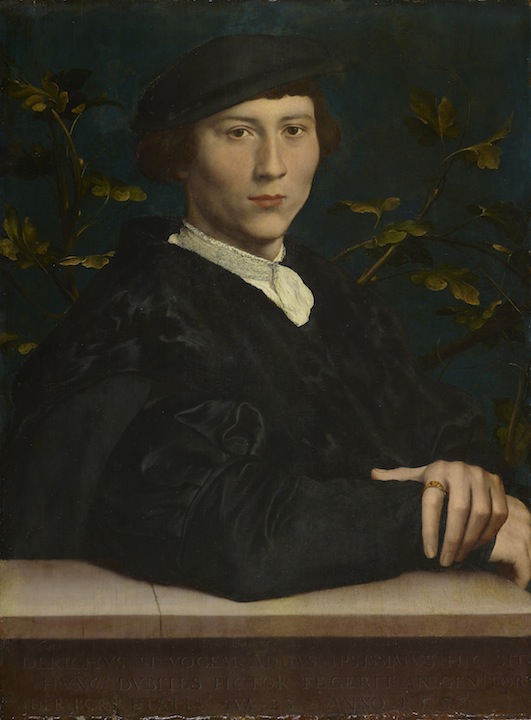 Framing the exhibition are its two foremast German practitioners. From the Bavarian town of Augsburg, Hans Holbein the Younger became the King’s Painter in England in 1536, before which he’d made his reputation during long stints in both London and Basel. In 1527, eight years before Henry VIII ordered his execution for denying the supremacy of the crown, Holbein had painted his patron Thomas More, the social philosopher, humanist and Lord Chancellor to the King. Although we do not see this great portrait in this exhibition, which hangs in the Frick Collection, the Royal Collection does own a fine and detailed cartoon of the painting, which we see here. With his gaze a little softer and less focused, and his face a little rounder, the drawing presents him as less the politician, more the visionary (image above right: Holbein, Derich Born, 1534).
A similar physical transformation is enacted with the portrait of Sir Henry Guildford. Holbein’s drawing, which we see alongside the painting, finds Sir Henry somewhat fuller-faced, while the finished portrait sees the nose and face lengthened, giving the courtier a sterner aspect. But one of the most arresting portraits in the exhibition is Holbein’s painting of Derich Born, a young Hanseatic merchant, whom Holbein painted in 1533. The inscription on the stone ledge on which the young man leans his arm aptly reads: “You would be in doubt whether the painter or his father made him.”
 We are spoilt for the number of prints by Dürer, including his famous woodcut of a rhinoceros (1515), a creature that he’d never seen in real life and here portrayed as if armour-plated and clad in chainmail. Then there is the daintily elegant study of a greyhound, drawn in about 1500, which was the same year Dürer painted his best-known self-portrait, the one in which he gazes out at us like Christ. Meanwhile, one of his most stunning engravings is St Jerome in his Study, 1524, impressive not only as a study in perspective, but for its softly variegated tones.
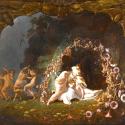
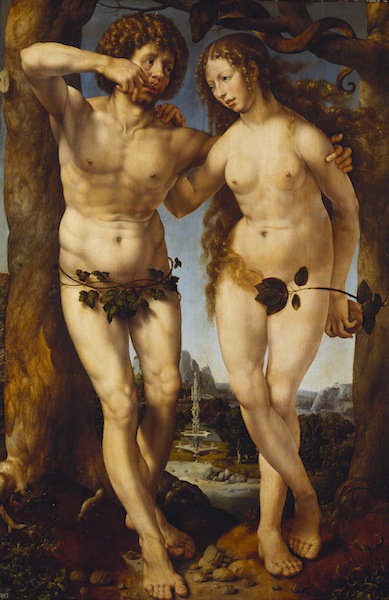
From here we encounter Lucas Cranach the Elder’s The Judgement of Paris, 1530-35, and from the Netherlands Jan Gossaert’s embracing Adam and Eve, c1520 (image left), and Hans Memling’s beguilingly sombre Portrait of a Young Man, c1475-80. And then, wonderfully, Pieter Bruegel The Elder’s Massacre of the Innocents, 1565-67 (main image), a wintry, panoramic scene that ostensibly depicts the slaying of the young under the orders of King Herod. However, as we see in the nearby infra-red image, the slaughtered infants were painted over by a later artist with details such as bundles, food and animals. If you look hard, you can just about catch shadowy glimpses beneath the over-painted surface.
This is an exhibition that ranges across Germany, the Netherlands, France and the Holy Roman Empire. The unsettling sight of a ghost of a Bruegal infant notwithstanding, it is full of senusal delights.
- The Northern Renaissance: Dürer to Holbein until 14 April 2013