
Cesena, Anne Teresa De Keersmaeker’s Rosas, Sadler’s Wells | reviews, news & interviews
Cesena, Anne Teresa De Keersmaeker’s Rosas, Sadler’s Wells
Cesena, Anne Teresa De Keersmaeker’s Rosas, Sadler’s Wells
An unmissable world of mystery and ritual from the great choreographer
Friday, 09 November 2012
All photos Anne van Aarschot
Well, if De Keersmaeker made us work hard for our enlightenment earlier in the week, we more than get our reward with her triumphant, astonishing Cesena in the second part of her double-programme designed for the Avignon Festival.
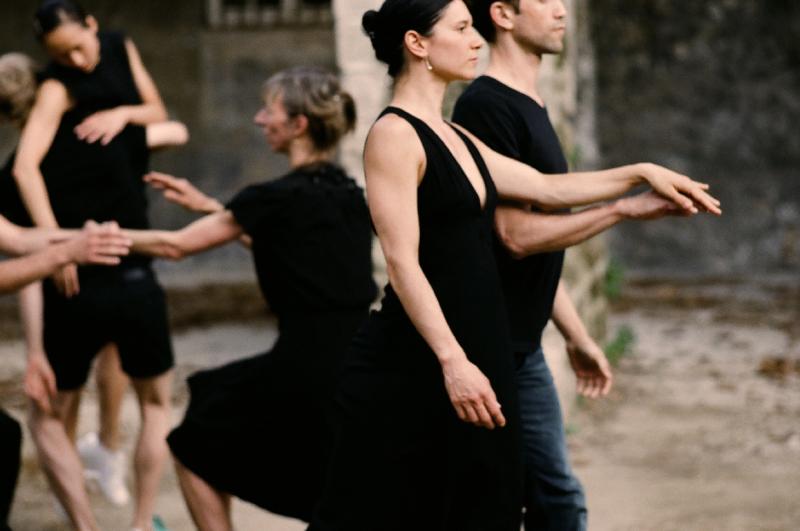
Both pieces are built around the form of 14th-century polyphony sung in the south, known today as the ars subtilior, the subtle art. While in En Atendant De Keersmaeker focused on the structure of the music, in Cesena she, together with Björn Schmelzer, founder of graindelavoix, a collective for musicians with an interest in physical theatre, concentrates on its dramatic and emotional effect, creating for us a world of ritual and mystery. The melding of her dancers and his singers is complete – it takes a real effort of will to distinguish one from the other, and one soon realizes there is no point: the 19-strong cast are not singers, not dancers, but performers, unified and impelled by movement and music as one.
We start almost literally in the dark (at Avignon, performed on the city walls, the piece began before dawn). As En Atendant ended with a naked man circling the stage, so Cesena begins with another, bending and shouting into the dark – the dark is the time for nakedness, for baring the selves that in the day we keep covered, whether with clothes or with rationalization. He is soon replaced by the entire cast pacing outwards to us, back to the dark, into the light, back to the dark, over and over, all to the rhythmic beat of what sounds like a chisel on flint.
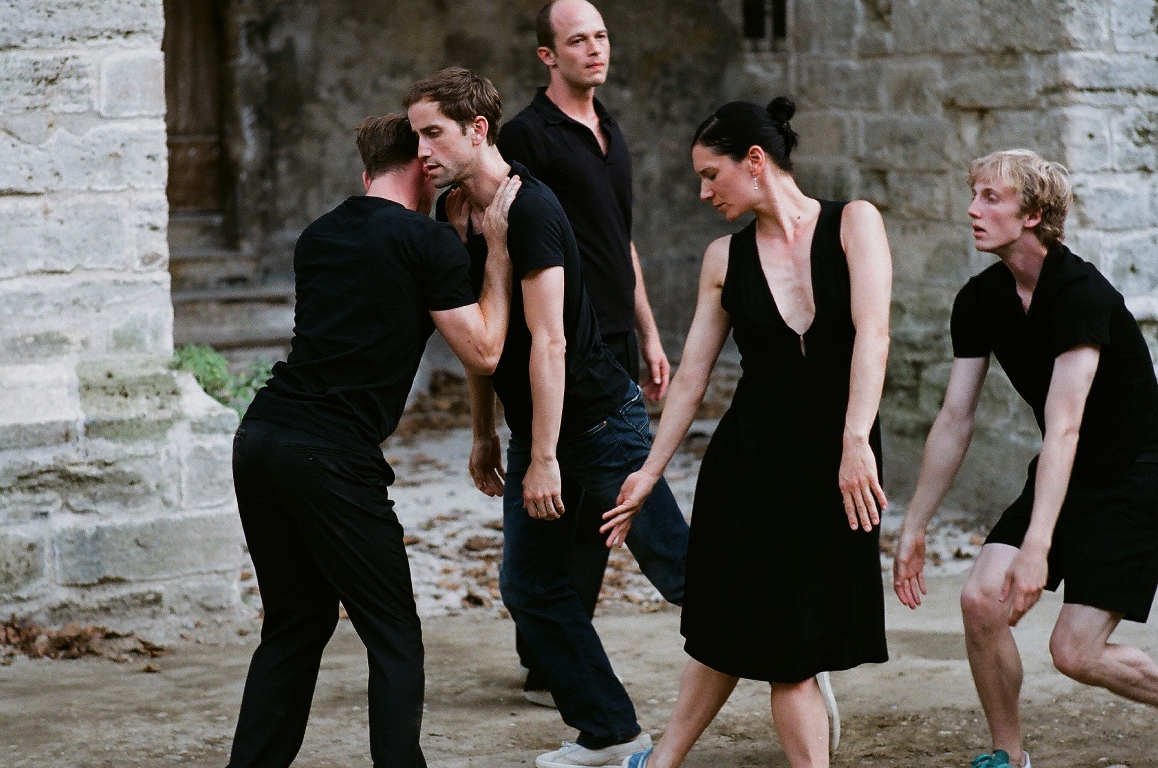 The archaic image conjured by the sound is not an accident. It is hard to say quite how De Keersmaeker achieves her sense of the archaic, for there are no theatrical gestures, no mime for “old”. The set, too, is merely the Sadler’s Well’s stage stripped right back to its bare walls, with no wings and no flats, just the nuanced and delicate lighting (courtesy, I assume, of the scenographer, Ann Veronica Janssens), which superficially entirely derives from three fluorescent strips that hang overhead, but magically does so much more.
On the floor is a white circle which, it becomes clear as the performers begin to move, brushing and smearing it, is made out of white sand. As they move across it, they leave behind in physical form the shape of their passing, building pictures of a world at once impenetrable to the modern mind, and yet cohesive, if not quite coherent. There is no sense, despite the work's title (Cesena, in today’s Emilia-Romagna, was the site a massacre in 1377, overseen by the man who later became the Avignon antipope Clement VII), that any story is being told, but the emotional resonances, outlined in the music, and in the movement, are never in doubt.
The greatness of De Keersmaeker’s art reveals itself in the simplicity with which she gains her profoundest effects. The company sing a Kyrie, standing on a diagonal across the stage, before moving forward, loomingly, to stare out at us from the front of the stage. Or two women circle the white sand, gently brushing their toes across the surface, turning inwards, half drifting, as though impelled by a sudden thought, rather than De Keersmaeker’s formidable geometrical brain. These are simple things to describe, but they carry incalculable power.
And all the time the music of the ars subtilior winds around our minds, our hearts, to leave an indelible idea of a world that has gone, a sense of intangibility that De Keersmaeker has, none the less, made tangible. By the end we are not so much watching a performance as taking part in a communal event. Unmissable.
- Cesena at Sadler's Wells, tomorrow, 9 November
And the music winds around our minds, our hearts, to leave an indelible idea of a world that has gone, a sense of intangibility that De Keersmaeker has made tangible
Buy
Explore topics
Share this article
Add comment
Subscribe to theartsdesk.com
Thank you for continuing to read our work on theartsdesk.com. For unlimited access to every article in its entirety, including our archive of more than 15,000 pieces, we're asking for £5 per month or £40 per year. We feel it's a very good deal, and hope you do too.
To take a subscription now simply click here.
And if you're looking for that extra gift for a friend or family member, why not treat them to a theartsdesk.com gift subscription?
more Dance
 The Winter's Tale, Royal Ballet review - what a story, and what a way to tell it!
A compelling case for ROH's ballet-friendly rebrand
The Winter's Tale, Royal Ballet review - what a story, and what a way to tell it!
A compelling case for ROH's ballet-friendly rebrand
 All You Need Is Death review - a future folk horror classic
Irish folkies seek a cursed ancient song in Paul Duane's impressive fiction debut
All You Need Is Death review - a future folk horror classic
Irish folkies seek a cursed ancient song in Paul Duane's impressive fiction debut
 MacMillan Celebrated, Royal Ballet review - out of mothballs, three vintage works to marvel at
Less-known pieces spanning the career of a great choreographer underline his greatness
MacMillan Celebrated, Royal Ballet review - out of mothballs, three vintage works to marvel at
Less-known pieces spanning the career of a great choreographer underline his greatness
 Carmen, English National Ballet review - lots of energy, even violence, but nothing new to say
Johan Inger's take on Carmen tries but fails to make a point about male violence
Carmen, English National Ballet review - lots of energy, even violence, but nothing new to say
Johan Inger's take on Carmen tries but fails to make a point about male violence
 WAKE, National Stadium, Dublin review - a rainbow river of dance, song, and so much else
THISISPOPBABY serves up a joyous tapestry of Ireland contemporary and traditional
WAKE, National Stadium, Dublin review - a rainbow river of dance, song, and so much else
THISISPOPBABY serves up a joyous tapestry of Ireland contemporary and traditional
 Swan Lake, Royal Ballet review - grand, eloquent, superb
Liam Scarlett's fine refashioning returns for a third season, and looks better than ever
Swan Lake, Royal Ballet review - grand, eloquent, superb
Liam Scarlett's fine refashioning returns for a third season, and looks better than ever
 First Person: Ten Years On - Flamenco guitarist Paco Peña pays tribute to his friend, the late, great Paco de Lucía
On the 10th anniversary of his death, memories of the prodigious musician who broadened the reach of flamenco into jazz and beyond
First Person: Ten Years On - Flamenco guitarist Paco Peña pays tribute to his friend, the late, great Paco de Lucía
On the 10th anniversary of his death, memories of the prodigious musician who broadened the reach of flamenco into jazz and beyond
 Dance for Ukraine Gala, London Palladium review - a second rich helping of international dancers
Ivan Putrov's latest gala was a satisfying mix of stars and young hopefuls
Dance for Ukraine Gala, London Palladium review - a second rich helping of international dancers
Ivan Putrov's latest gala was a satisfying mix of stars and young hopefuls
 Nelken: A Piece by Pina Bausch, Sadler's Wells review - welcome return for an indelible classic
A new generation of gifted performers for us to get to know
Nelken: A Piece by Pina Bausch, Sadler's Wells review - welcome return for an indelible classic
A new generation of gifted performers for us to get to know
 Dark With Excessive Bright, Royal Ballet review - a close encounter with dancers stripped bare
The Royal's Festival of New Choreography launches with an unforgettable walk in the dark
Dark With Excessive Bright, Royal Ballet review - a close encounter with dancers stripped bare
The Royal's Festival of New Choreography launches with an unforgettable walk in the dark
 La Strada, Sadler's Wells review - a long and bumpy road
Even the exceptional talents of Alina Cojocaru can't save dance adaptation of Fellini film
La Strada, Sadler's Wells review - a long and bumpy road
Even the exceptional talents of Alina Cojocaru can't save dance adaptation of Fellini film
 First Person: pioneering juggler Sean Gandini reflects on how the spirit of Pina Bausch has infiltrated his work
As Tanztheater Wuppertal Pina Bausch's 'Nelken' comes to Sadler’s Wells, a tribute from across the art forms
First Person: pioneering juggler Sean Gandini reflects on how the spirit of Pina Bausch has infiltrated his work
As Tanztheater Wuppertal Pina Bausch's 'Nelken' comes to Sadler’s Wells, a tribute from across the art forms
Comments
This was as subtle and